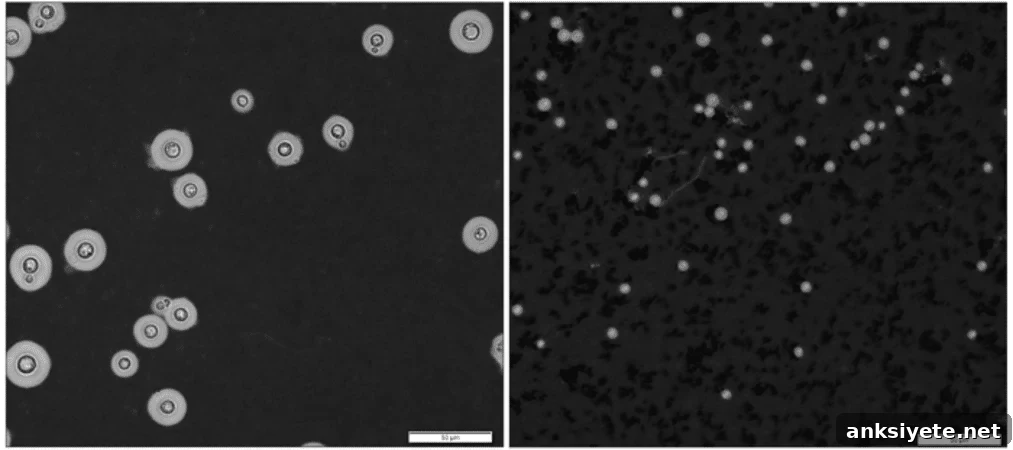
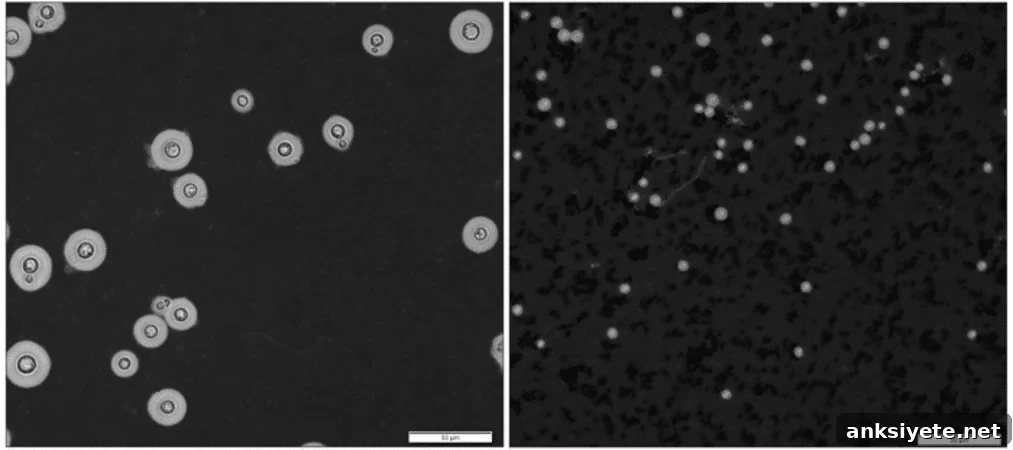
Summary: Cryptococcus neoformans, a fungus that causes fungal meningitis, rapidly changes size and surface features as it moves through the body, adopting a specialized form that promotes spread to the brain.
Source: University of Utah
A common cause of fungal meningitis, the fungus Cryptococcus neoformans, undergoes a striking transformation after entering the body that enables it to invade the brain, according to new research from University of Utah Health.
Mouse studies show that as the fungus moves from the lungs into the bloodstream and toward other organs, individual cells shrink and adopt distinct surface features and gene activity that make them more capable of spreading within the host. These changes occur over just a few days and appear central to the pathogen’s ability to cause deadly brain infection in people with weakened immune systems.
“Cryptococcus cells in the lungs are highly variable in size and appearance. When my student showed me images of the uniform population found in the brain, I was surprised,” says Jessica Brown, Ph.D., associate professor of pathology at University of Utah Health and senior author of the study. That uniformity suggested a strong selection for a particular cell type that manages to reach and colonize the brain. Steven Denham, Ph.D., a former graduate student in Brown’s lab, is the study’s lead author.
Their findings were published in the peer-reviewed journal Cell Host & Microbe.
The fungus adapts rapidly to tolerate different microenvironments in the body
Cryptococcus neoformans is an environmental organism that lives in places such as rotting wood and bird droppings. When spores are inhaled into the lungs, the fungus can survive and—especially in people with compromised immune systems—disseminate through the bloodstream to organs including the brain. Each tissue presents a distinct microenvironment, and the fungus must remodel itself to survive and spread.
Previous work showed that in the lungs some C. neoformans cells enlarge dramatically, likely to evade immune destruction. Brown’s team questioned whether the much smaller cells observed in other tissues provide a different advantage, particularly for entry into the brain.
To test this, the researchers infected mice with fungal populations sorted by cell size. They discovered that the smallest cells preferentially reached the brain compared with medium and large cells. These tiny cells were not simple miniatures of the larger forms: they had distinct surface components, different gene expression profiles, and an enhanced capacity for uptake by host phagocytes. Based on their colonizing behavior, the investigators named these cells “seed” cells.
After searching for environmental triggers, Brown’s group identified phosphate as a potent inducer of the seed cell state. Phosphate is released during tissue damage and can accumulate in infected lungs; when present, it stimulates C. neoformans to switch into the dissemination-prone seed morphotype. Seed cells show increased expression of genes for phosphate acquisition, and strains unable to import phosphate fail to form seed cells, linking phosphate sensing to the morphological shift.
From bird guano to the brain
Interestingly, the environmental niche that favors seed cell formation may help explain how this pathogen evolved its ability to infect mammals. Pigeon droppings—one common reservoir for C. neoformans—are rich in phosphate, and the team found that material from bird guano strongly promotes the seed cell transition. Brown suggests that selective pressures in environmental reservoirs like pigeon guano could have shaped traits that later enabled the fungus to colonize mammalian tissues.
Whether or not this is the original driver of pathogenicity, the discovery points to possible therapeutic strategies. Brown’s lab is testing FDA-approved drugs to see if any existing compounds can block the seed cell transition. An approved drug that prevents seed cell formation could offer a fast path to reduce fungal dissemination and the risk of meningitis in vulnerable patients.
In addition to Jessica Brown and Steven T. Denham, co-authors include Brianna Brammer, Krystal Y. Chung, Morgan A. Wambaugh, Joseph M. Bednarek, Li Guo, and Christian T. Moreau from University of Utah Health.
Funding: This research, titled “A dissemination-prone morphotype enhances extrapulmonary organ entry by the fungus Cryptococcus neoformans,” was supported by the National Institutes of Health.
About this meningitis research news
Author: Julie Kiefer
Source: University of Utah
Contact: Julie Kiefer – University of Utah
Image: The image is credited to Steven Denham
Original Research: Open access. “A dissemination-prone morphotype enhances extrapulmonary organ entry by the fungus Cryptococcus neoformans” by Jessica Brown et al., published in Cell Host & Microbe.
Abstract
A dissemination-prone morphotype enhances extrapulmonary organ entry by the fungus Cryptococcus neoformans
Environmental pathogens must adapt when moving from ecological niches into mammalian hosts, confronting dramatically different conditions in each tissue. Cryptococcus neoformans, the fungal meningitis pathogen, requires additional adaptation to disseminate beyond the lungs. This study shows that formation of a small C. neoformans morphotype—termed “seed” cells because of their colonizing ability—is critical for entry into extrapulmonary organs.
Seed cells display reduced cell size, altered surface composition, and gene expression changes that promote phagocyte uptake and dissemination. Environmental triggers—including components of C. neoformans’ ecological niche—induce seed cell formation; phosphate, abundant in pigeon guano and released by tissue damage, plays a central role. Mutants unable to acquire phosphate do not form seed cells, linking phosphate sensing and transport to the dissemination-prone morphotype. A feed-forward loop in which tissue damage releases phosphate, promoting more seed cell formation and spread, could amplify infection. These results identify inducible morphological states in C. neoformans that reshape host interactions and facilitate microbial dissemination to the brain and other organs.