
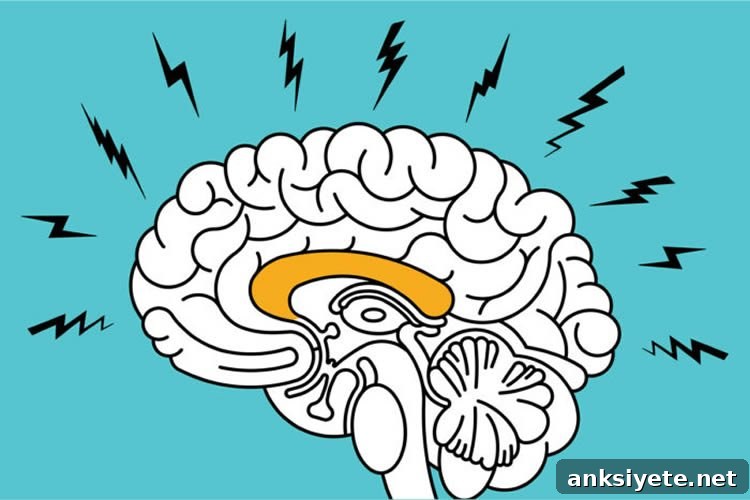
Summary: Researchers report identifying a set of neurons in the anterior cingulate cortex that become active when an animal faces the possibility — but not the certainty — of an unpleasant event.
Source: WUSTL.
Specific neurons activate when there’s a chance of a negative experience
Worry about a possible future setback — from exam anxiety to job uncertainty — is a nearly universal human experience. When anticipatory worry grows excessive and begins to interfere with everyday functioning, it can develop into an anxiety disorder. Anxiety disorders are among the most common mental health conditions, affecting a large portion of adults at some point in their lives.
New research from Washington University School of Medicine in St. Louis reveals neural activity that may help explain how the brain registers the possibility of negative events. The study, published July 26 in Nature Communications, identifies a population of neurons in the anterior cingulate cortex (ACC) that respond specifically when an animal perceives a risk of an unpleasant outcome, but not when the unpleasant outcome is certain to occur.
“We discovered a group of neurons that become active specifically when monkeys believed something bad or annoying — such as a brief air puff to the face — might happen, but not when the same aversive event was guaranteed,” said Ilya Monosov, PhD, assistant professor of neuroscience and biomedical engineering and the study’s lead author. “These cells did not activate for the possible receipt of a reward, such as a small sip of sweet juice. Their response was selective for the uncertainty of a negative event.”
The findings help pinpoint cellular mechanisms that could underlie anxiety and related disorders, and they suggest new directions for research into treatments that target uncertainty-related brain signals.
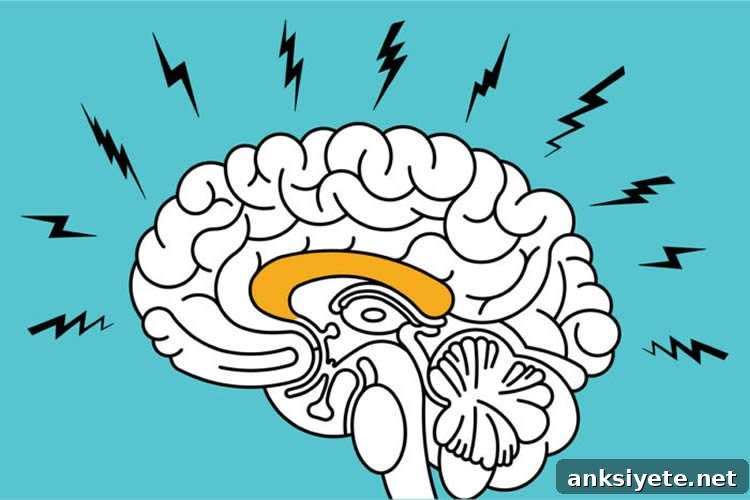
Monosov focused on the anterior cingulate cortex, a region of the brain located on the medial surface of the frontal lobes where the hemispheres fold inward. Variations in ACC structure and function have been associated with a range of psychiatric conditions — including anxiety, obsessive-compulsive disorder, attention disorders, and depression — implicating this region in mood and behavior regulation. Until now, however, the specific cell populations and their roles in processing uncertainty were not well characterized.
To explore how neurons in the ACC respond to uncertainty, Monosov used rhesus macaque monkeys, whose ACC anatomy closely resembles that of humans. He trained two monkeys to recognize three geometric symbols: one that signaled an imminent, guaranteed air puff to the face (an aversive stimulus), one that indicated a 50/50 chance of receiving an air puff, and one that signaled no air puff would occur.
While the animals viewed these cues, Monosov recorded the activity of individual ACC neurons. A distinct group of cells began firing rapidly when the monkeys faced the 50/50 cue — when a puff of air might arrive. Those same cells remained largely silent when the air puff was certain to occur or certain not to occur. In other words, these neurons encoded the uncertainty of a potential aversive event rather than the unpleasant sensory experience itself.
Monosov also trained the same monkeys to associate other geometric symbols with a small reward — a sip of juice — presented with either certainty or chance. Distinct ACC neurons signaled reward-related predictions: one set changed activity when a reward was guaranteed and another set when a reward was only possible. As with the aversive cues, cells that responded to the possibility of reward were different from those that responded when reward delivery was certain.
These results demonstrate that the ACC contains diverse, valence-specific neural signals that separately encode value and uncertainty for rewards and punishments. The selective activation for uncertainty about negative outcomes suggests a cellular basis for behaviors driven by anxious anticipation.
“By identifying which ACC cells respond to the uncertainty of an adverse event, we can now test whether disrupting that activity alters anxious behaviors,” Monosov said. “This opens promising avenues for future work that could lead to treatments for anxiety and mood disorders where uncertainty plays a central role.”
Source: Tamara Bhandari – WUSTL
Image credit: Sara Moser.
Original research: “Anterior cingulate is a source of valence-specific information about value and uncertainty” by Ilya E. Monosov, published in Nature Communications on July 26, 2017. DOI: 10.1038/s41467-017-00072-y.
Monosov, I. E. (2017). Cellular roots of anxiety identified. Washington University School of Medicine press summary, based on research published in Nature Communications (July 26, 2017).
Abstract
Anterior cingulate is a source of valence-specific information about value and uncertainty
The anterior cingulate cortex (ACC) has been implicated in behaviors related to reward, punishment, and uncertainty, but the cellular basis for these roles was unclear. Using a Pavlovian task in monkeys that elicited a range of reward-, punishment-, and uncertainty-related behaviors, this study shows that many ACC neurons represent expected value and uncertainty in a valence-specific manner. Some neurons signaled value or uncertainty predictions specifically about rewards or about punishments. Other neurons signaled prediction information for both rewards and punishments by showing excitation to both types of outcomes. This diversity of valence representations may support the ACC’s involvement in behavioral states that are influenced by both rewards and punishments (for example, vigilance) or states specific to reward or punishment (for example, approach versus avoidance). The discovery of ACC signals specifically related to punishment uncertainty suggests the region could be a target for treating mood disorders tied to uncertainty.