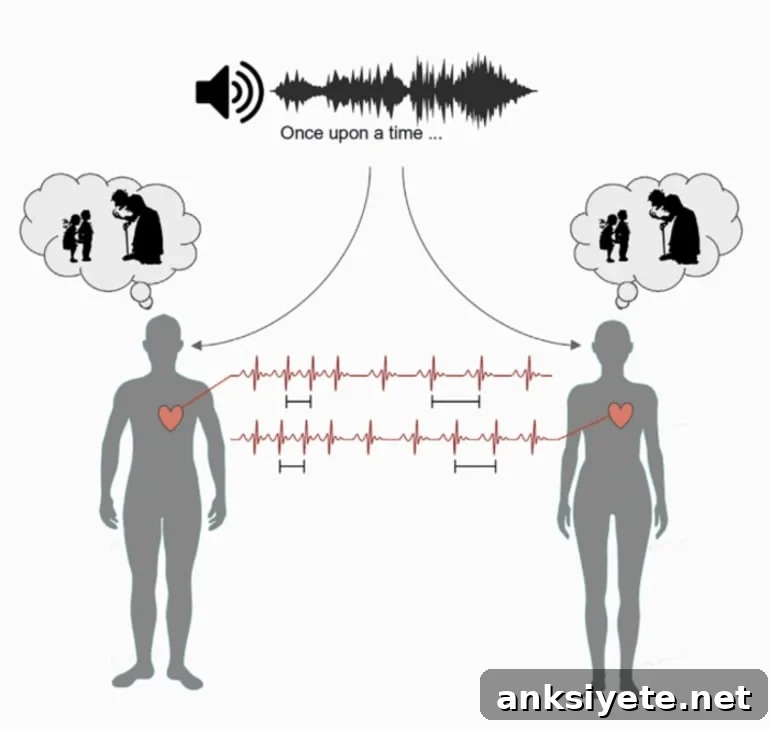
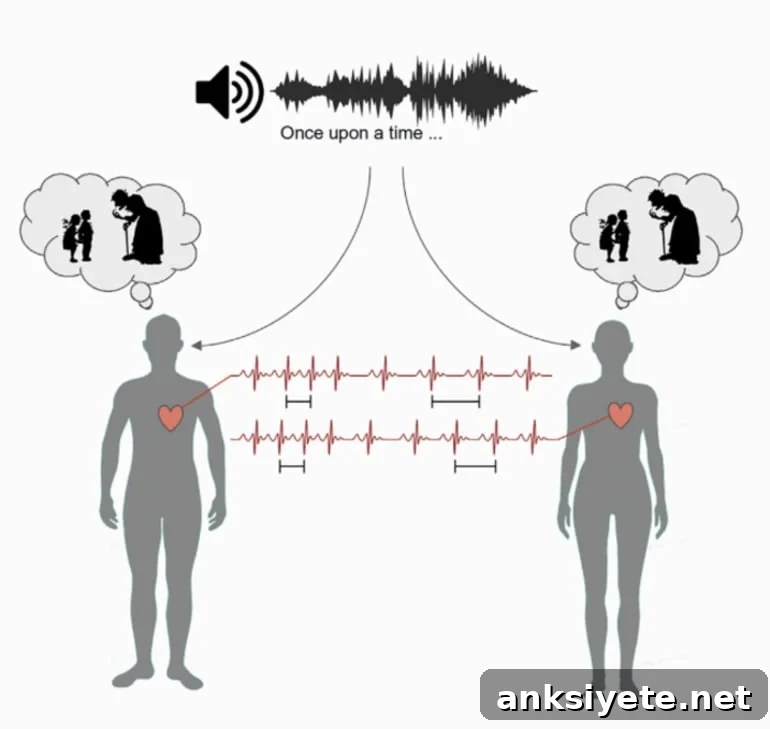
Summary: Listening attentively to the same narrative causes people’s heart rates to fluctuate in sync, even when they are alone; this alignment depends on attention to the story.
Source: Cell Press
New research shows that heart rate synchronization can occur across individuals who are not physically together, simply by processing the same story. The effect appears only when listeners focus on the narrative, suggesting that cognitive engagement, not just social presence or shared emotion, drives coordinated changes in heartbeat timing.
The study’s results were published September 14 in the journal Cell Reports.
Co-senior author Lucas Parra, a professor at City College of New York, explains that while past work has documented physiological synchrony during shared experiences, those studies usually involved people interacting or being in the same physical space. This new work expands that view: when different people follow the same narrative, their heart rates show parallel rises and falls tied to story events. In other words, “the cognitive processing of a narrative can drive heart rate fluctuations,” Parra notes.
Co-senior author Jacobo Sitt, a researcher at the Paris Brain Institute and Inserm, emphasizes that attention determines the effect. He points out that the phenomenon reflects engagement with the story and anticipation of what will happen next rather than merely emotional responses: the brain’s processing sends signals that modulate the heart.
The team ran four experiments to test how consciousness and attention influence heart-rate synchronization. In the first experiment, healthy volunteers listened to an audiobook version of Jules Verne’s 20,000 Leagues Under the Sea while researchers recorded their electrocardiograms (EKGs). Analysis showed that most listeners experienced heart rate increases and decreases at the same narrative moments, indicating synchronized fluctuations linked to the story’s content.
A second experiment used short instructional videos that lacked strong emotional variation to isolate attention from emotional engagement. During the first viewing, participants’ heart rates showed similar patterns across individuals. When the same viewers watched the videos again but performed a mental distraction task—counting backward in their heads—the alignment of heart rate fluctuations dropped markedly, demonstrating that sustained attention is necessary for synchronization.
In the third experiment, participants listened to brief children’s stories under two conditions: attentive listening and distracted listening. Afterward they answered questions about the narratives. The researchers found that stronger synchronization of heart rate across listeners predicted better memory performance on those tests, supporting the idea that synchronized heart dynamics reflect conscious processing of the narrative.
The research team also measured breathing and found that respiratory patterns did not show the same level of synchronization. That result was unexpected because breathing can influence heart rate, but it suggests that the observed heart rate alignment cannot be fully explained by synchronized respiration.
The fourth experiment included healthy volunteers and patients with disorders of consciousness, such as those in comas or persistent vegetative states. All subjects heard an audiobook of a children’s story. As anticipated, patients showed lower heart-rate synchrony than healthy participants. Importantly, among patients who were re-evaluated six months later, those who initially exhibited higher synchronization were more likely to have regained some level of consciousness.
Sitt suggests that, although preliminary, the findings point to a potentially simple, low-cost test of brain function that could be used in clinical settings. Because heart-rate recordings require relatively little equipment, such measures might even be collected during patient transport. He cautions that larger studies and direct comparisons with established methods like EEG and fMRI are still needed, and his group continues to pursue that validation.
Parra adds that the results contribute to a broader view of the brain-body connection and the physiology of attention and mindfulness. The findings support the idea that cognitive states influence bodily rhythms, and they open new avenues for studying how neural processing and peripheral physiology interact.
Funding: The research received support from the Paris Brain Institute (France) and the program “Investissements d’avenir,” along with a Sorbonne PhD grant, a CARNOT maturation grant, a Sorbonne Universités EMERGENCE grant, an EU-PerMed grant, a French embassy UK – Seeding Grant 2018, a Medical Research Council New Investigator Research Grant (UK), and the National Science Foundation.
Parra and Sitt acknowledge that trainees carried out much of the experimental work. The paper’s co-first authors are Jens Madsen, a postdoctoral fellow in the Parra lab, and Pauline Pérez, a PhD student in the Sitt lab.
About this neuroscience research news
Author: Carly Britton
Source: Cell Press
Contact: Carly Britton – Cell Press
Image: Image credited to Perez and Madsen et al./Cell Reports
Original Research: Open access. “Conscious processing of narrative stimuli synchronizes heart rate between individuals” by Jacobo Sitt et al., Cell Reports.
Abstract
Conscious processing of narrative stimuli synchronizes heart rate between individuals
Highlights
- Narrative stimuli can synchronize fluctuations of heart rate between individuals
- This interpersonal synchronization is modulated by attention and predicts memory
- These effects on heart rate cannot be explained by modulation of respiratory patterns
- Synchrony is lower in patients with disorders of consciousness
Summary
Heart rate naturally fluctuates due to autonomic processes, but growing evidence indicates that conscious processing also shapes the timing of heartbeats. The researchers hypothesized that attentive processing of the same narrative stimulus would produce aligned heart-rate patterns across individuals.
To test this, they presented the same auditory or audiovisual narratives to different subjects and measured inter-subject correlation of heart rate (ISC-HR). They found significant ISC-HR when participants listened to or watched the narratives. Distraction reduced ISC-HR, and higher ISC-HR predicted better recall of story details. Patients with disorders of consciousness showed lower ISC-HR than healthy individuals. The authors conclude that heart rate fluctuations are partly driven by conscious processing, depend on attentional state, and may offer a straightforward physiological marker to assess consciousness in unresponsive patients.