
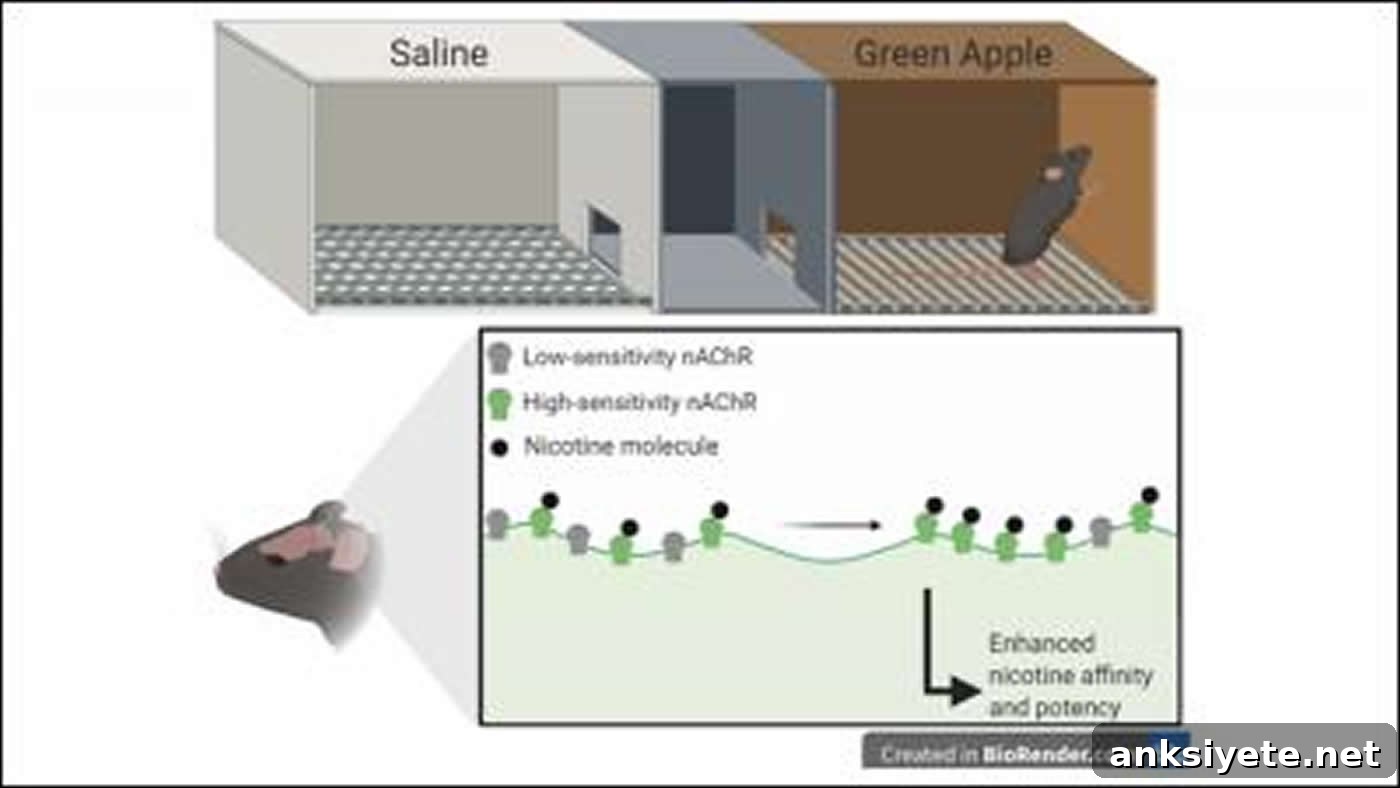
Summary: The green apple flavorant farnesene, commonly used in e-cigarette liquids, increases nicotine reward in mouse models and produces reward-related behavior on its own. Researchers warn that flavored vapes — even those without nicotine — may pose neurological risks, including increased addiction potential.
Source: SfN
A common green apple e-cigarette flavorant, farnesene, enhances nicotine reward and is intrinsically rewarding in mice, new research published in eNeuro finds.
Flavored vaping products — from green apple to cotton candy — have been a major factor in driving e-cigarette use among adolescents and young adults. Although many users vape nicotine-free flavored e-liquids, the chemical flavorants themselves have received little study; among the thousands of flavor chemicals on the market, only a few have been tested for effects on the brain. This study examines how one popular flavorant, farnesene, influences reward-related behavior and nicotine receptor function in the brain.
In behavioral experiments, researchers exposed mice to three treatment conditions: nicotine alone, the green apple flavorant farnesene alone, or a combination of nicotine and farnesene in one chamber of a conditioned place preference assay, with saline in the opposite chamber. Mice showed a clear preference for the chamber associated with farnesene alone, demonstrating that farnesene produces reward-related behavior without nicotine. When farnesene was paired with nicotine, the combination produced an even stronger preference, indicating that the flavorant can enhance nicotine’s rewarding effects.
To explore underlying mechanisms, the team measured how farnesene affects nicotinic acetylcholine receptors (nAChRs) and activity in the ventral tegmental area (VTA), a brain region central to reward processing and addiction. Using mice engineered to express fluorescently labeled nAChRs and electrophysiological recordings from putative VTA dopamine neurons, the researchers observed that farnesene by itself partially activates nAChRs and produces inward currents. These currents were sensitive to the nAChR antagonist DhβE, confirming that farnesene acts, at least in part, through nicotinic receptors.
Although farnesene-induced currents were smaller than those produced by nicotine — roughly 30% of nicotine’s efficacy — the flavorant nevertheless altered receptor function and composition. The data indicate a shift in nAChR stoichiometry toward a higher proportion of high-sensitivity α4β2 receptors in the VTA. Because high-sensitivity nAChRs respond more strongly to typical nicotine doses, an increased ratio of these receptors would amplify nicotine’s effects, potentially enhancing reward and driving drug-seeking behavior. In short, farnesene both produces reward on its own and makes brain circuits more responsive to nicotine.
These findings have important implications for public health and regulatory policy. Marketing that promotes flavored e-liquids as harmless — especially products labeled as nicotine-free — overlooks the potential of flavor chemicals to modify brain receptor function and behavior. The study highlights how specific flavorants like farnesene can increase the abuse potential of e-cigarettes and suggests a need for further investigation into the neurological impacts of the many flavor chemicals used in vaping products.
About this neuroscience research article
Source: SfN
Media Contacts:
Calli McMurray – SfN
Image Source:
The image is credited to Cooper et al., eNeuro 2020.
Original Research: Open access
“Green Apple E-Cigarette Flavorant Farnesene Triggers Reward-Related Behavior by Promoting High-Sensitivity nAChRs in the Ventral Tegmental Area” by Skylar Y. Cooper, Austin T. Akers and Brandon J. Henderson. eNeuro.
Abstract
Green Apple E-Cigarette Flavorant Farnesene Triggers Reward-Related Behavior by Promoting High-Sensitivity nAChRs in the Ventral Tegmental Area
While combustible cigarette smoking has declined, the use of electronic nicotine delivery systems (ENDS) has risen, particularly among adolescents. Chemical flavorants are of growing concern as zero-nicotine flavored e-liquids become more popular. Yet the effects of many ENDS flavorants on vaping-related behavior and brain function remain poorly understood. Building on prior work showing that the green apple flavorant farnesol enhances nicotine reward and is rewarding without nicotine, this study evaluates the effects of the related flavorant farnesene.
Using adult C57BL/6J mice engineered to express fluorescent nicotinic acetylcholine receptors and administering farnesene at doses of 0.1, 1.0, and 10 mg/kg, the investigators found that farnesene alone elicits reward-related behavior in both male and female mice. Whole-cell patch-clamp recordings from ventral tegmental area dopamine neurons revealed farnesene-induced inward currents that were blocked by the nAChR antagonist DhβE, indicating nAChR involvement. Although farnesene’s currents reached about 30% of nicotine’s efficacy, farnesene also increased nicotine’s potency at activating nAChRs on VTA dopamine neurons. The data suggest a change in nAChR stoichiometry, shifting toward high-sensitivity α4β2 receptors, which would amplify the effects of standard nicotine doses. Overall, the findings demonstrate that farnesene causes reward-related behavior without nicotine and enhances nicotine’s effects on VTA dopamine neurons through modifications in nAChR composition. These results underscore the need for continued research into how ENDS flavorants affect vaping-related behaviors and addiction risk.
SIGNIFICANCE STATEMENT
While combustible cigarette use has declined over recent decades, ENDS use has increased dramatically among youth. Most ENDS users consume flavored products, and the rising popularity of nicotine-free flavored e-liquids raises critical questions about whether flavorants themselves contribute to addiction. This study shows that the green apple flavorant farnesene causes reward-related behavior on its own and alters nicotinic receptor function in brain reward circuits, advancing our understanding of how flavorants may promote neurological changes and influence nicotine addiction.