
Summary: New research finds that people often treat internally generated, “filled-in” visual percepts as more reliable than comparable external images.
Source: eLife
People rely more on inferred visual objects produced by the brain than on equivalent external images, new research shows.
Researchers at the University of Osnabrück, Germany, report that when observers are presented with two identical visual stimuli—one that is partially “filled in” by the brain at the physiological blind spot and one that is fully visible—they frequently prefer the internally generated percept. The study, published in eLife, reveals a surprising bias toward inferred visual information during perceptual decision-making.
To navigate the world, humans integrate information from multiple sensory sources and ordinarily weight those sources by their estimated reliability. For instance, vision typically dominates hearing when determining whether it is safe to cross a street, although this weighting can change in low-visibility conditions such as fog. The blind spot presents a unique case: no photoreceptor input reaches the brain from this small retinal region, yet we rarely notice a gap because the visual system “fills in” surrounding details to create a seamless percept.
“When information falls in the blind spot, the brain fills in the missing region from surrounding context so that nothing seems missing,” says Professor Peter König of the Institute of Cognitive Science at the University of Osnabrück. “Although this filling-in usually produces a convincing percept, it is fundamentally different from direct sensory input because the brain never receives veridical information from that part of the visual scene. We wanted to know whether people treat filled-in percepts differently from true sensory input when making perceptual judgments.”
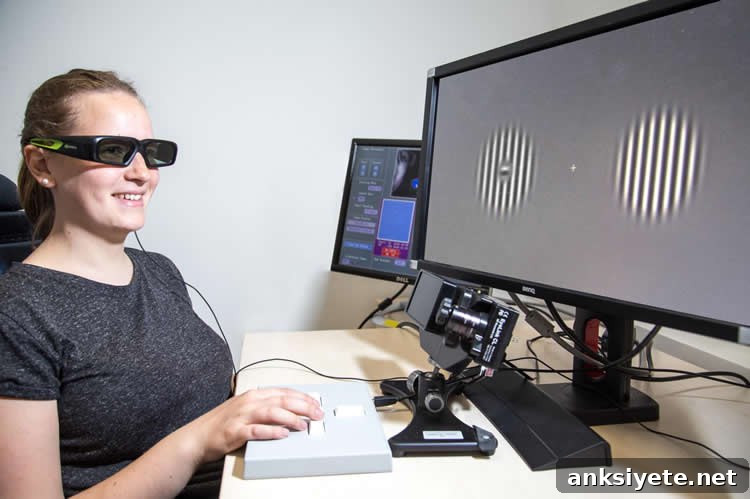
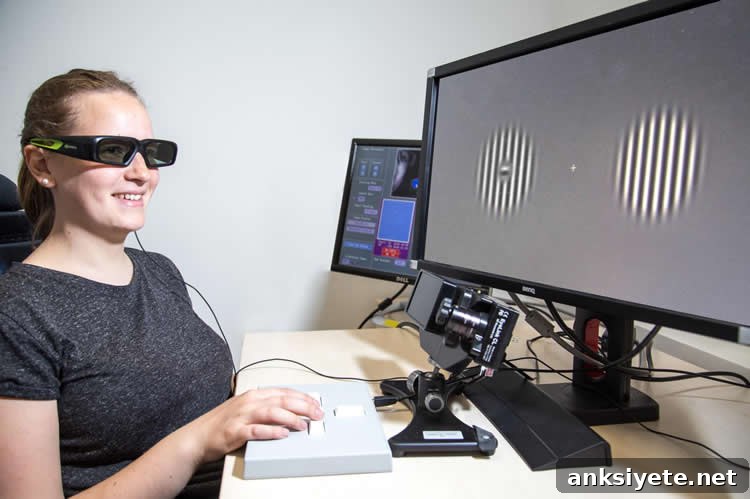
In the experiments, participants viewed pairs of striped Gabor-like images through shutter glasses. One image was displayed partly within the anatomical blind spot to induce filling-in, while the other was presented entirely outside the blind spot. Each trial asked observers to indicate which stimulus they believed represented a continuous, uninterrupted pattern—that is, which appeared to be the real, continuous stimulus without a small orthogonal inset. When both images were physically identical and contained no inset, observers showed a clear and consistent preference for the stimulus presented inside the blind spot.
Benedikt Ehinger, the study’s first author, explains, “We expected that observers might either have no strong preference or that they would favor the veridical stimulus outside the blind spot. Instead, participants were more likely to choose the filled-in stimulus as the better example of a continuous pattern. In exploratory analyses we also found a slight tendency for quicker decisions when participants selected the blind-spot stimulus.”
Why would observers prefer a percept that is, in principle, less reliable because it is inferred rather than directly sensed? The authors propose an account based on predictive and error-based processing: the brain maintains an internal template or prediction of how a continuous stimulus should appear and compares incoming sensory signals to that template. When true sensory input is present, any mismatch between prediction and input produces an error signal. In the blind spot, however, no bottom-up input arrives to generate such an error; the filled-in percept matches the internal template more closely and therefore produces a smaller or absent error signal. At the point of making a perceptual decision, the reduced error signal renders the inferred percept relatively more credible, despite its objective unreliability.
“In short, the implicit awareness that a filled-in region lacks real input does not seem to factor into the decision process,” Ehinger notes. The result indicates that perceptual decision-making can favor inferred information when the brain’s internal model produces a close match, even when observers have implicit knowledge that that information originates from an absence of direct sensation.
The authors emphasize that understanding how the brain weights inferred versus sensory information has implications for models of perceptual decision-making and sensory integration. If internal predictions or templates can reduce perceived error and thereby increase the apparent reliability of inferred percepts, this could influence how we think about visual illusions, afterimages, change blindness, and other phenomena where internal representations play a major role.
Professor König adds, “By comparing implied, filled-in stimuli to veridical ones, we can refine models of how the brain combines internal and external signals. A key open question is whether the enhanced credibility of inferred percepts reported here is unique to blind-spot filling-in or whether similar effects occur for other internally generated visual content.”
Funding: Horizon 2020 and Deutsche Forschungsgemeinschaft supported this work.
Primary source: eLife. Original research: “Humans treat unreliable filled-in percepts as more real than veridical ones,” by Benedikt V. Ehinger, Katja Häusser, José P. Ossandón, and Peter König. Published online May 16, 2017. DOI: 10.7554/eLife.21761.
Abstract
Humans treat unreliable filled-in percepts as more real than veridical ones
Humans typically weigh sensory signals by their reliability to make optimal decisions. This study uses the physiological blind spot—a region without direct retinal input where the visual system fills in missing information—to compare partially inferred percepts with veridical percepts. In a task that required choosing the continuous Gabor stimulus without a small orthogonal inset, observers paradoxically preferred the stimulus that was partially inferred inside the blind spot when both stimuli were physically identical. The findings show that a percept generated in the absence of direct input can be judged more reliable than an externally supported percept, revealing that perceptual decision-making can favor inferred content under certain conditions.