
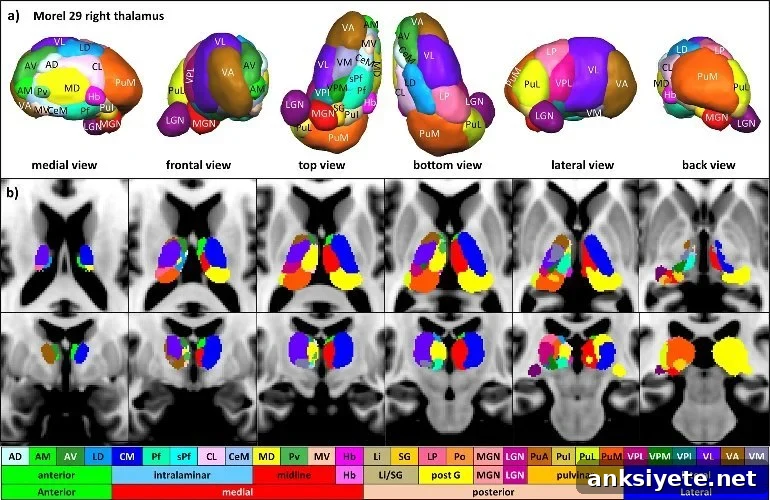
Summary: A new brain map reveals how the thalamus connects with other regions of the brain.
Source: Max Planck Institute
The thalamus functions as a central communication hub in the brain, routing signals from the senses and coordinating activity across brain regions. Despite its central role, its detailed functions have remained incompletely understood.
Researchers at the Max Planck Institute for Biological Cybernetics in Tübingen analyzed how different parts of the thalamus correlate with the rest of the brain. Using extensive statistical methods, they inferred which mental processes are associated with individual thalamic subregions.
Their results, published in the journal Communications Biology, could guide more precise clinical interventions for conditions such as Parkinson’s disease and epilepsy by improving our understanding of thalamic function.
Deep inside the brain sits the thalamus, a hub that receives and redistributes information from the senses and diverse brain areas. Visual and auditory signals, for example, arrive at thalamic nuclei before being routed to cortical regions that process them—akin to passengers making connections through a major airport.
Until now, however, it has been difficult to pinpoint which thalamic subregions support which cognitive and sensory functions.
The thalamus: versatile and multifunctional
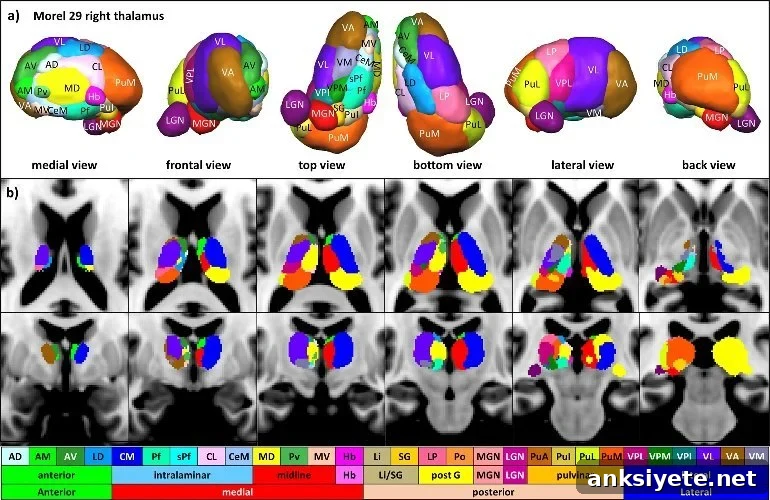
The Max Planck team produced a detailed functional map of the thalamus, showing how its nuclei relate to different brain networks and tasks. Surprisingly, many thalamic subunits are involved in multiple functions rather than serving a single, dedicated role.
“We call this functional multiplicity,” explains Vinod Kumar, lead author of the study. “It is similar to how a CPU handles diverse programs: the processor doesn’t care whether it is running a game or a productivity app—it allocates computation to whatever task needs resources at the moment.”
Beyond sensory relay, the thalamus also contributes to higher cognitive processes. Its involvement spans working memory, decision-making, impulse control and other functions typically attributed to the cerebral cortex, the brain’s outer layer of neural tissue that expanded during mammalian evolution.
“Our observations regarding relay nuclei of the visual thalamus are consistent with animal studies, but seeing this evidence in humans was notable,” Kumar adds.
Statistical mapping based on millions of scans
To achieve these insights, the researchers analyzed roughly 3.5 million functional MRI data points from 730 subjects drawn from the Human Connectome Project database. Functional MRI (fMRI) measures changes in oxygenated and deoxygenated blood to highlight regions of neural activity. Even during rest, fMRI reveals patterns of connectivity that indicate which brain areas work together.
The team complemented these resting-state data with results from 14,371 task-based fMRI studies in which participants performed specific tasks while being scanned. Because the cortex’s task associations are already well documented, the researchers used observed thalamus–cortex connections to infer the likely functions of individual thalamic nuclei. For example, a thalamic region that consistently co-activates with cortical pain networks is likely to participate in pain processing.
Clinical relevance and potential applications
A clearer picture of thalamic function has many potential clinical implications. Damage or dysfunction of the thalamus can cause sensory loss, memory problems, tremor, and contribute to neurological conditions including Parkinson’s disease and epilepsy.
Neurosurgeons already target thalamic regions with deep brain stimulation (DBS) to alleviate symptoms in Parkinson’s disease and drug-resistant epilepsy. Noninvasive techniques such as transcranial direct-current stimulation (tDCS) and transcranial magnetic stimulation (TMS) are also used in the treatment of various neurological and psychiatric conditions. Understanding which thalamic nuclei support specific functions may explain why stimulation of one site can produce both intended benefits and unintended side effects.
“Recognizing functional multiplicity in thalamic nuclei helps interpret clinical outcomes,” says Kumar. “This knowledge could guide more targeted stimulation strategies to improve effectiveness and reduce side effects for patients receiving neuromodulation therapies.”
About this brain mapping research news
Author: Sophia Jahns
Source: Max Planck Institute
Contact: Sophia Jahns – Max Planck Institute
Image: The image is credited to the research
Original Research: Open access. “Relay and higher-order thalamic nuclei show an intertwined functional association with cortical-networks” by Vinod Jangir Kumar et al., Communications Biology
Abstract
Relay and higher-order thalamic nuclei show an intertwined functional association with cortical networks
Cortical processing strongly depends on interactions with the thalamus, yet the functional relationships between human thalamic nuclei and cortical networks remain incompletely mapped. This study examines network-specific connectivity and task-related mapping between cortical areas and the thalamus to clarify those relationships.
The findings show that relay and higher-order thalamic nuclei have intertwined associations with different cortical networks. Relay-specific thalamic nuclei are involved not only in traditional relay functions but also in higher-order behaviors. This expanded view of thalamic–cortical interactions deepens our understanding of brain network organization and offers insights relevant to both neuroscience research and clinical practice.