
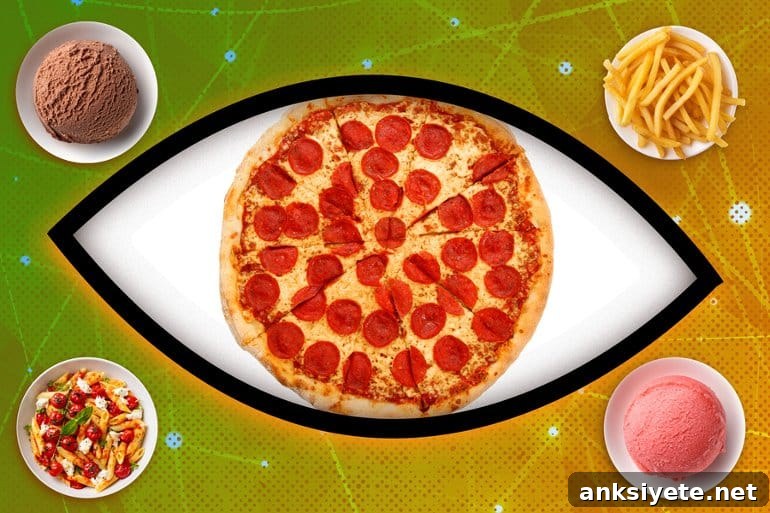
Summary: Images of food reliably activate a newly identified population of food-responsive neurons in the ventral visual stream. Researchers suggest this neural tuning could reflect the cultural and behavioral importance of food for humans.
Source: MIT
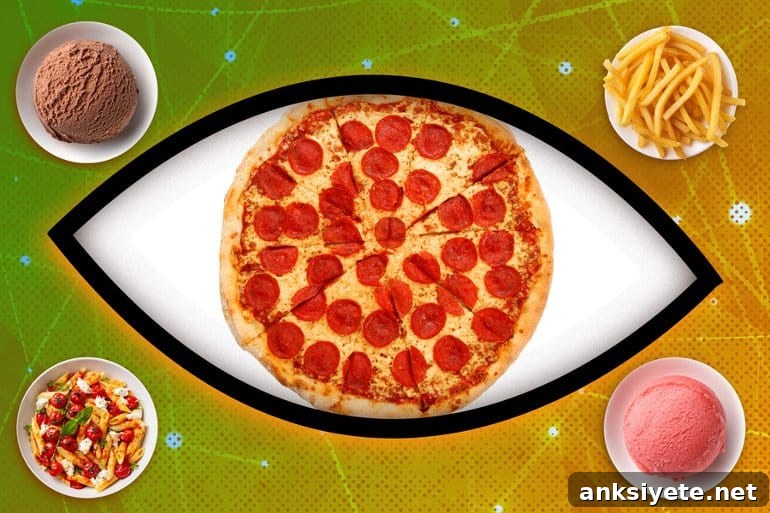
A gooey slice of pizza. A pile of crispy French fries. Ice cream melting down a cone on a hot day. When people view images of these and other foods, a specialized region of the visual cortex becomes active, according to new research from MIT neuroscientists.
The study identifies a distinct population of food-responsive neurons embedded within the ventral visual stream — the brain pathway responsible for recognizing objects. These neurons sit alongside well-known populations that respond selectively to faces, bodies, places, and written words. The presence of a food-specific response raises intriguing questions about why the brain allocates dedicated resources to food perception and what that reveals about human behavior and culture.
“Food plays a central role in human social life and cultural practice. It’s not just nourishment,” says Nancy Kanwisher, the Walter A. Rosenblith Professor of Cognitive Neuroscience and a member of MIT’s McGovern Institute for Brain Research and Center for Brains, Minds, and Machines. “Food touches so many aspects of identity, ritual, and social interaction that it makes sense to explore whether the brain represents it in a specialized way.”
The results come from a data-driven analysis of a large, public dataset of full-brain functional magnetic resonance imaging (fMRI) responses collected while subjects viewed thousands of images. The work not only confirms previously known category-selective regions but also reveals this previously undetected food-responsive component. The lead author is MIT postdoc Meenakshi Khosla, with coauthor MIT research scientist N. Apurva Ratan Murty. The paper appears in the journal Current Biology.
Visual categories
Over two decades ago, Kanwisher and colleagues identified cortical regions that respond selectively to faces. Later studies found distinct clusters for places, bodies, and words. Those discoveries often relied on hypothesis-driven experiments that specifically searched for particular categories. To avoid such biases and probe the underlying organization of the ventral visual stream, the MIT team applied an unbiased, data-driven method to a dataset of fMRI responses from eight participants viewing roughly 10,000 images.
Conventional fMRI measures brain activity in voxels — three-dimensional units that each contain hundreds of thousands of neurons. If small, functionally distinct neuronal populations are mixed within a voxel, their signals can be blurred together and become difficult to detect. The researchers used a mathematical technique previously applied to auditory cortex data that separates the responses of intermingled neural populations within each voxel, improving sensitivity to fine-grained selectivity.
Applying this method recovered the major, well-established category-selective populations for faces, places, bodies, and words, validating the approach. Unexpectedly, a fifth component also emerged that exhibited a strong, consistent response to images of food.
“Food is visually diverse — apples, corn, pasta and other items look very different — so it was surprising to find a single population that responds consistently across such a wide range of foods,” Khosla explains. The team named this food-selective response the ventral food component (VFC). It appears as two clusters of neurons located on either side of the fusiform face area (FFA). The intermingling of food-selective neurons with nearby category-selective populations likely contributed to their being overlooked in earlier fMRI studies that lack the spatial resolution this analysis provides.
Paul Rozin, a psychology professor at the University of Pennsylvania not involved in the study, commented that the analytical approach is impressive for recovering known category systems and that the discovery of a food category response is especially striking. He notes the challenge of explaining how the brain could reliably identify such visually diverse objects as food items based on visual features alone, making this finding particularly intriguing.
Food vs non-food
To probe the VFC in more depth, the team trained a computational model of the VFC using approaches previously developed for face and place systems. The model predicted VFC responses to new images and enabled experiments without collecting additional fMRI data. In one test, the researchers fed the model matched image pairs that shared visual properties but differed in edibility — for example, a banana versus a yellow crescent moon. The model still responded more strongly to the edible item, suggesting that the VFC discriminates food beyond simple low-level visual features.
The model also analyzed millions of images to confirm the VFC’s selectivity for food. From the human fMRI data, the researchers observed modest differences across individuals: in some participants, the VFC responded slightly more to processed foods like pizza than to unprocessed foods like apples. Future work aims to examine how familiarity, preference, cultural background, and developmental experience shape responses in this region.
Open questions remain about when the VFC becomes specialized during childhood, which other brain regions it interacts with, and whether similar food-selective populations exist in nonhuman primates that do not share human cultural relationships with food.
Funding: The research was supported by the National Institutes of Health, the National Eye Institute, and the National Science Foundation through the MIT Center for Brains, Minds, and Machines.
About this neuroscience research news
Author: Anne Trafton
Source: MIT
Contact: Anne Trafton – MIT
Image: The image is credited to Jose-Luis Olivares, MIT
Original Research: The findings will appear in Current Biology