
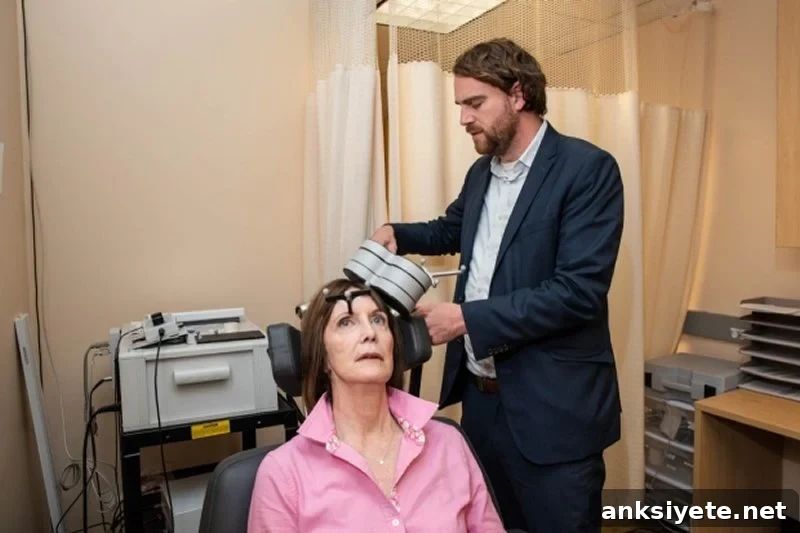
Summary: Researchers at Stanford modified transcranial magnetic stimulation to make it faster, stronger and more precisely targeted. Their protocol, called Stanford Accelerated Intelligent Neuromodulation Therapy (SAINT), focuses stimulation on a subregion of the dorsolateral prefrontal cortex that is connected to the overactive subgenual cingulate in depression. In an open-label study, 90% of participants experienced rapid relief of depressive symptoms and 60% remained in remission one month after treatment.
Source: Stanford
Stanford’s SAINT: Rapid Relief for Treatment-Resistant Depression
Researchers at the Stanford University School of Medicine report that a revised form of transcranial magnetic stimulation (TMS) produced very high remission rates in a small, open-label study of people with treatment-resistant depression. The protocol, named Stanford Accelerated Intelligent Neuromodulation Therapy (SAINT), combines a higher pulse dose, accelerated delivery, and individualized targeting based on each patient’s brain connectivity.
The initial study involved 22 participants; 21 completed the protocol. All participants had previously failed to respond to antidepressant medications, conventional FDA-approved TMS, or electroconvulsive therapy. After SAINT, 19 of the 21 completers scored in the nondepressed range on standard depression scales, and none of the participants reported suicidal thoughts that they had experienced before treatment.
The research team is now conducting a larger, double-blind, sham-controlled trial to confirm these findings. In that trial, half of the participants receive a placebo (sham) version of the treatment to rigorously test how much of the effect is due to the intervention itself.
How SAINT differs from standard TMS
SAINT builds on intermittent theta-burst stimulation (iTBS), an FDA-approved, noninvasive brain stimulation technique for depression. The investigators modified the conventional protocol in three important ways:
- Higher pulse dose: Each SAINT session delivers 1,800 pulses, compared with the 600 pulses used in common iTBS protocols.
- Accelerated schedule: Patients receive multiple short sessions per day — typically ten 10-minute sessions with 50-minute intervals — allowing the full course to be delivered in five consecutive days instead of six weeks.
- Individualized targeting: Resting-state functional MRI (fcMRI) identifies, for each patient, the specific subregion of the left dorsolateral prefrontal cortex (DLPFC) that is most anticorrelated with the subgenual anterior cingulate cortex (sgACC), a node often overactive in depression.
These changes aim to strengthen a weak functional connection between the DLPFC and the sgACC. Stimulating the DLPFC subregion that is most closely tied to the sgACC can reduce sgACC hyperactivity and thereby ease depressive symptoms.
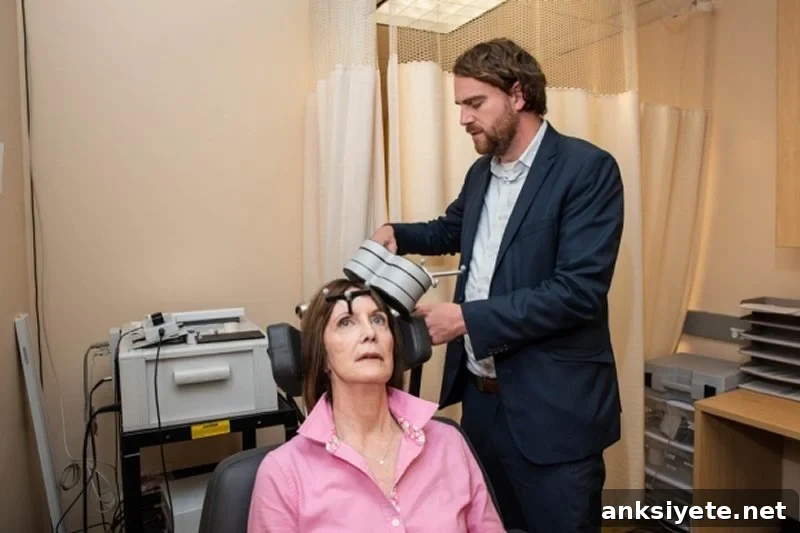
Rapid and durable improvements
In this trial participants typically experienced improvement very quickly. Many reported meaningful symptom relief within one to three days; some felt better after a single day of treatment. On average, three days of SAINT was enough for participants to register clinically significant improvement. One month after treatment, 60% of participants remained in remission. The authors note that follow-up studies are ongoing to determine how long the antidepressant effects last.
Researchers administered neuropsychological tests before and after treatment to check safety and cognitive effects. They found no cognitive decline; rather, participants showed improvement on tasks involving mental flexibility and problem solving—changes consistent with recovery from depression.
Patient experience
Patients reported only mild side effects, predominantly transient fatigue and some discomfort during stimulation sessions. A participant quoted in the study described the experience as dramatically calming “the constant chattering” of negative thoughts and regaining a sense of peace and stability that had been absent for years.
One patient, who had lived with bipolar disorder and severe depressive episodes, described regaining the energy to complete a college degree and a new capacity to enjoy daily life without being overwhelmed by negative mood.
Next steps and potential applications
The research team emphasizes that these promising results come from an open-label study and require confirmation in blinded, controlled trials. The ongoing randomized sham-controlled study will test whether the exceptionally high remission rates reported here hold up under rigorous conditions.
Investigators also plan to explore SAINT’s potential in other psychiatric and neurological conditions where targeted neuromodulation might help, including obsessive-compulsive disorder, addiction, and aspects of neurodevelopmental disorders such as autism spectrum conditions.
Study authors and funding
The study was led by Nolan R. Williams, M.D., with lead authors including Eleanor J. Cole, Ph.D., Katy H. Stimpson, B.S., and Brandon S. Bentzley, M.D., Ph.D. Many additional Stanford researchers and clinicians contributed to the trial and analysis. Funding came from a mix of private foundations, university awards, and grants, including support from the National Institutes of Health and several philanthropic funds dedicated to neuromodulation research.
About this neuroscience research article
Original Research: “Stanford Accelerated Intelligent Neuromodulation Therapy for Treatment-Resistant Depression.” American Journal of Psychiatry, DOI 10.1176/appi.ajp.2019.19070720.
Feel free to share this depression research news.