
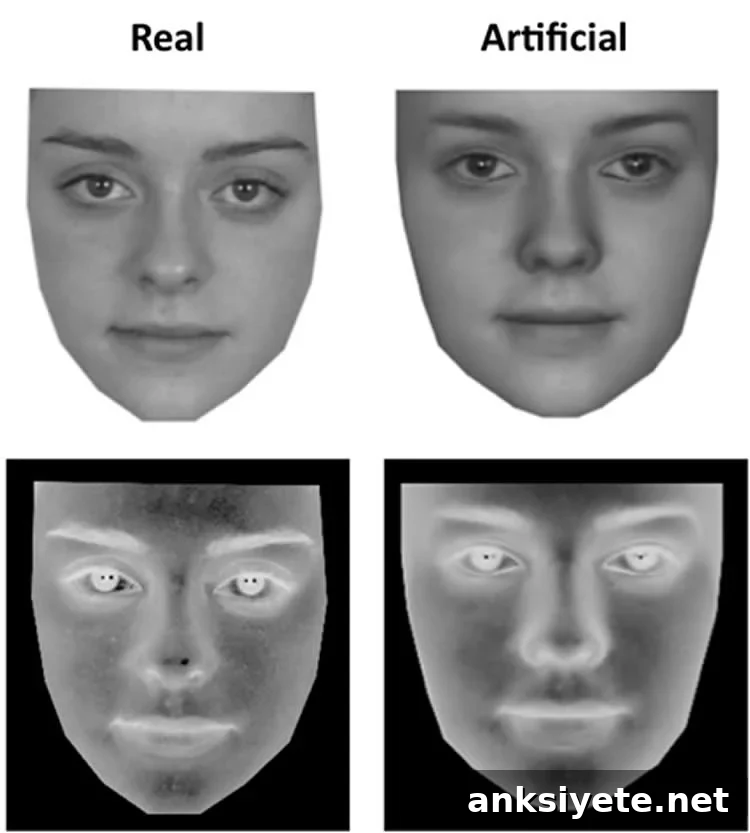
Faces fascinate us from infancy. We seek out familiar or friendly faces in a crowd, and creators in fields such as video games and film work to make faces appear convincingly human. Dr. Benjamin Balas of North Dakota State University (NDSU) and the Center for Visual and Cognitive Neuroscience studies how the brain decides whether a face looks real or artificial. New research by Balas and NDSU graduate Christopher Tonsager, published in the journal Perception, shows that more than the eyes are required for a face to appear human.
Human vision relies on highly specialized circuits that can, in a matter of seconds, evaluate whether a face is alive and believable. Balas and Tonsager note that people encounter artificial faces regularly—in video games, movies, and increasingly as social agents in technology. “Whether a face looks real influences many subsequent judgments,” said Balas, assistant professor of psychology. “Can it show emotion? Does it have intentions or thoughts? We wanted to learn which visual cues people use first to decide if a face is real or computer-generated, because that initial judgment guides many other inferences.”
The study’s results indicate that people integrate visual cues from multiple facial regions when judging how “alive” a face appears, and that the appearance of those regions interacts in complex ways. While prior work emphasized the central role of the eyes in face perception, the NDSU experiments reveal that both the eyes and skin-related cues contribute roughly equally to judgments of animacy.
Balas and Tonsager recruited 45 participants to view systematically altered facial images. To create the stimuli, Tonsager first cropped photographs so only the face and neck were visible, removing hair and other external cues. Using FaceGen Modeller, the photographs were converted into three-dimensional, computer-generated face models. The team then applied contrast negation—creating photographic negatives—to some images to alter the appearance of skin tone and shading. Across two experiments, the researchers tested whether contrast negation affected observers’ ability to distinguish real from artificial faces and whether the eyes alone carried a disproportionate share of the information needed to detect animacy.
“We initially assumed the eyes would be the dominant cue for distinguishing real from computer-generated faces,” said Tonsager. “The data did not support a strong, exclusive role for the eyes. Instead, we discovered that negating skin tone and other surface cues made it significantly harder for participants to judge animacy. This suggests the entire eye region and adjacent skin appearance together play a substantial role in that distinction.”
The experimental findings have practical implications. “Beyond increasing our understanding of how the brain distinguishes living faces from artificial ones, these results matter for anyone developing lifelike computer graphics,” Balas explained. “Creating artificial faces that look convincingly human is an expanding industry, and faces that are close but not quite right can produce an unpleasant or uncannily eerie reaction. Our work helps identify which visual cues designers should prioritize to improve realism in digital characters and social agents.”
Methodologically, the study highlights how altering contrast and surface properties—such as skin tone and local shading—disrupts the perceptual signals that contribute to animacy judgments. By isolating and manipulating the eye region and overall facial surface appearance, the research clarifies how multiple facial components combine to form impressions of life and authenticity.
Balas and Tonsager also presented their findings at the Vision Sciences Society 13th Annual Meeting, held May 16–21 in St. Petersburg, Florida.
The research was supported by the North Dakota Experimental Program to Stimulate Competitive Research (NSF award #EPS-0814442) and the Center of Biomedical Research Excellence (COBRE) Grant GM103505 from the National Institute of General Medical Sciences (NIGMS), part of the National Institutes of Health (NIH). The authors note that the study’s contents are their responsibility and do not necessarily reflect the official views of NIGMS or the NIH.
Contact: Carol Renner – North Dakota State University
Source: North Dakota State University press release
Image source: Image credited to NDSU/Dr. Benjamin Balas and Christopher Tonsager; adapted from the university press release.
Original research: Abstract for “Face animacy is not all in the eyes: Evidence from contrast chimeras” by Benjamin Balas and Christopher Tonsager in Perception. Published online June 2014, doi:10.1068/p7696.