
Summary: New research in fruit flies identifies a brain pathway that prevents daytime sleep, shedding light on how circadian signals sustain wakefulness.
Source: SfN.
Researchers have mapped a neural pathway in fruit flies that helps maintain wakefulness during daylight hours. Published in eNeuro, the study reveals how a light-responsive neuropeptide suppresses sleep-promoting neurons, a mechanism that may inform our understanding of sleep/wake regulation in mammals.
Background
Past work in sleep research has outlined circuits that trigger sleep at nightfall and suppress it before dawn, but the mechanisms that actively preserve wakefulness through daytime have been less clear. Maintaining daytime arousal is essential for survival and normal behavior, and it is regulated by an interaction between the circadian clock, environmental light, and specific neural signaling pathways. This study focuses on how those signals operate in Drosophila, a model organism widely used to study conserved principles of brain function.
Key findings
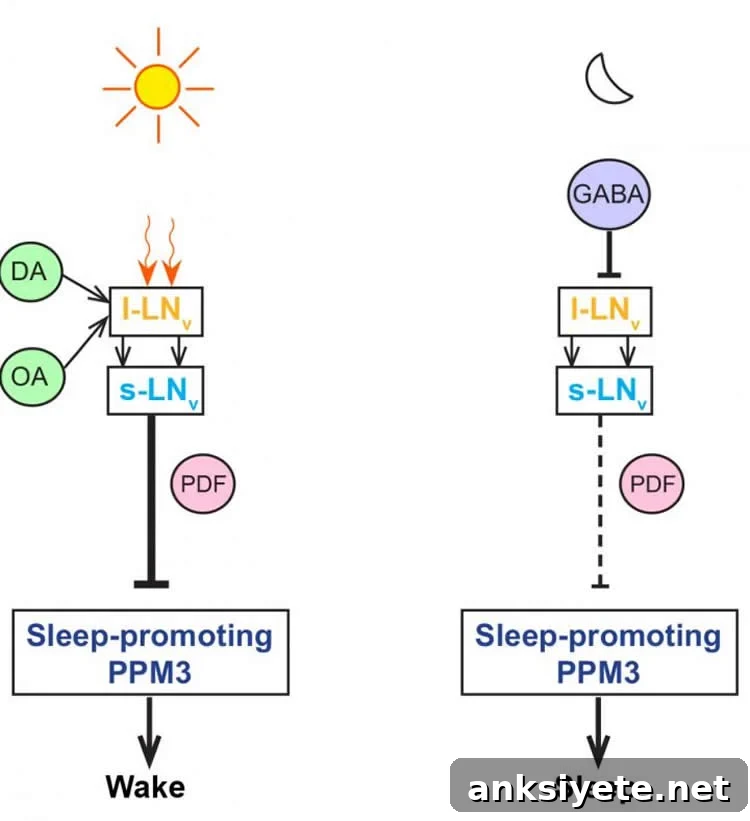
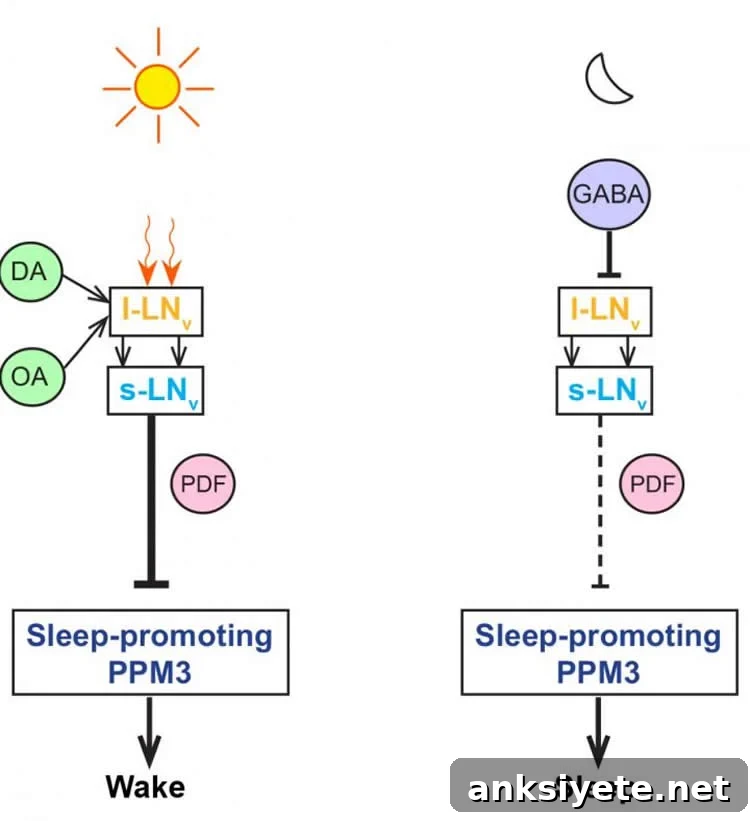
Sheetal Potdar and Sheeba Vasu identified a subset of dopaminergic neurons that are inhibited during the day by the neuropeptide Pigment Dispersing Factor (PDF). PDF is a circadian, light-responsive signaling molecule, and the researchers show that its receptor (PDFR) on these dopaminergic cells mediates the daytime suppression of their activity. Manipulating the expression of the gene that encodes PDFR altered daytime sleep: reducing PDFR expression in the targeted neurons increased daytime sleep, while boosting PDFR expression reduced daytime sleep. These results point to a direct role for PDF signaling in blocking the activity of neurons that would otherwise promote sleep during daylight.
Interpretation and significance
The authors propose that elevated levels of PDF during daylight hours sustain wakefulness by inhibiting dopaminergic neurons that favor sleep. This mechanism provides a clear example of how circadian neuropeptides can gate arousal by modulating specific neural populations rather than solely through broad changes in brain state. Because many aspects of sleep/wake regulation are evolutionarily conserved, these findings in fruit flies may help frame questions about how similar pathways operate in mammals, including how circadian signals and light inputs interact with dopamine systems to control daytime alertness.
Methods overview (general)
While the full methodological details appear in the original eNeuro publication, the core experimental strategy combined genetic manipulation of receptor expression with behavioral measurements of sleep. By selectively reducing or increasing expression of the PDF receptor in identified dopaminergic neurons, the researchers were able to link receptor levels to changes in daytime sleep. They also used knowledge of PDF’s light-responsive nature to relate these cellular effects to the circadian regulation of arousal.
Implications for future research
These findings open several avenues for follow-up studies. Researchers can now investigate how PDF signaling interfaces with other arousal and sleep-promoting circuits, map downstream targets of the inhibited dopaminergic neurons, and test how environmental light and circadian phase alter PDF dynamics. Translationally, uncovering conserved elements of this pathway could inform treatments for disorders of sleep timing, excessive daytime sleepiness, or circadian disruption, though direct clinical applications will require careful validation in mammalian systems.
Funding: This study was funded by the Science and Engineering Research Board.
Source and reporting: David Barnstone – SfN. The study is published in eNeuro. Image credit: Potdar & Vasu.
Please refer to the original eNeuro article for the complete experimental details and formal citation. This summary is based on the SfN report and the published research.
This article summarizes the principal conclusions from the reported study and avoids speculative claims beyond the evidence presented by the authors. It highlights how a circadian neuropeptide can directly inhibit sleep-promoting neurons to preserve daytime wakefulness in fruit flies, a mechanism with potential relevance to broader sleep/wake biology.