
Summary: A new study reveals that the brain processes visual stimuli above and below the horizon with different precision, speed, and sensitivity.
Source: Tübingen University.
Visual information from near and far space is processed with different levels of acuity.
Researchers at the Werner Reichardt Centre for Integrative Neuroscience (CIN) at the University of Tübingen, led by Dr. Ziad Hafed, report that the primate brain represents the upper and lower halves of the visual field asymmetrically in the superior colliculus (SC). Their experiments in non-human primates show that more neural tissue in the SC is devoted to the upper visual field than to the lower. As a result, stimuli above the horizon are processed with greater sharpness, stronger responses, and faster timing—analogous to the brain wearing bifocals.
Vision relies heavily on automatic mechanisms: we perceive details most clearly along the central visual axis and less distinctly in the periphery. When the brain detects an interesting object in peripheral vision, it typically triggers an eye movement that brings the object into the fovea—the small retinal region with a much higher density of photoreceptors—so we can analyze it in detail. This behavioral preference for central vision is mirrored in brain circuitry. For example, the SC, a midbrain structure that helps initiate eye movements directly from retinal input, shows a concentrated representation of foveal signals compared with peripheral signals, a phenomenon known as foveal magnification.
Hafed and colleagues demonstrate that the SC’s representational magnification is not limited to the fovea. Their data indicate that the SC also emphasizes the upper visual field. Neurons encoding locations above the horizon have smaller receptive fields, are more finely tuned to spatial detail, and are more sensitive to contrast than neurons representing lower visual-field locations. In contrast, the lower visual field is represented with lower spatial resolution. In this view, the SC’s internal mapping resembles bifocal glasses: one “lens” optimized for the upper field and another for the lower.
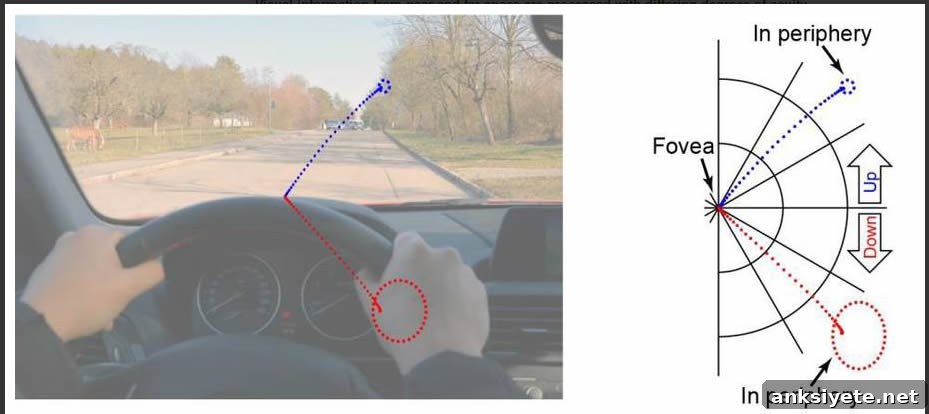
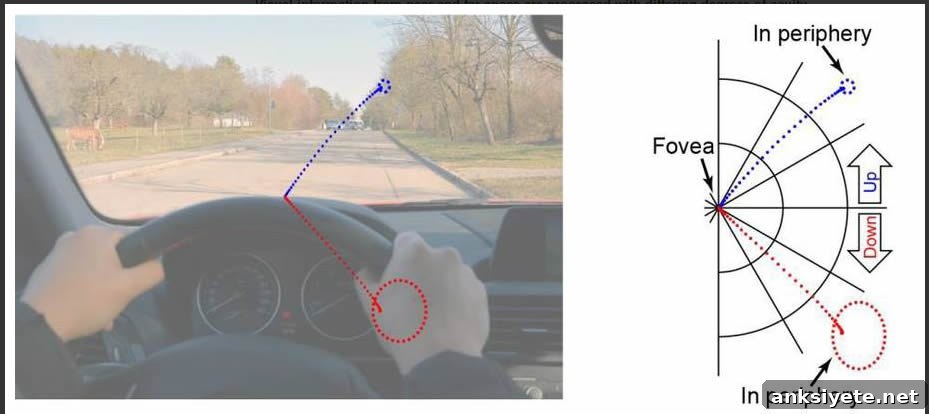
From an ecological perspective, this asymmetry makes sense. Far objects project smaller images on the retina than close objects, so distant features require higher visual resolution to be localized and identified accurately. In everyday three-dimensional settings, the lower visual field typically corresponds to near space—for example, the dashboard and instruments while driving—while the upper visual field tends to encompass extra-personal, far space such as roadways and distant intersections. Dr. Hafed explains that greater resolution, sensitivity, and faster responses in the upper visual field facilitate precise orienting to far objects, whereas near objects can be processed adequately with lower spatial resolution and different response dynamics. The team’s observations argue that the traditional SC model, which assumes symmetric representation across the horizontal meridian, should be revised to reflect this ecological specialization.
The study’s findings have practical implications for human-machine interfaces, particularly in augmented reality (AR) and virtual reality (VR). Immersive displays cover large portions of the visual field, and designers must decide where to position critical feedback that requires rapid orienting. The SC’s “bifocal” organization—faster, sharper, and stronger orienting toward the upper field—suggests that placing essential, time-sensitive indicators where the human visual system is most responsive could improve usability and reaction times in AR/VR applications.
Source: Dr. Paul Töbelmann, Tübingen University
Image credit: Ziad Hafed/CIN
Original research: “Sharper, Stronger, Faster Upper Visual Field Representation in Primate Superior Colliculus” by Ziad M. Hafed and Chih-Yang Chen, published in Current Biology. Published online June 9, 2016. doi:10.1016/j.cub.2016.04.059
Sharper, Stronger, Faster Upper Visual Field Representation in Primate Superior Colliculus
Highlights
• Smaller SC visual and saccade-related response fields for the upper visual field
• Higher spatial-frequency tuning and greater contrast sensitivity in the upper visual field
• Over-representation of the upper visual field in both visual and saccade-related SC maps
• SC tuning matches the smaller image features typically encountered in upper visual-field scenes
Summary
Visually guided behavior in three-dimensional environments imposes different sensory and motor demands across retinotopic locations. Peri-personal or near space is mainly viewed through the lower retinotopic visual field (LVF), while extra-personal or far space is typically viewed through the upper visual field (UVF). This ecological separation means that the visual system benefits from different tuning and sensitivity across the vertical meridian. Contrary to the common assumption that visuomotor circuits such as the superior colliculus represent space symmetrically across the horizontal meridian, this study reveals substantial and multifaceted differences: neurons representing the UVF have smaller receptive fields, finer spatial tuning, faster and stronger responses, and greater contrast sensitivity. These differences produce a categorical change when crossing the horizontal meridian and predict novel effects on eye movements. The results suggest that SC organization aligns closely with the statistical structure of natural three-dimensional environments and motivate a reevaluation of structure-function relationships in visual circuits from an ecological perspective.
“Sharper, Stronger, Faster Upper Visual Field Representation in Primate Superior Colliculus” by Ziad M. Hafed and Chih-Yang Chen in Current Biology. Published online June 9, 2016. doi:10.1016/j.cub.2016.04.059