Summary: New research identifies a previously unknown role for a scaffolding protein complex in transporting glutamate (AMPA) receptors to synapses, a process that influences memory formation and maintenance.
Source: Colorado State University
“We are our memories,” is a phrase often quoted by Assistant Professor Frédéric J. Hoerndli and his team.
Hoerndli, a neuroscientist in the Department of Biomedical Sciences, and his laboratory have published new findings in Cell Reports that clarify how neurons move AMPA-type glutamate receptors to synapses — a key step in forming and preserving memories.
“This project took more than a decade to complete and went through many revisions,” Hoerndli said. “The core challenge was explaining a complex sequence of molecular events in a clear way.”
Memory ability often declines with age, and the precise regulation of neurotransmitter receptors at synapses plays a major role in whether memories persist. AMPA receptors, which respond to the neurotransmitter glutamate, are central to the synaptic changes that encode memory. Maintaining the right number of these receptors at junctions between neurons — synapses — is essential for keeping memories intact.
For a long time, scientists assumed that receptor regulation was handled mainly at the synapse itself. Beginning in 2009, Hoerndli redirected his research toward the transport mechanisms that deliver receptors to synaptic sites. That effort led to the discovery of a previously unrecognized function for a scaffolding complex associated with MAPK (mitogen-activated protein kinase) signaling.
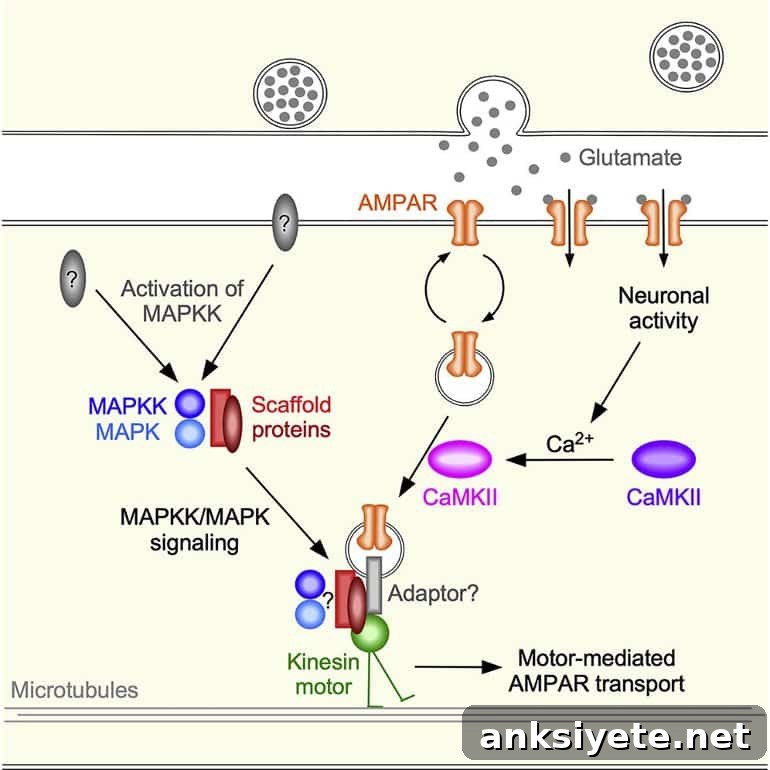
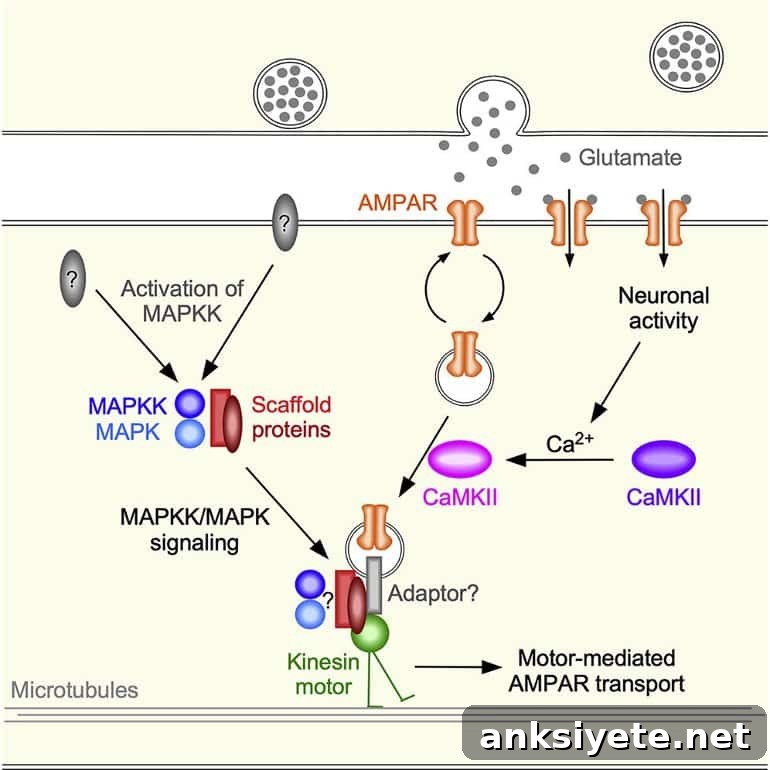
By integrating earlier work on this scaffold with new observations of how neurons control intracellular transport, the team determined that two distinct signaling pathways must converge to permit receptor delivery. These signals need to occur at the synapse either simultaneously or in rapid succession for transport to proceed efficiently.
“We found how two synaptic signals cooperate to control the transport machinery that moves AMPA receptors,” Hoerndli explained. “Understanding how these signals combine allowed us to assemble a coherent model linking molecular events to changes in memory-related synaptic strength.”
A deceptively simple organism advances our understanding
Hoerndli’s lab conducts these experiments in Caenorhabditis elegans, a transparent nematode with a small nervous system of 302 neurons and a fully mapped connectome. Its short lifespan and extensive genetic toolkit make C. elegans an ideal model for live, real-time studies of synaptic signaling and receptor transport.
Working with intact, living worms allows researchers to observe molecular events as they naturally occur within an operational nervous system without causing harm to the organism. These experiments reveal how genes and protein complexes conserved across species participate in learning and memory.
“It was eye-opening to me as a student that genes and structures found in humans can be investigated in far simpler organisms,” Hoerndli said. “The depth of insight we can gain from these models is remarkable.”
The Hoerndli laboratory continues to map how multiple signaling pathways at the synapse coordinate to regulate receptor trafficking and synaptic maintenance. Their aim is to expand foundational knowledge about how memory is preserved and how synapses adapt during learning.
About this memory research news
Author: Rhea Maze
Source: Colorado State University
Contact: Rhea Maze – Colorado State University
Image: The image is credited to the researchers
Original Research: Open access.
MAPK signaling and a mobile scaffold complex regulate AMPA receptor transport to modulate synaptic strength by Frédéric J. Hoerndli et al., Cell Reports
Abstract
MAPK signaling and a mobile scaffold complex regulate AMPA receptor transport to modulate synaptic strength
Highlights
- Mobile MAPK-associated scaffold proteins are necessary for AMPA receptor (AMPAR) transport.
- MAPK kinases (MAPKKs) and MAPKs are required to load scaffold proteins onto kinesin motor proteins.
- CaMKII activity is required to load AMPARs onto the scaffold complex.
- CaMKII and MAPK signaling together support the rapid turnover and exchange of synaptic AMPARs during early synaptic plasticity.
Summary
Synaptic plasticity depends on swift, experience-dependent changes in the number and composition of neurotransmitter receptors at synapses. Earlier work showed that motor-driven transport of AMPA-type glutamate receptors to and from synapses is a key determinant of synaptic strength.
This study outlines two converging signaling pathways that coordinate sequential loading steps: first, CaMKII enables AMPARs to associate with a conserved JIP-family scaffold complex; second, MAPK signaling promotes attachment of that scaffold to kinesin-1 motors for transport. Using genetic analysis and in vivo real-time imaging in C. elegans, the researchers demonstrate how these coordinated steps permit rapid, experience-dependent changes in synaptic receptor levels.
Together, the data support a model in which CaMKII and a MAPK signaling cascade cooperate to enable the fast exchange of AMPARs required for early stages of synaptic plasticity, thereby linking molecular transport events to the cellular basis of memory formation and maintenance.