
New Light-Activated Tool Reveals How Proteins Form Liquid and Solid Assemblies Inside Living Cells
Summary: Researchers have created an optogenetic tool that helps explain how proteins assemble into both liquid droplets and gel-like solids inside living cells.
Source: Princeton University.
Researchers have developed a light-activated method called optoDroplet that enables precise control of protein phase transitions inside living cells, shedding light on how membraneless organelles form and how pathological protein aggregates may arise.
Cells carry out thousands of biochemical reactions, many of which occur in specialized compartments known as organelles. Some organelles are not enclosed by membranes yet remain distinct structures within the cell’s crowded interior. These membraneless organelles form by a process known as phase separation, in which certain proteins and nucleic acids condense into liquid-like droplets or transition into gel-like and solid states.
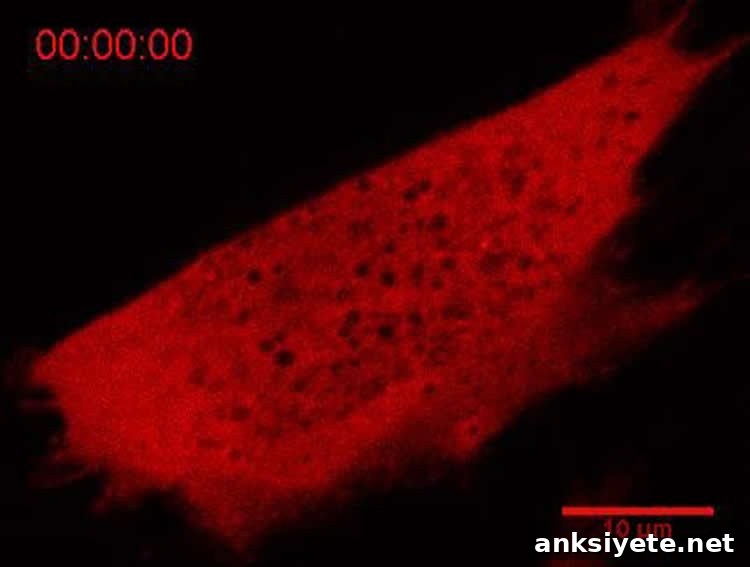
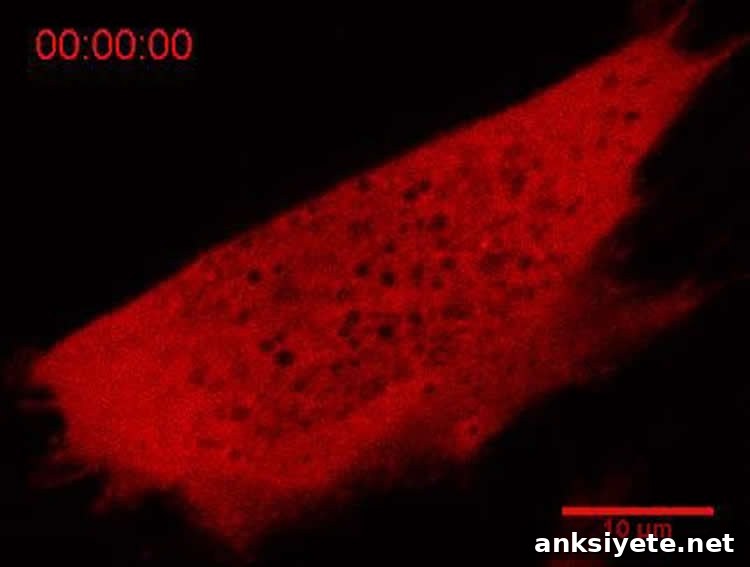
Scientists at Princeton University introduced optoDroplet, an optogenetic platform that uses light to trigger and reverse phase transitions driven by intrinsically disordered protein regions (IDRs). By turning light on and off, researchers can force target proteins to assemble into condensates and then dissolve them, enabling the first detailed mapping of intracellular phase behavior in living cells.
“The optoDroplet tool allows us to dissect the physical and chemical rules that govern self-assembly of membraneless organelles,” said Clifford Brangwynne, assistant professor of chemical and biological engineering at Princeton and senior author of the study published in Cell. “Understanding these mechanisms could point toward interventions for diseases linked to protein aggregation, such as ALS.”
Until now, most phase-separation studies relied on purified proteins in test tubes. Those experiments offered important insights but lacked the complexity of living cells, where many interacting components and dynamic processes influence assembly. OptoDroplet provides an experimental handle for studying when phase transitions are reversible and functional, and when they progress toward semi-solid gels and irreversible aggregates implicated in neurodegenerative disease.
The system exploits optogenetics: researchers fused a light-sensitive protein domain—derived from the plant Arabidopsis thaliana—to the IDRs of proteins known to drive phase separation, such as FUS, DDX4 and HNRNPA1. Exposing transfected mouse and human cells to blue light causes the light-sensitive tag to self-associate, driving the fused IDRs to condense into droplets.
By tuning light intensity and local protein concentration, the team could control the timing, location and extent of condensation. Low to moderate activation produced liquid-like droplets that assembled and disassembled reproducibly with light cycles. Stronger activation or higher concentrations pushed the system deeper into a phase boundary, producing semi-solid gels that initially reversed but aged into persistent, lumpy aggregates over time.
“We can now precisely map the intracellular phase diagram,” Brangwynne said. “This helps us understand how cells move through different phase states to assemble distinct kinds of organelles—and how pathological states might emerge when control is lost.”
The reversible liquid droplets formed with optoDroplet appear to be tolerated by cells, while repeated cycling into gel-like states produced assemblies that cells could not clear. Such irreversible aggregates resemble deposits observed in several neurodegenerative diseases.
FUS provides an illustrative example. FUS normally participates in RNA processing and DNA repair, but many genetic mutations make FUS more aggregation-prone. Those sticky variants can form persistent inclusions inside neurons, a hallmark of amyotrophic lateral sclerosis (ALS). Similar pathological aggregates of other proteins are associated with Huntington’s and Alzheimer’s diseases, suggesting that dysregulated intracellular phase transitions can underlie diverse disorders.
Co-authors on the study include Yongdae Shin (lead author), Joel Berry, Mikko Haataja, Nicole Pannucci and Jared Toettcher. Berry and Haataja contributed mathematical models to interpret intracellular phase behavior, while Pannucci and Toettcher provided optogenetics expertise and molecular design support. The work received funding from the National Institutes of Health and the National Science Foundation.
Independent researchers have noted the promise of the optoDroplet approach. Edward Lemke of the European Molecular Biology Laboratory commented that the system offers minimally invasive, highly controlled modulation of proteins that participate in phase separation, enabling new insight into their normal functions and roles in disease.
Brangwynne and colleagues plan to continue using optoDroplet to probe how cells regulate liquid and solid phase states and to investigate how aberrant transitions contribute to pathology. Their goal is to translate fundamental understanding of intracellular phase behavior into strategies for preventing or reversing harmful protein aggregation.
Funding: National Institutes of Health; National Science Foundation.
Source: Princeton University. Image credit: Princeton University.
Abstract
Spatiotemporal Control of Intracellular Phase Transitions Using Light-Activated optoDroplets
Highlights
• optoDroplets provide light-activated control of intracellular phase transitions
• Rapid growth and fast inactivation allow droplet assembly in defined subcellular regions
• Driving cells into deep supersaturation produces solid-like gels
• Gels can be initially reversible but subsequently age into irreversible aggregates
Summary
Intrinsically disordered regions (IDRs) drive many intracellular phase transitions that form liquid-like RNA/protein bodies and other membraneless organelles. A lack of tools to control these transitions inside living cells has limited understanding of their physiological and pathological roles. The optoDroplet optogenetic platform activates IDR-mediated phase separation using light, allowing spatiotemporal control in living cells. Constructs incorporating IDRs from RNP body proteins undergo light-activated condensation above a concentration threshold, forming liquid optoDroplets that can assemble and disassemble with light. Under conditions of deep supersaturation, assemblies form solid-like gels that age into irreversible aggregates. This system enables study of both normal phase behavior and the processes that link phase transitions to pathological aggregation.