
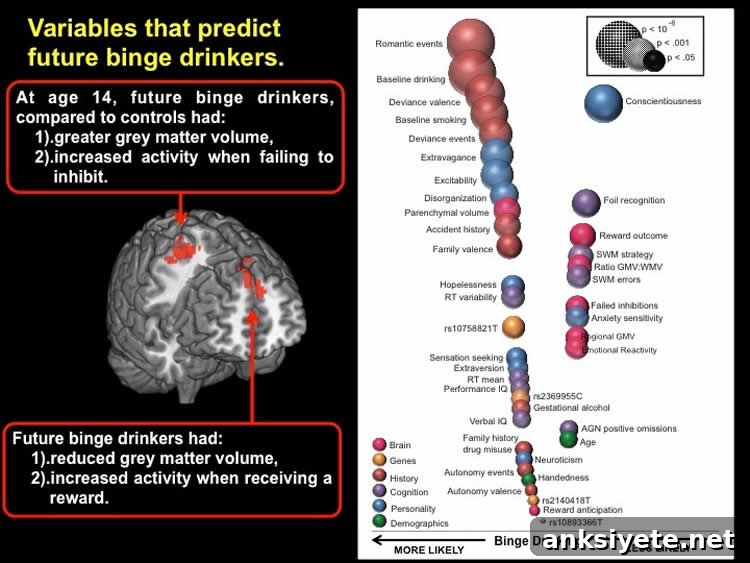
Neuroscientists running the largest longitudinal adolescent brain imaging study to date report that predicting teenage binge drinking is feasible. In their published analysis, researchers found that a combination of factors—including genetics, brain function and roughly 40 demographic, psychological and behavioral variables—can forecast which adolescents are likely to develop a pattern of binge drinking with about 70 percent accuracy. The findings were published online July 3, 2014 as an Advance Online Publication in the journal Nature.
The research team, led by first author Robert Whelan, Ph.D., and senior author Hugh Garavan, Ph.D., carried out comprehensive assessments on each participant. Whelan, a former University of Vermont postdoctoral fellow in psychiatry and now a lecturer at University College Dublin, and Garavan, an associate professor of psychiatry at the University of Vermont, and their colleagues evaluated 2,400 fourteen-year-old adolescents across eight sites in Europe. Each adolescent completed approximately ten hours of testing that included neuroimaging to assess brain activity and structure, cognitive performance tasks, IQ testing, personality assessments and blood draws for genetic analysis and biomarkers.
The study’s primary aim was to build a predictive model that would clarify how brain anatomy and function, personality traits, environmental influences and genetic factors combine to increase the risk of adolescent alcohol misuse. Using the data collected at age 14, the researchers developed an analytic approach to predict which individuals would go on to binge drink by age 16. The model’s reliability was confirmed by reproducing similar predictive accuracy in a separate test group of adolescents.
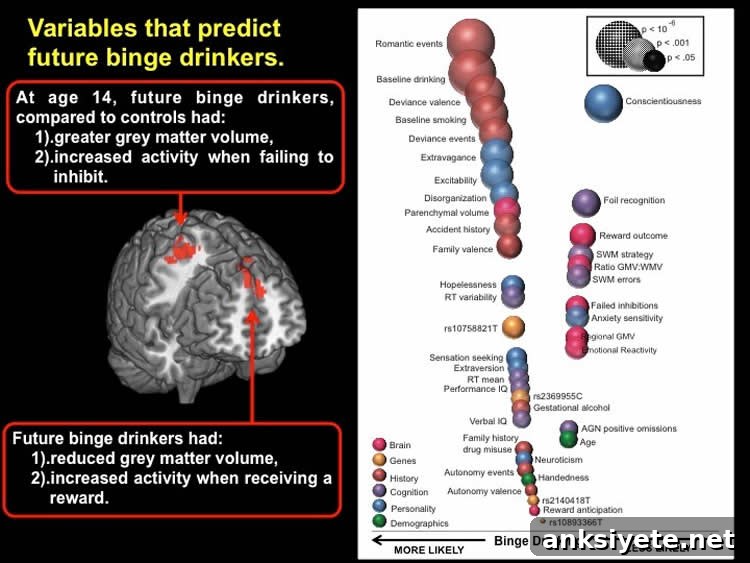
Earlier work from this team, published in Nature Neuroscience in 2012, had identified brain network patterns linked to higher-risk behaviors such as experimentation with drugs and alcohol. The current study extended that research by tracking the same participants over several years; at the time of publication the cohort had reached approximately 19 years of age. By isolating which baseline (age 14) measures best predicted later heavy drinking, the investigators produced a ranked list of predictors spanning neurobiological, genetic, psychological and environmental domains.
According to the authors, no single factor fully explains adolescent binge drinking. Instead, a wide mixture of influences contributes to risk. Among the strongest predictors were certain personality traits—especially sensation-seeking and low conscientiousness—plus a family history of substance use. Early exposure to alcohol was also a powerful indicator: adolescents who had consumed even a single drink by age 14 were more likely to binge drink later. Additional risk factors included impulsive behavior and the experience of multiple stressful life events.
An intriguing neurodevelopmental finding was that larger brain volume in some regions correlated with greater risk. Adolescence is characterized by rapid brain remodeling—gray matter volumes typically decline while white matter increases as neural circuits become more efficient. The researchers interpret larger or more “immature” gray matter volumes in some teens as a marker of delayed maturation that may be associated with higher likelihood of risk-taking and later heavy alcohol use.
The research team believes these results can guide targeted prevention efforts. By identifying adolescents with a high-risk neuropsychosocial profile, clinicians and public health programs could focus early, tailored interventions on those most likely to develop harmful drinking patterns.
Gunter Schumann, M.D., professor of biological psychiatry and head of the section at the Social, Genetic and Developmental Psychiatry Centre, Institute of Psychiatry, King’s College London, serves as the principal investigator of the IMAGEN study, which provided the dataset for this analysis. Schumann and the team describe the work as an effort to create a robust predictive standard for adolescent behavior that can inform the design of simpler and widely applicable screening tools. Future analyses planned by the group aim to examine how environmental moderators—such as exposure to nicotine, other drugs or psychosocial stress—interact with identified risk profiles to shape the development of substance use patterns.
The authors also plan further in-depth brain analyses to determine whether different predictors apply to misuse of other substances, and they are preparing additional studies using the same dataset to investigate predictors of cannabis use and other outcomes.
Coauthors from the University of Vermont who contributed to analyses and interpretation include Robert Althoff, M.D., associate professor of psychiatry; Catherine Orr, Ph.D., postdoctoral fellow in psychiatry; Richard Watts, M.D., associate professor of radiology; and former neuroscience graduate student Nick Ortiz, Ph.D. The UVM Complex Systems Center provided advising on analysis methods used by the UVM team.
Source: Jennifer Nachbur, University of Vermont (press release)
Contact: University of Vermont press office (press release)
Image credit: Hugh Garavan, Ph.D., University of Vermont (image adapted from the press release)
Original research: Whelan R. et al., “Neuropsychosocial profiles of current and future adolescent alcohol misusers,” Nature, published online July 2, 2014, doi:10.1038/nature13402. Related earlier work: Whelan R. et al., “Adolescent impulsivity phenotypes characterized by distinct brain networks,” Nature Neuroscience, published online April 29, 2012, doi:10.1038/nn.3092.