
Summary: New mouse research shows that merely seeing or smelling food can trigger liver processes that prepare the body for digestion.
Source: Cell Press.
The sight or smell of appetizing food often makes the mouth water, but sensory perception of food can also produce rapid physiological changes beyond the salivary response. New research in mice indicates that visual and olfactory cues alone are sufficient to prime the liver for digestion. The study was published November 15 in the journal Cell.
“This finding changes our view of one of the most fundamental bodily processes,” says senior author Jens Brüning, an endocrinologist and geneticist and director of the Max Planck Institute for Metabolism Research in Cologne, Germany. “Food perception in the brain activates the liver in a way that begins preparing it to receive nutrients it expects to come.”
Previous work in 2015 demonstrated that sensory detection of food by mice could activate neural pathways usually responsive during actual eating. In that work, sensing food suppressed AgRP neurons, which drive hunger, and activated POMC neurons, which promote satiety. The new study extends those findings by tracing how these neural signals translate into metabolic activity in the liver.
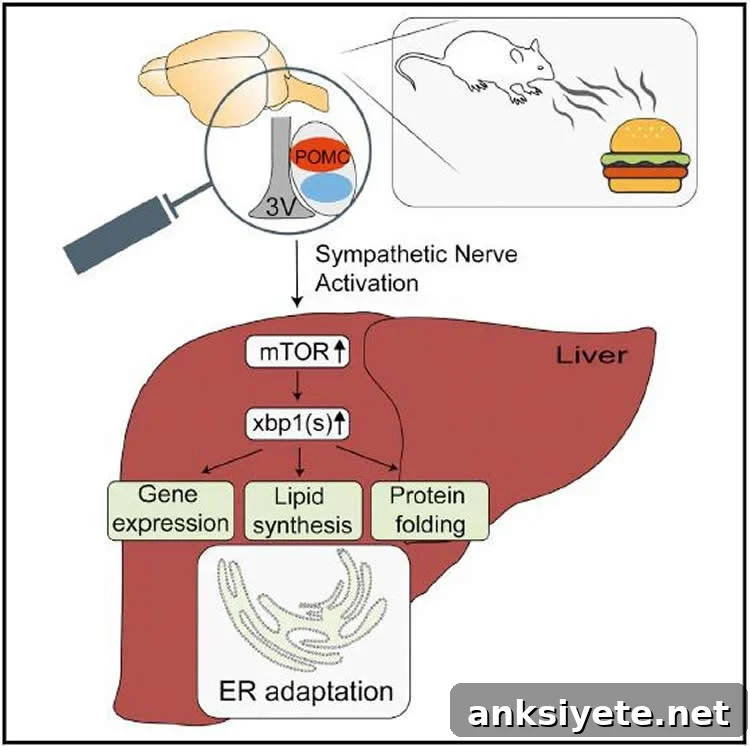
In the current experiments, researchers observed that within five minutes of mice seeing or smelling food, changes in hypothalamic POMC neuron activity initiated a rapid signaling cascade in the liver. This cascade activated the mTOR signaling pathway and induced Xbp1 splicing—pathways normally activated when the liver takes up amino acids after a meal. These pathways increase the endoplasmic reticulum’s (ER) capacity to fold and assemble proteins from dietary amino acids, essentially priming the ER for enhanced protein synthesis after feeding.
“Our data show that liver changes occur in response to food cues alone,” Brüning explains. “It’s a coordinated program that primes the ER to handle increased protein synthesis and folding once nutrients arrive.”
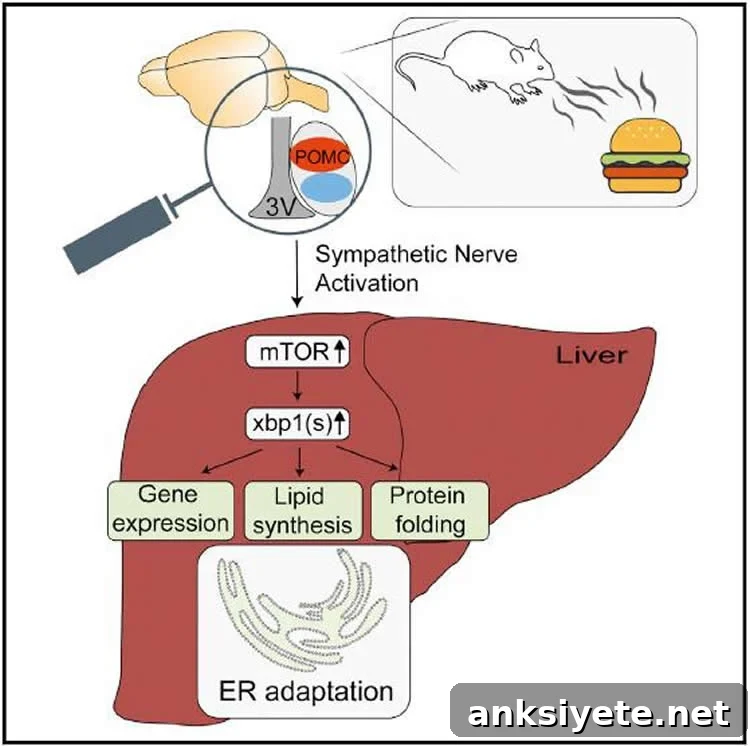
The investigators traced a clear neural-to-organ pathway. Sensory food perception activated POMC neurons in the hypothalamus. Optogenetic stimulation of POMC neurons reproduced the liver responses—mTOR activation and Xbp1 splicing—while loss of MC4R expression reduced these effects. Chemogenetic activation of POMC neurons increased sympathetic nerve activity to the liver, and norepinephrine exposure produced similar molecular and cellular responses in isolated hepatocytes and in vivo liver tissue as were seen following food perception. Together, these results reveal a melanocortin–sympathetic–mTOR–Xbp1s axis that coordinately primes liver ER homeostasis in anticipation of feeding.
Beyond basic physiology, the findings may help explain links between metabolic disease and sensory feeding cues. The authors suggest that obesity could impair sensory-dependent priming of the liver, disrupting ER protein-folding capacity after meals and thereby contributing to defective insulin signaling and insulin resistance. “There’s a possibility that this food sensory-dependent priming of the liver may be compromised in obesity,” Brüning says. “If the liver is not properly primed for protein folding after eating, that could disturb the normal insulin response.” The team plans follow-up studies in mouse models of obesity to test this idea.
Translating these findings from mice to humans will require more research. The investigators are developing translational studies to evaluate whether visual and olfactory exposure to food—without eating—affects insulin sensitivity and related metabolic responses in human volunteers.
Funding: Research support came from the Excellence Initiative by German Federal and State Governments, the National Center for Diabetes Research (DZD), the European Research Council (ERC) advanced grant “SYNEME,” the Danish Council for Independent Research in Medical Sciences, and the US National Institutes of Health.
Source: Carly Britton – Cell Press
Publisher: Organized by NeuroscienceNews.com
Image Source: Image credited to Brandt et al. / Cell, 2018.
Original Research: Open access research titled “Food Perception Primes Hepatic ER Homeostasis via Melanocortin-Dependent Control of mTOR Activation” by Claus Brandt et al., published in Cell on November 15, 2018.
DOI: 10.1016/j.cell.2018.10.015
MLA: Cell Press. “Seeing and Smelling Food Prepares the Liver for Digestion: Mouse Study.” NeuroscienceNews, 15 November 2018.
APA: Cell Press (2018, November 15). Seeing and Smelling Food Prepares the Liver for Digestion: Mouse Study. NeuroscienceNews. Retrieved November 15, 2018.
Chicago: Cell Press. “Seeing and Smelling Food Prepares the Liver for Digestion: Mouse Study.” NeuroscienceNews, accessed November 15, 2018.
Abstract
Food Perception Primes Hepatic ER Homeostasis via Melanocortin-Dependent Control of mTOR Activation
Adaptation of the liver to the postprandial state requires tightly coordinated regulation of protein synthesis, protein folding, and lipid metabolism. This study shows that sensory perception of food is sufficient to elicit early activation of hepatic mTOR signaling, Xbp1 splicing, increased expression of ER-stress-related genes, and stimulation of phosphatidylcholine synthesis, which together induce rapid morphological remodeling of the endoplasmic reticulum. These early responses overlap with those seen during refeeding and are further amplified by actual nutrient supply. Sensory food cues activate POMC neurons in the hypothalamus; optogenetic activation of POMC neurons triggers hepatic mTOR signaling and Xbp1 splicing, and absence of MC4R attenuates these responses to sensory perception. Chemogenetic activation of POMC neurons elevates sympathetic nerve activity to the liver, and norepinephrine produces similar molecular changes in hepatocytes in vitro and in vivo as observed after sensory exposure to food. Collectively, these experiments reveal that sensory food perception primes postprandial liver ER adaptation through a melanocortin–sympathetic–mTOR–Xbp1s signaling axis.