
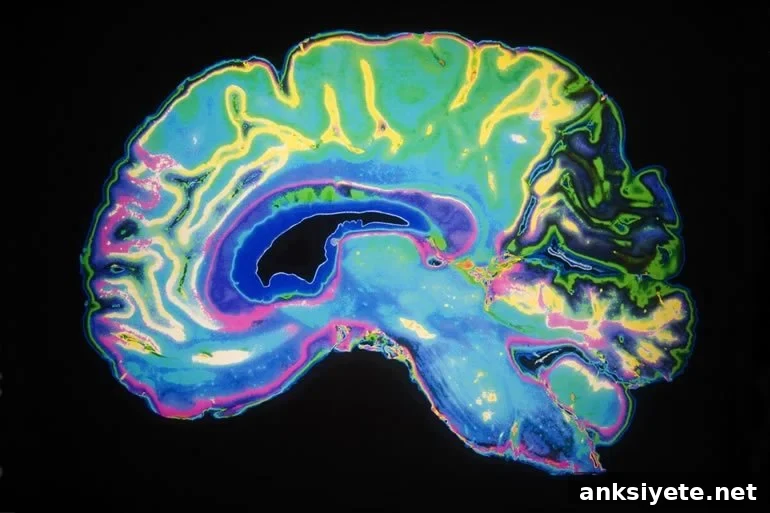
Summary: By about two-and-a-half years of age, sleep shifts from primarily supporting brain growth to serving mainly maintenance and repair functions—roles it continues to perform throughout life.
Source: UCLA
Prolonged sleep deprivation has long been linked to serious health problems in humans and other animals. A multidisciplinary team led by UCLA researchers has clarified why sleep is essential, identifying a striking shift in sleep’s main purpose that occurs at roughly two-and-a-half years of age.
In the first years of life, the brain grows rapidly. During REM sleep—the stage associated with vivid dreaming—young brains build and strengthen synapses, the connections that allow neurons to communicate. This period of intense neural reorganization supports learning and development.
“Don’t wake babies during REM sleep—important work is being done in their brains as they sleep,” said senior study author Gina Poe, a UCLA professor of integrative biology and physiology who has studied sleep for more than three decades.
Around age two-and-a-half, however, the dominant function of sleep changes. Rather than primarily supporting the construction of new neural circuits, sleep’s chief role becomes maintenance and repair—clearing metabolic waste, repairing damage, and preserving healthy brain function. According to the researchers, this repair-and-clearance role then remains the primary purpose of sleep for the rest of life.
During waking hours, neurons accumulate molecular damage and cellular debris, including damaged proteins and DNA. If this debris builds up, it can contribute to brain disorders. Sleep supports processes that remove waste and repair neuronal damage—essentially decluttering the brain to prevent long-term harm.
“I was shocked how huge a change this is over a short period of time, and that this switch occurs when we’re so young,” said Van Savage, a UCLA professor of ecology and evolutionary biology and of computational medicine, and a senior author on the study. “It’s a transition that is analogous to when water freezes to ice.”
The researchers performed the most comprehensive statistical analysis of sleep to date, pooling data from more than 60 sleep studies across humans and other mammals. Their analysis included total sleep time, REM sleep duration, brain size and body size throughout development. They also developed and tested a mathematical model to explain how sleep patterns change with brain and body growth.
Findings were consistent across species: a pronounced decline in REM sleep occurred at the developmental stage equivalent to about two-and-a-half years in humans. Whether studying rabbits, rats, pigs or people, the proportion of sleep spent in REM remained similar before and after this transition point, indicating a conserved developmental pattern.
The researchers found that REM sleep declines as brain size increases during development. Newborns spend about half their sleep time in REM; by age 10 this falls to roughly 25%, and in adults older than 50 it is about 15% of sleep time. The sharp decrease in REM around age two-and-a-half coincides with the switch from neural reorganization to repair.
“Sleep is as important as food,” Poe said. “It’s remarkable how well sleep aligns with the needs of the nervous system. From jellyfish to birds to whales, all animals sleep. And while we sleep, our brains remain active in ways that are vital to health.”
Chronic sleep loss likely contributes to long-term health risks, including cognitive decline, dementia, metabolic disorders such as diabetes, and obesity, the researchers noted. When tiredness arises, they advise listening to the body and prioritizing sleep rather than resisting it.
“I pulled all-nighters in college and regret it now,” Savage said. “A good night’s sleep would have served me better. Today, when I feel tired, I don’t feel guilty about sleeping.”
For most adults, a regular seven-and-a-half hours of sleep per night is typical; time spent awake in bed does not count toward that total, Poe points out. Children require more sleep than adults, and infants need roughly twice as much sleep as grown people. The large share of REM sleep in infants contrasts sharply with the much smaller REM proportions seen across adult mammals with widely varying brain and body sizes. Adult humans typically experience five REM cycles during a full night of sleep and can have multiple dreams in each cycle.
A consistent, restorative night’s sleep is powerful medicine—and it’s free, Poe emphasizes.
About this sleep research article
Source:
UCLA
Contacts:
Press Office – UCLA
Image Source:
The image is adapted from the UCLA news release.
Original Research: Open access
“Unraveling why we sleep: Quantitative analysis reveals abrupt transition from neural reorganization to repair in early development” by Junyu Cao et al. Science Advances.
Abstract
Unraveling why we sleep: Quantitative analysis reveals abrupt transition from neural reorganization to repair in early development
Sleep supports several key functions, most notably neural repair and metabolite clearance as well as circuit reorganization. The relative importance of these functions has been debated. The authors present a mechanistic framework to understand and predict how sleep changes across development and across species. Using this theory, they quantitatively distinguish sleep devoted to neural reorganization from sleep devoted to repair and clearance. Their analysis reveals an abrupt developmental transition between about two and three years of age in humans. After this transition, differences in sleep across species and during later development are largely explained by sleep’s role in repair and clearance; before this transition, sleep predominantly supports neural reorganization and learning. The study also indicates that neuroplastic reorganization occurs mainly during REM sleep rather than NREM sleep, highlighting a complex interaction between developmental and evolutionary constraints on sleep.