
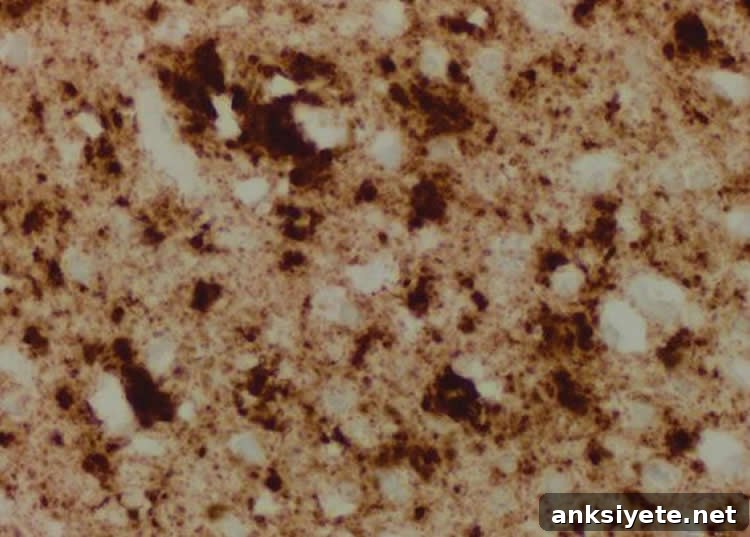
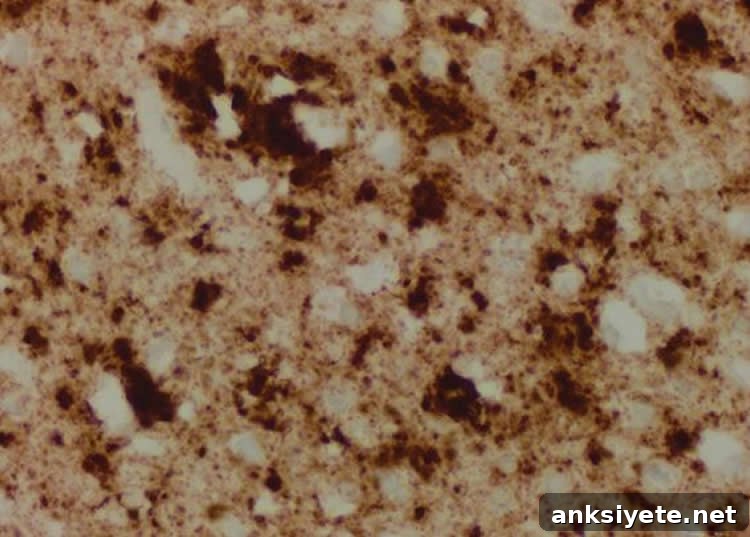
Summary: Researchers have detected abnormal prion protein linked to Creutzfeldt-Jakob disease (CJD) in the skin of nearly two dozen people who died from the condition. The results prompt questions about whether prion transmission could occur via skin-related medical procedures and whether a skin-based test could help diagnose prion diseases.
Source: NIH/NIAID.
Scientists at the U.S. National Institutes of Health (NIH), together with colleagues from Case Western Reserve University School of Medicine, have identified disease-associated prion protein in the skin of 23 people who died from Creutzfeldt-Jakob disease (CJD). Using a sensitive assay called Real-Time Quaking-Induced Conversion (RT-QuIC), the team detected abnormal prion seeding activity in skin samples from all CJD cases tested and in none of the non-CJD controls. In bioassays, mice exposed to skin extracts from two CJD patients developed prion disease, demonstrating that skin from these patients contained infectious prions. The findings, published in Science Translational Medicine, raise important questions about prion transmission risk in procedures involving skin and about the potential for skin-based diagnostics for prion disease.
Creutzfeldt-Jakob disease is an ultimately fatal neurodegenerative disorder in the family of prion diseases. Prion diseases arise when the normal prion protein (PrP) adopts an abnormal, misfolded form (PrPSc) that can induce other PrP molecules to misfold, leading to tissue damage and characteristic sponge-like degeneration in the brain. Human prion diseases include variant, familial and sporadic CJD, fatal familial insomnia, kuru, and Gerstmann-Straussler-Scheinker syndrome. Sporadic CJD is the most common form, occurring at an incidence of about one in one million people per year worldwide. Related prion diseases affect animals, such as scrapie in sheep, chronic wasting disease in deer and elk, and bovine spongiform encephalopathy in cattle.
Although prion infections are most commonly associated with the central nervous system, prior research has detected abnormal prion protein in non-neural tissues including spleen, kidney, lung and liver. Established iatrogenic transmission routes for sporadic CJD include invasive procedures that involve central nervous system tissue and corneal transplants; however, the possibility of transmission via skin has not been a major focus historically.
In this study, investigators analyzed autopsy or biopsy skin samples from 38 individuals: 23 who died from CJD (21 sporadic CJD and 2 variant CJD) and 15 who died from other causes. Paired brain tissue was also tested for most CJD decedents. The RT-QuIC assay detected prion-seeding activity in the skin of all 23 CJD decedents and in none of the 15 non-CJD controls, in blinded testing. Western blotting, a less sensitive method, detected dermal PrPSc in only a small subset of cases; RT-QuIC proved far more sensitive for identifying low levels of prion seeding activity.
Quantitatively, the team estimated that prion-seeding activity in skin was roughly 1,000- to 100,000-fold lower than in brain tissue from the same patients. To assess infectivity, researchers inoculated two lines of humanized transgenic laboratory mice with either brain or skin homogenates from two sCJD patients. All 12 mice inoculated with brain material developed prion disease, as did all 12 mice inoculated with skin extracts. Disease onset in mice receiving skin inocula occurred later—about twice as long—than in mice receiving brain inocula (roughly 400 days), but neuropathology in the affected mice was comparable between groups.
The authors stress perspective in interpreting these data. As Byron Caughey, Ph.D., a senior investigator at NIH’s Rocky Mountain Laboratories and a study co-leader, noted, these experiments used highly permissive conditions: humanized mice and direct intracerebral inoculation of tissue extracts. Such conditions are optimized to reveal infectivity and are not representative of routine human exposure. There is no evidence from this work that casual contact with skin spreads CJD in real-world settings. Nevertheless, the demonstration of prion seeding activity and infectivity in skin supports the need for further study of possible transmission risks associated with surgical instruments, skin grafts, or other medical procedures that might contact prion-contaminated skin.
The study also highlights the diagnostic potential of RT-QuIC applied to skin tissue. RT-QuIC is already widely used on brain and cerebrospinal fluid samples to diagnose CJD, but such samples are not always available or practical to obtain. Developing RT-QuIC protocols for readily accessible and minimally invasive samples—such as skin biopsies, nasal brushings or blood—could expand diagnostic options for suspected prion disease and improve early detection.
Caughey’s group at RML continues to refine RT-QuIC methods, including determining when and where pathological prion protein appears in skin, improving assay sensitivity and specificity for clinical use, and exploring methods to reliably inactivate infectious forms of prions in tissues and instruments.
Funding: This study was funded by the NIH National Institute of Allergy and Infectious Diseases (NIAID).
Source: Ken Pekoc, NIH/NIAID. Publisher: Organized by NeuroscienceNews.com. Image credit: Case Western Reserve University.
Original research: Christina D. Orrú et al., “Prion seeding activity and infectivity in skin samples from patients with sporadic Creutzfeldt-Jakob disease,” Science Translational Medicine. Published online November 22, 2017. DOI: 10.1126/scitranslmed.aam7785.
Abstract (condensed)
Sporadic Creutzfeldt-Jakob disease (sCJD) is transmissible through iatrogenic routes due to abundant infectious prions in the central nervous system. This study examined prion seeding activity and infectivity in skin from sCJD patients. RT-QuIC detected prion seeding in skin from all 23 CJD decedents tested and in none of 15 non-CJD controls. Although skin contained approximately 10^3–10^5-fold less prion seeding activity than brain tissue, inoculation of skin homogenates from two sCJD patients caused prion disease in transgenic humanized mice. These results demonstrate that human skin can harbor prion seeding activity and infectious material, underscoring the need for further study of iatrogenic transmission risks and for development of sensitive diagnostic assays using accessible tissues.
This article summarizes peer-reviewed research without adding new or unverified claims. The findings emphasize scientific considerations about prion detection, infectivity, and potential implications for medical procedures, while noting that experimental conditions in animal bioassays differ substantially from typical human exposures.