
Summary: Researchers report that midbrain dopamine neurons display a previously unrecognized pattern of activity—tonic firing—when an animal evaluates rewards whose value shifts moment by moment.
Source: University of Tsukuba
Decisions in everyday life require animals to estimate the value of future rewards. While phasic bursts of dopamine neuron firing have long been linked to reward prediction, new work from Japan reveals an alternative, sustained firing pattern that tracks continuously changing reward values.
In a study published in eLife, neuroscientists at the University of Tsukuba show that midbrain dopamine neurons adopt a tonic firing mode to follow reward values that increase or decrease over time. This finding extends our understanding of how dopamine neurons encode reward information and how the brain monitors changing opportunities in real time.
Previous research emphasized the role of phasic dopamine responses—brief, sporadic bursts of spikes—in signaling prediction errors and guiding learning. Those phasic signals are important for many forms of reward-driven behavior, but they are brief and intermittent, which raises the question of how the brain continuously monitors rewards that evolve on subsecond timescales.
“Dopamine neurons in the midbrain are classically known for phasic responses to rewards and reward-predicting cues,” says Yawei Wang, the study’s first author. “However, phasic activity is sparse and transient, so it seems unlikely to support ongoing, moment-to-moment monitoring of a reward that is changing continuously.”
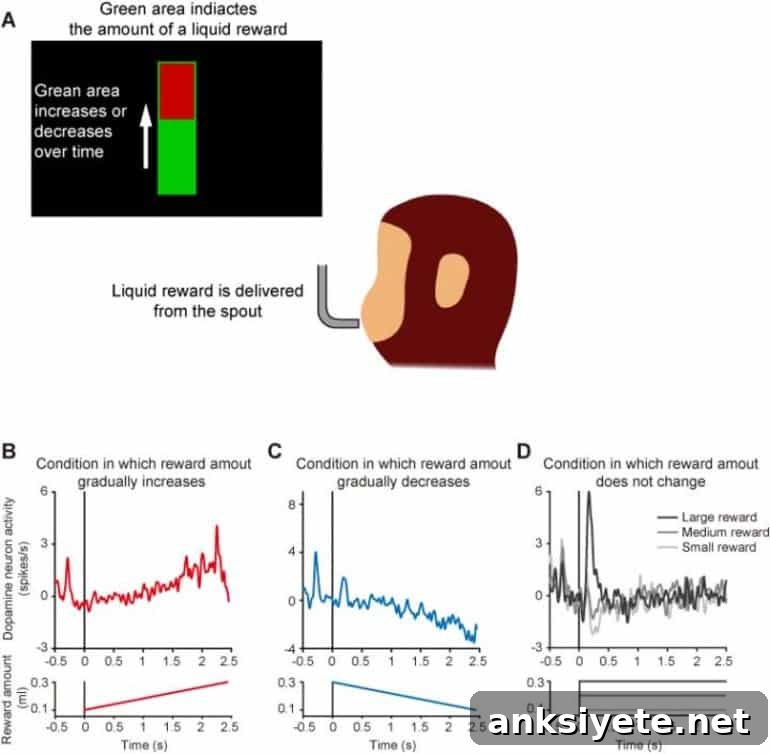
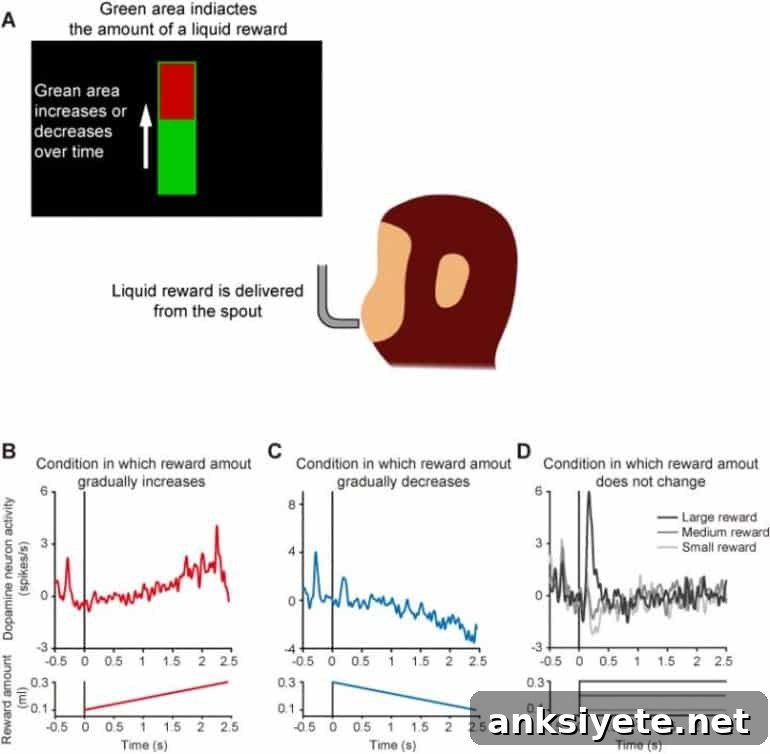
To test this, the team trained macaque monkeys on a Pavlovian task in which the value of a cued reward gradually increased or decreased while the animal observed. During the task, researchers recorded the activity of identified dopamine neurons in the midbrain to determine how neural firing patterns related to the changing reward value.
The results revealed a distinct pattern: instead of only exhibiting phasic bursts, many dopamine neurons showed tonic changes in firing rate that tracked the direction and magnitude of the changing reward value. When the cue signaled a rising reward, tonic firing rates gradually increased; when the signal indicated a decreasing reward, tonic firing rates declined.
“We were surprised to observe sustained, tonic activity that continuously reflected the changing expected value,” explains Professor Masayuki Matsumoto, senior author of the study. “This tonic mode appears to be a different operational state from the brief bursts typically associated with reward prediction.”
The authors determined that the tonic activity was driven more strongly by non-burst spikes than by the burst spikes that produce conventional phasic responses. This suggests that dopamine neurons can switch firing modes—phasic versus tonic—depending on the behavioral demands of the moment, enabling both discrete signaling for prediction errors and ongoing tracking of dynamic reward information.
Understanding these multiple firing modes is important because dopamine is a central neuromodulator involved in motivation, decision-making, and learning. Revealing how dopamine neurons encode continuously changing reward values sheds light on the neural computations that support real-time decisions and adaptive behavior.
The study opens new avenues for research into how tonic dopamine signaling contributes to cognitive functions and how these distinct firing patterns interact in different contexts. It may also inform models of reinforcement learning and the neural basis of value-guided choices.
About this neuroscience research news
Source: University of Tsukuba
Contact: Naoko Yamashina – University of Tsukuba
Image: The image is credited to University of Tsukuba
Original Research: Open access. “Tonic firing mode of midbrain dopamine neurons continuously tracks reward values changing moment-by-moment” by Yawei Wang, Osamu Toyoshima, Jun Kunimatsu, Hiroshi Yamada, Masayuki Matsumoto. DOI: 10.7554/eLife.63166. Published in eLife.
Abstract
Tonic firing mode of midbrain dopamine neurons continuously tracks reward values changing moment-by-moment
Behavior is guided by the expected value of future rewards, and phasic midbrain dopamine activity is known to signal such values and prediction errors. Because reward values often change continuously—even on subsecond timescales—adaptive behavior requires a mechanism for ongoing value monitoring. The transient, sporadic nature of phasic activity may be insufficient for this continuous tracking.
Using electrophysiological recordings in monkeys performing a Pavlovian task in which cued reward values gradually increased or decreased, the authors identified a tonic firing mode in dopamine neurons. These neurons showed sustained increases or decreases in firing rate that paralleled the direction of the changing reward value. The tonic response relied more on non-burst spikes than on the burst spikes that underlie conventional phasic signals.
These findings indicate that dopamine neurons can switch firing modes to signal reward values in ways appropriate to the behavioral context, adding nuance to current models of dopamine function in reward processing and decision-making.