
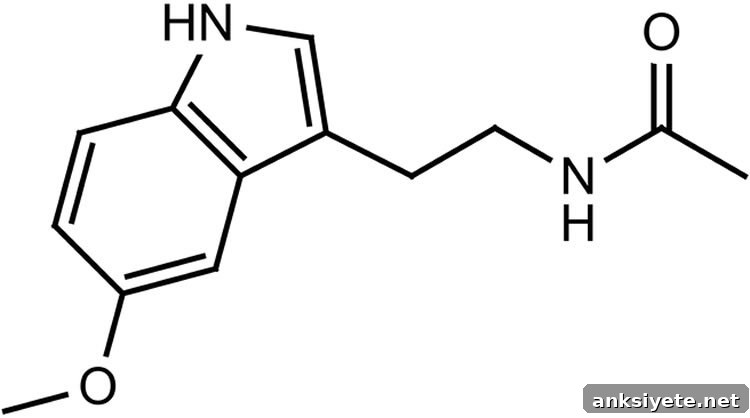
Summary: New findings show that melatonin suppression and circadian phase shifts can operate independently in response to night-time light exposure.
Source: The Psychological Society
Researchers publishing in The Journal of Physiology report new evidence about how night-time light affects the body’s internal clock. The results improve understanding of light’s impact on sleep and have implications for treatments for poor sleep, shift work disorder, and mood conditions such as depression.
The human body is governed by a 24-hour internal clock that coordinates daily cycles in physiology and behaviour, commonly called circadian rhythms. Light is the most powerful external cue for synchronizing this internal clock to the natural day–night cycle. At night, the brain secretes the hormone melatonin, which helps regulate sleep timing and signals biological nighttime. Exposure to bright light before or during habitual sleep time can reduce melatonin production and may impair sleep quality. Until now, melatonin suppression and the process that resets the timing of the circadian clock—known as circadian phase resetting—have often been treated as tightly linked responses to light.
Because melatonin suppression is easier to measure than circadian phase shifts, many researchers and clinicians have used melatonin reduction as a surrogate marker for light-induced changes in the clock. The new study tested whether this assumption is valid by directly comparing melatonin suppression and phase resetting after different patterns of night-time light exposure. The investigators report that the magnitude of a phase shift in the circadian clock can be functionally independent from the degree of melatonin suppression. In other words, strong changes in clock timing do not always accompany large drops in melatonin, and vice versa. This finding challenges the routine use of melatonin suppression as a proxy for circadian phase resetting and has important implications for designing light therapy protocols and evaluating how night-time lighting affects sleep and mood.
The study examined healthy volunteers who completed tightly controlled inpatient protocols at Brigham and Women’s Hospital, Boston. Each participant spent nine to ten days in the laboratory under strict control of sleep–wake schedules, activity and light/dark exposure. The investigators compared continuous bright-light exposures with intermittent bright-light pulses delivered during the night. Intermittent exposure patterns produced significant phase shifts—delaying the internal clock—while inducing relatively less melatonin suppression than would be expected if the two responses were always proportional. Notably, each brief pulse of bright light produced a similar immediate suppression of melatonin, but those pulses did not generate equal-sized phase shifts in circadian timing. These observations indicate that melatonin suppression and phase resetting may be mediated by distinct neurophysiological pathways or mechanisms.
Although the pattern of results was consistent across conditions tested, the authors acknowledge limitations, including the modest number of participants assigned to some exposure groups. This factor may limit the generalisability of effect sizes for specific lighting patterns and calls for further work with larger samples and a wider range of light conditions.
Lead author Dr Shadab Rahman commented on the implications of the findings: “Our results indicate that melatonin suppression and circadian phase resetting can be correlated under some conditions, but they are driven by separable neurophysiological processes. This means melatonin suppression should not be relied upon as a sole surrogate for phase resetting. This distinction is important for developing and optimising light therapies for people with disrupted sleep schedules—such as shift workers—or for patients with mood disorders where circadian timing is relevant. Further research is needed to refine light therapy protocols and to determine how specific light patterns can selectively target clock timing or melatonin signalling.”
Source: Andrew Mackenzie – The Psychological Society
Publisher: Organized by NeuroscienceNews.com
Image source: Public domain image used by NeuroscienceNews.com
Original research: Rahman SA, St Hilaire MA, Gronfier C, Chang A-M, Santhi N, Czeisler CA, Klerman EB, Lockley SW. “Functional decoupling of melatonin suppression and circadian phase resetting in humans.” The Journal of Physiology. Published April 29, 2018. DOI: 10.1113/JP275501
The Psychological Society (2018). “Rhythms of the Night.” NeuroscienceNews. Published April 30, 2018.
Abstract
Functional decoupling of melatonin suppression and circadian phase resetting in humans
Previous experiments with continuous light exposures often show that conditions producing larger melatonin suppression also produce larger circadian phase shifts, which led to the assumption that one response could stand in for the other. To evaluate this assumption, the investigators studied 16 healthy participants in a 9-day inpatient protocol and measured both melatonin suppression and circadian phase resetting in response to nocturnal light exposures with different temporal patterns. Conditions included dim-light control (<3 lux) and intermittent bright light (two 12-minute pulses separated by 36 minutes in darkness, approximately 9,500 lux), along with comparisons to historical data from single continuous bright exposures of varying durations and a multi-pulse intermittent pattern. All light exposure groups showed significantly greater phase-delay shifts than the dim-light control. While an overall monotonic relationship between melatonin suppression and phase shift existed across many conditions, intermittent light patterns produced notable phase shifts without proportionally large melatonin suppression. Each intermittent bright pulse induced similar melatonin suppression, yet the pulses did not produce equivalent phase shifts. These results support the conclusion that melatonin suppression and circadian phase resetting can be mediated by distinct mechanisms and that melatonin suppression is not a reliable proxy for phase resetting.