
Babies’ Early Vocabulary: Six-Month-Olds Recognize When Words Are Related
Summary: An eye-tracking study shows that infants as young as six months can distinguish relationships between the meanings of some words.
Source: Duke University
New parents often struggle to decode cries, squeals and coos. Yet even before babies can speak, their brains are actively learning about language.
“Although infants show few obvious signals of language knowledge, language is developing rapidly beneath the surface,” said Elika Bergelson, assistant professor of psychology and neuroscience at Duke University.
Bergelson led a surprising 2012 finding that six- to nine-month-olds have a basic understanding of common nouns for food and body parts. In a newer study, her team used eye-tracking technology to demonstrate that infants this young can also detect when some words are more closely related in meaning—such as car and stroller—than others, like car and juice.
Using recordings made in the infants’ homes, the researchers found that babies’ early word knowledge was linked to how often caregivers talked about visible objects in the child’s immediate environment.
“Even at the earliest stage of comprehension, infants appear to grasp something about how words relate to one another,” Bergelson said. “And by six months, measurable features of a baby’s everyday language environment predict how much of this early knowledge they possess. These findings point to follow-up work that could inform interventions for children at risk of language delays.”
The study was published in the Proceedings of the National Academy of Sciences the week of November 20, 2017.
To measure word comprehension, Bergelson invited infants and their caregivers to a lab with a single computer screen and minimal distractions. During the task, each baby saw pairs of images on the screen. Pairs were either semantically related (for example, a foot and a hand) or unrelated (for example, a foot and a carton of milk). A caregiver—who could not see the screen—was prompted to name one of the two images while an eye-tracker measured the infant’s gaze.
The results showed that infants looked longer at the named image when the two images were semantically unrelated than when they were related. In other words, when the competitor image was not meaningfully similar to the target, babies more reliably attended to the named item.
“They likely don’t have the full adult meaning of a word, but they seem to understand that some words share more semantic similarity than others,” Bergelson explained.
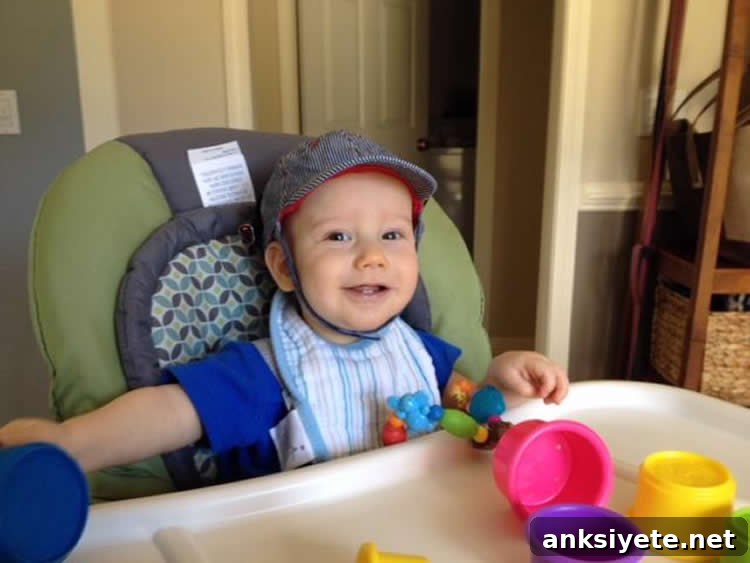
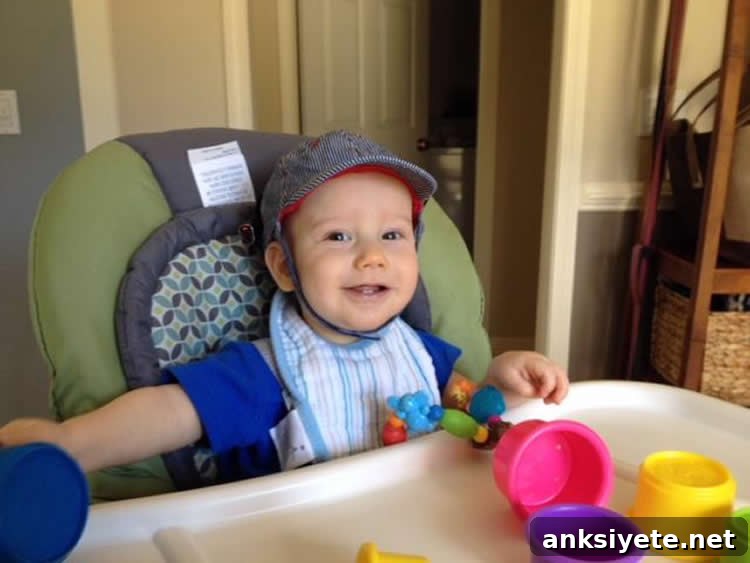
To explore how lab performance related to the everyday language infants hear, the research team collected day-long audio recordings from each infant’s point of view. Caregivers put a vest equipped with a small recorder on the child to capture natural interactions throughout a typical day. In addition, infants wore tiny hats with small video cameras for hour-long sessions, providing visual perspectives of caregiver-child interactions.
The research team analyzed these recordings to code and quantify features of the language input: which objects were named, the phrases used, who spoke, and whether the named objects were present and being attended to when they were mentioned.
“We found that the proportion of time parents talked about objects while those objects were visible and attended to by the infant correlated with the babies’ overall comprehension,” Bergelson said.
For example, if a caregiver holds up a pen and says, “Here is my favorite pen,” the infant can link the word pen to the visible object. By contrast, statements about events or objects that are not present—such as “Tomorrow we will see the lions at the zoo”—provide fewer immediate cues for meaning.
Sandra Waxman, professor of psychology at Northwestern University, who was not involved in the study, called the work “an exciting first step” in understanding how infants begin to learn words, how their earliest lexicons are organized, and how the surrounding language environment shapes that development.
Waxman cautioned that it is premature to prescribe specific speaking behaviors for caregivers based on a single study. “Before recommending precise approaches for parents, we need more research to disentangle the roles of culture, context and infant age in early word learning,” she said.
Bergelson’s practical advice for caregivers is straightforward: “Talk to your child as much as you can. They are listening and learning from what you say, even when it doesn’t look that way.”
Funding: The research was supported by grants from the National Institutes of Health (T32 DC000035, DP5-OD019812, HD-037082).
Benjamin Wolozin is Co-Founder and Chief Scientific Officer for Aquinnah Pharmaceuticals Inc.
Source: Kara Manke — Duke University
Publisher: Organized by NeuroscienceNews.com
Image Source: Image credited to the parents/Duke.
Original Research: Bergelson E. and Aslin R. N., “Nature and origins of the lexicon in 6‑mo‑olds,” Proceedings of the National Academy of Sciences. Published online November 20, 2017. DOI: 10.1073/pnas.1712966114
Nature and origins of the lexicon in 6‑mo‑olds
Previous research found that six-month-olds understand common nouns. This study asked whether the nascent lexicon of 6‑month-olds already shows hallmarks of mature lexical structure, such as cross-word relations, and whether features of the home language environment that relate to later vocabulary are detectable at this early stage. Using both in-lab comprehension measures and home recordings from the same infants, the authors found evidence of cross-word structure: infants looked more at named targets when the competing image was semantically unrelated than when it was related, mirroring patterns seen in older learners. They also found early links between home language input and lab comprehension: when referents of words were present and attended to in home recordings, infants’ comprehension in the lab tended to be stronger. These findings suggest that cross-word relations form early and that the home learning environment helps shape the emerging lexicon from the outset.