
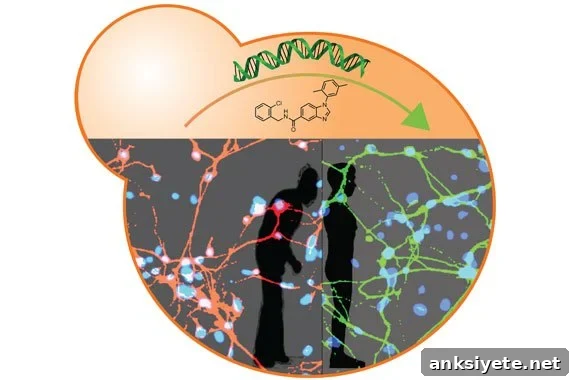
Whitehead Institute researchers have used a discovery platform that spans baker’s yeast to human stem cell–derived neurons to pinpoint a new drug target for Parkinson’s disease and a compound that repairs neurons from patients with the disease.
The platform and its capabilities are described in two papers published this week in Science. By combining simple model organisms with patient-derived human neurons, the approach could speed the identification of drug candidates that target the underlying biology of Parkinson’s and related neurodegenerative disorders—diseases for which no therapies currently halt or reverse progression.
Parkinson’s disease (PD), like Huntington’s and Alzheimer’s diseases, is marked by the misfolding and accumulation of proteins in neurons. In PD, buildup of the protein alpha-synuclein has long been linked to neuronal damage, making that protein a natural focus for therapeutic discovery. Traditional drug discovery often relies on target-based screens that test large libraries of compounds against purified proteins in vitro. Those assays are high-throughput but can miss important cellular context: compounds that act on an isolated protein may behave differently in living cells.
To capture cellular complexity, Susan Lindquist’s lab at the Whitehead Institute used phenotypic screens in living cells. Baker’s yeast, which preserves many core cellular mechanisms shared with human cells, served as a “living test tube” to study protein misfolding and search for compounds that reverse alpha-synuclein toxicity. Yeast engineered to overexpress alpha-synuclein provide a robust model for the cellular damage that contributes to PD.
“Phenotypic screening underexploits the power of living cells to reveal therapeutically relevant targets,” says Daniel Tardiff, a scientist in Lindquist’s lab and lead author on one of the Science papers. “By letting yeast biology guide us, we identify pathways and targets that actually reverse alpha-synuclein toxicity in a cellular context.”
Screening nearly 200,000 small molecules, Tardiff and collaborators discovered a compound that reversed alpha-synuclein toxicity in yeast and provided partial rescue in worm and rat neuron models. Treatment with the compound reduced cellular defects linked to alpha-synuclein, including impaired vesicular trafficking and elevated oxidative stress. Chemical optimization and synthesis support from the Buchwald lab at MIT enabled the team to show that the compound restores function to a key trafficking protein that had previously been considered difficult to drug.
To determine whether these findings translate to human neurons, Chee-Yeun Chung and Vikram Khurana led a second study examining neurons derived from induced pluripotent stem (iPS) cells made from Parkinson’s patients. The researchers generated neurons from patients carrying alpha-synuclein mutations that cause aggressive disease, and as controls they used genetically corrected iPS lines so pathologies could be attributed to the mutation itself.
Chung and Khurana mapped the cellular disturbances observed in the aging patient neurons to the pathways highlighted by the yeast model. Remarkably, the compound identified in the yeast screen reversed the neuronal damage in patient-derived neurons, acting through the same conserved target and pathway that yeast genetics had revealed.
“It was striking that a compound discovered in yeast rescued both simple and human neurons by acting on the same conserved mechanism—a target we might not have found without yeast genetics,” says Khurana, who is both a postdoctoral scientist in the Lindquist lab and a neurologist at Massachusetts General Hospital. The team believes the cellular defects they observed reflect early disease processes, raising the possibility that intervening on these targets could slow or prevent progression if treated early enough.
Finding robust disease-related phenotypes in patient-derived neurons was not guaranteed. Because neurodegenerative diseases are strongly linked to aging, many researchers expected it would be difficult to model key aspects of these disorders in cells grown in a dish. “We, like others, were skeptical that reprogrammed patient cells would reveal meaningful neurodegenerative phenotypes,” says Chung. “We validated these findings in post-mortem brain tissue as well, which gives us confidence that the abnormalities are relevant to the human disease.”
The team’s immediate next steps include chemically optimizing the compound and testing it in animal models. They also see broader potential in the combined yeast-to-human stem cell discovery pipeline for other neurodegenerative conditions for which yeast models exist.
“This work demonstrates the power of combining yeast genetics with human stem cell biology to identify druggable pathways and compounds that act on core disease pathology,” says Susan Lindquist, professor of biology at MIT and a Howard Hughes Medical Institute investigator. “As medical advances reduce deaths from cancer and heart disease, the societal impact of neurodegenerative diseases will continue to grow. We need robust discovery platforms like this to develop therapies that can prevent or slow these disorders.”
Notes about this neurogenetics and Parkinson’s disease research
This research was supported by the National Institutes of Health (grants 5R01GM069530, GM58160, K01 AG038546, and 5 R01CA084198), the Howard Hughes Medical Institute, the JPB Foundation, the Eleanor Schwartz Charitable Foundation, the Bachmann-Strauss Dystonia & Parkinson Foundation, the American Brain Foundation, and the Parkinson’s Disease Foundation.
Written by Matt Fearer
Contact: Matt Fearer – Whitehead Institute
Source: Whitehead Institute press release
Image Source: Image adapted from the Whitehead Institute press release. Image credit: Tom DiCesare/Whitehead Institute.
Original Research: Abstracts in Science for “Yeast Reveal a ‘Druggable’ Rsp5/Nedd4 Network that Ameliorates α−Synuclein Toxicity in Neurons” and “Identification and Rescue of α-Synuclein Toxicity in Parkinson Patient–Derived Neurons.”
#neurology, #Parkinsons, #neurodegeneration