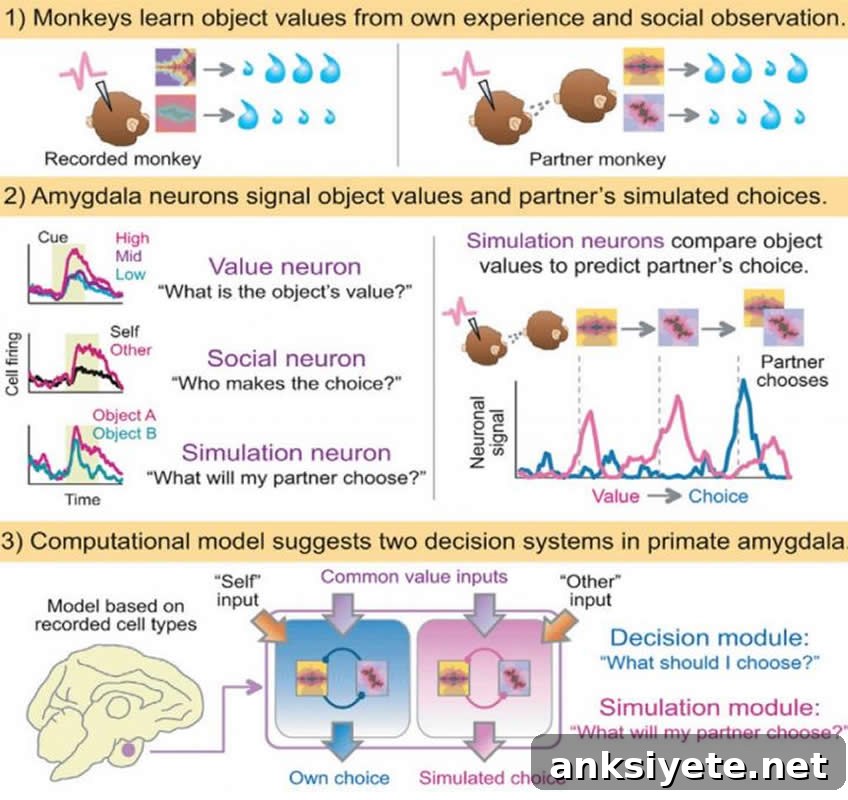
Summary: Newly identified “simulation neurons” in the amygdala enable animals to reconstruct the mental states of social partners and predict their intentions. Dysfunction in these neurons may contribute to social behavior disorders such as autism and social anxiety.
Source: UPF Barcelona
Psychologists and philosophers have long proposed that simulation is the mechanism people use to understand others’ minds, but the neural basis of this process was unclear. The amygdala, a brain region linked to social behavior and implicated in autism, had not been shown to support advanced social cognition such as simulating another individual’s decisions. A new study has identified a distinct type of neuron in the amygdala that learns from observing others’ decisions and spontaneously simulates their decision processes.
The researchers propose that malfunctioning simulation neurons could limit social understanding, a hallmark of autism spectrum conditions, while overactive simulation neurons might amplify perceived mental states of others and contribute to social anxiety.
The study, published 14 April in Cell, was led by Wolfram Schultz at the University of Cambridge and includes Gustavo Deco, ICREA research professor at the Department of Information and Communication Technologies (DTIC) and director of the Center for Brain and Cognition (CBC) at UPF.
The findings indicate that these “simulation neurons,” located in the amygdala within the temporal lobe, enable animals—and potentially humans—to reconstruct the mental states of social partners and thereby anticipate their choices.
The simulation of decisions supports social learning
Fabian Grabenhorst, the study’s first author and a researcher at the Department of Physiology, Development and Neuroscience at the University of Cambridge, explains: “We searched for neurons involved in social learning and were surprised to find that amygdala neurons do more than learn values from observed objects—they also use that information to simulate a partner’s decision.”
Simulating another’s decisions is an advanced cognitive operation central to social learning. Gustavo Deco, a co-author, gives a practical example: “By watching another individual forage, we can learn which foods are worth choosing. This knowledge not only informs our own choices but also helps us predict what others will choose in the future.”
To investigate, the team recorded amygdala neuron activity in monkeys during observational learning tasks. Monkeys were paired, facing one another with a touchscreen between them, and made reward-based choices for fruit juice. To maximize reward, each monkey had to learn and monitor the probability of reward associated with different images on the screen. Observing animals watched their partner’s choices and acquired the reward values of the images. When roles switched, the observing monkey could use this learned information on its own turn.
Surprisingly, when an animal observed its partner, certain neurons in the observer’s amygdala exhibited activity consistent with decision computations. These neurons predicted the reward value of the partner’s likely choices even before the partner acted—consistent with an internal simulation of the partner’s decision-making. Crucially, these decision-like activity patterns appeared spontaneously and well before the partner’s choices, without any requirement for the observer to make a decision at that moment.
The first computational model of amygdala circuits for social cognition
From their empirical results the researchers built the first computational model of amygdala circuits implicated in social cognition. According to Gustavo Deco, “Examining how specific neuron types interact, the model suggests that the amygdala contains a ‘decision circuit’ for an animal’s own choices and a separate ‘simulation circuit’ that predicts a social partner’s choices.”
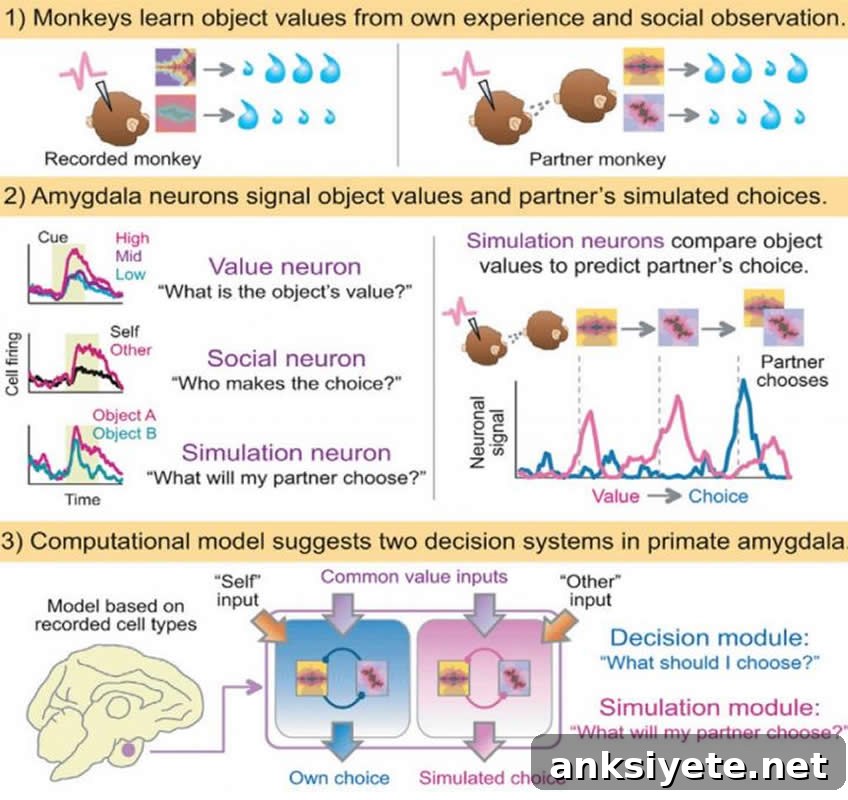
Simulation and decision neurons are intermingled within the amygdala. The computational model allowed the authors to distinguish these cell types and to characterize their distinct contributions—anatomical and functional details that would be difficult to resolve with human brain imaging, which averages activity across large neural populations.
Autism and social anxiety may reflect altered simulation circuitry
The authors suggest that impaired simulation neuron function could underlie reduced social cognition. Grabenhorst comments: “If simulation neurons don’t operate properly, an individual may struggle to engage with others’ mental states. We still know little about how particular neuron types shape social cognition and the difficulties experienced by people with autism. Identifying the specific neurons and circuit mechanisms for mental simulation opens new perspectives for understanding these conditions.”
Source:
UPF Barcelona
Media contacts:
Nuria Pérez – UPF Barcelona
Image source:
Image credited to UPF.
Original research (open access):
“Primate Amygdala Neurons Simulate Decision Processes of Social Partners.” Fabian Grabenhorst, Raymundo Báez-Mendoza, Wilfried Genest, Gustavo Deco, Wolfram Schultz. Cell. doi: 10.1016/j.cell.2019.02.042
Abstract
Primate Amygdala Neurons Simulate Decision Processes of Social Partners
Highlights
• Amygdala neurons derive object values from both personal experience and social observation.
• Simulation neurons convert object values into predictions of a social partner’s choices.
• Simulation neurons display signatures of decision computations during social observation.
• Simulation signals can arise from converging object-value and self-other signals.
Summary
By observing social partners, primates learn object reward values. This study shows that monkeys’ amygdala neurons derive values from observation and use those values to simulate another monkey’s decision process. While monkeys alternated making reward-based choices, amygdala neurons encoded object-specific values learned from observation. Dynamic activity converted these values into representations of the recorded monkey’s own choices. Unexpectedly, similar activity patterns occurred spontaneously before a partner’s choices in separate neurons, as if simulating the partner’s decision-making. These “simulation neurons” carried signatures of mutual-inhibitory decision computation—value comparisons and value-to-choice conversions—enabling accurate predictions of a partner’s choices. Population decoding revealed distinct contributions from different amygdala subnuclei. Biophysical modeling showed that simulation neurons can naturally emerge where object-value signals converge with self-other signals. By simulating decision computations during observation, these neurons could allow primates to reconstruct their social partners’ mental states.