
Summary: Researchers have identified connections deep in the brain that form a communication pathway linking regions responsible for emotion, decision-making, and movement. Cells within this network may also be potential targets in Parkinson’s disease.
Source: MIT.
Researchers suspect cells in this brain circuit could also be targets of Parkinson’s disease.
MIT neuroscientists have described a previously underappreciated neural pathway that links emotional and decision-making regions of the cortex with dopamine-producing neurons that influence movement and mood. The team calls these specialized connections “striosome–dendron bouquets.” Based on their anatomy and inputs, the researchers propose that these structures help the brain integrate emotional information when making difficult, anxiety-tinged decisions, and they may be vulnerable in Parkinson’s disease.
The discovery depended on expansion microscopy, a technique developed at MIT that physically enlarges preserved brain tissue before imaging. By expanding the tissue, scientists can resolve cellular and subcellular structures with much higher effective resolution than conventional light microscopy allows. This approach, combined with targeted labeling of cellular populations, enabled the researchers to trace the bouquet-like arrangements formed where striatal axons meet dopamine-containing dendrites.
Edward Boyden, an associate professor of biological engineering and brain and cognitive sciences at the MIT Media Lab, contributed to the development of the imaging approach used in the study. Jill R. Crittenden, a research scientist at the McGovern Institute, is the study’s lead author, and Ann M. Graybiel, an Institute Professor and member of the McGovern Institute, is the senior author. The research appeared in the Proceedings of the National Academy of Sciences.
Tracing a circuit
The researchers focused on the striatum, a subcortical component of the basal ganglia that plays a central role in habit formation, voluntary movement, motivation, and emotional processing. Within the striatum are distinct clusters of neurons known as striosomes. Earlier work from Graybiel’s lab showed that striosomes receive selective input from parts of the prefrontal cortex involved in processing emotions and assessing motivational value. That prior research also implicated striosomes in decisions that require weighing emotional costs and benefits.
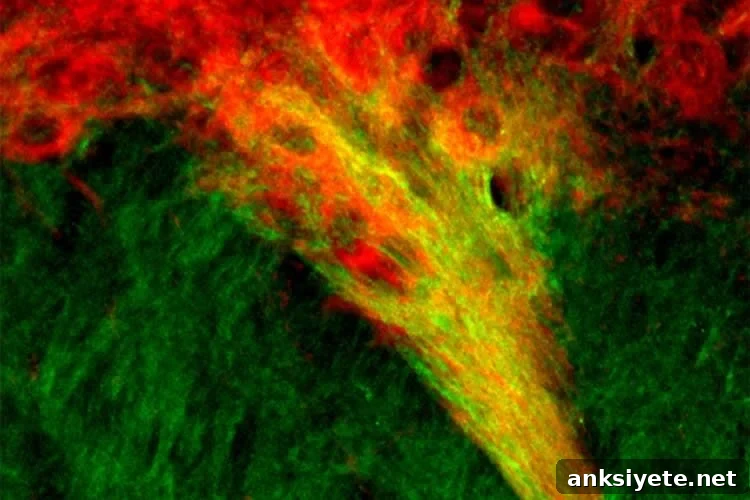
In the present study, the team used expansion microscopy to examine how striosomes communicate with dopamine-producing neurons in the substantia nigra, a major source of dopamine in the brain. They found that axons originating in striosomes form dense, bouquet-like arrays that interdigitate with ventrally projecting dendrites of dopamine neurons. These interwoven bundles create striking, rope-like structures in which many striosomal fibers are tightly associated with dopamine-containing dendrites and nearby nigral cell bodies.
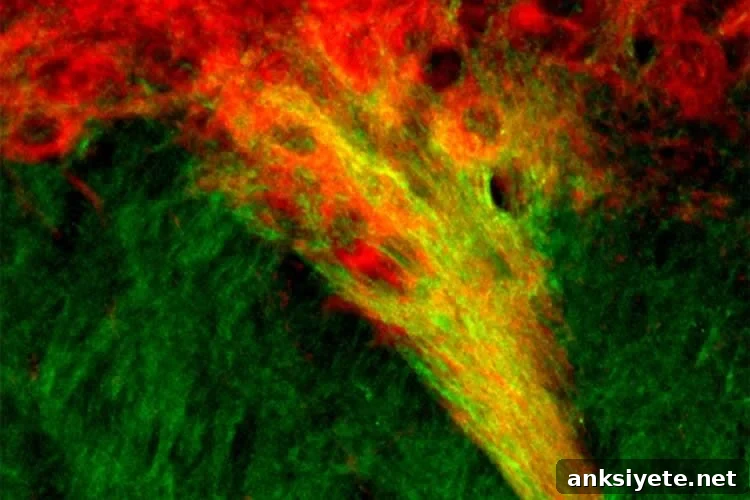
“Expansion microscopy allowed us to see direct physical connections between these cell groups by unraveling unusually intertwined bundles of axons and dendrites,” says Crittenden. The technique revealed specific, localized clusters of dopamine neurons that are the apparent targets of the striosomal bundles, suggesting a highly organized subcircuit within the larger nigrostriatal system.
Hard decisions
These findings broaden the known decision-making network to include a clear anatomical pathway from prefrontal cortical regions, through striosomes, to a subset of dopamine-producing neurons in the substantia nigra. Functionally, striosomes may act as integrative gatekeepers that collect emotionally relevant cortical input and convey a computed signal to dopamine neurons, which then initiate or modulate behavioral responses. This arrangement would allow emotional and motivational information to directly influence the dopamine signals that guide action and learning.
To test this functional model, the researchers plan experiments in mice that allow selective activation or inhibition of the striosome–dendron bouquets while animals perform tasks that require cost–benefit decision-making under anxiety-provoking conditions. These experiments will help determine whether manipulating this pathway alters choices in ways that reflect changes in emotional valuation.
The team also intends to examine whether these striosome–dendron connections are affected in models of Parkinson’s disease. Parkinson’s is characterized by the degeneration of dopamine neurons in the substantia nigra, and postmortem and imaging studies have shown broad loss of these cells in patients. Determining whether the dopamine neurons that form part of the striosome–dendron bouquets are preferentially lost or disrupted in Parkinson’s disease could clarify whether this circuit contributes to specific motor, mood, or decision-making symptoms.
About this neuroscience research article
Source: Anne Trafton – MIT
Image source: Image credited to the researchers.
Original research: The study is titled “Striosome–dendron bouquets highlight a unique striatonigral circuit targeting dopamine-containing neurons,” authored by Jill R. Crittenden, Paul W. Tillberg, Michael H. Riad, Yasuyuki Shima, Charles R. Gerfen, Jeffrey Curry, David E. Housman, Sacha B. Nelson, Edward S. Boyden, and Ann M. Graybiel, and published in Proceedings of the National Academy of Sciences.
Abstract
The authors describe striatonigral fibers arising from striosomes that form bouquet-like arborizations targeting ventrally directed dopamine-containing dendrites and clusters of nigral cell bodies. Retrograde tracing indicates those clustered nigral bodies project back to the striatum as part of the nigrostriatal loop. Expansion microscopy resolved many striosomal fibers tightly intertwined with dopamine dendrites and with afferents labeled by markers for glutamatergic, GABAergic, and cholinergic inputs, as well as astrocytic markers. The striosome–dendron bouquets may represent specialized integrative units within the dopaminergic nigral system, potentially important for reinforcement, decision-making, and disorders such as Parkinson’s disease.