
Some brain tumors are notoriously difficult to treat. Whether removed surgically, targeted with radiation, or treated with chemotherapy, they often return.
Many recurrent brain tumors owe their resilience to a subpopulation of cancer stem cells that survive therapy and regenerate new tumor tissue. These cells are more treatment-resistant and are capable of repopulating tumors after surgery, radiation, or chemotherapy.
Researchers at Washington University School of Medicine in St. Louis have identified a vulnerability in those tumor stem cells. The team found a critical regulatory pathway that tumor stem cells rely on to maintain their stem-like properties. When this pathway is disrupted, the cells lose their ability to drive tumor growth and invasion.
“This discovery may help us attack the root of some of the deadliest brain tumors,” said senior author Albert H. Kim, MD, PhD, assistant professor of neurological surgery. “A successful brain cancer treatment will very likely require blocking the tumor stem cells’ ability to survive and replenish themselves.”
The findings were published online June 11 in Cell Reports.
Kim’s laboratory focuses on glioblastoma, an aggressive and often fatal form of brain cancer that affects roughly 18,000 people in the United States each year. Median survival after diagnosis remains about 15 months, and only about 30 percent of patients live longer than two years.
Over the past decade, researchers have recognized that tumors such as glioblastomas are heterogeneous: some cancer cells are more therapy-resistant than others. Those resistant cells, often called glioblastoma stem-like cells or tumor stem cells, are particularly adept at re-establishing tumor growth after treatment.
“These tumor stem cells are really the kingpins of cancers — the cells that direct and drive much of the harm done by tumors,” Kim said. He treats patients at Siteman Cancer Center at Barnes-Jewish Hospital and Washington University School of Medicine.
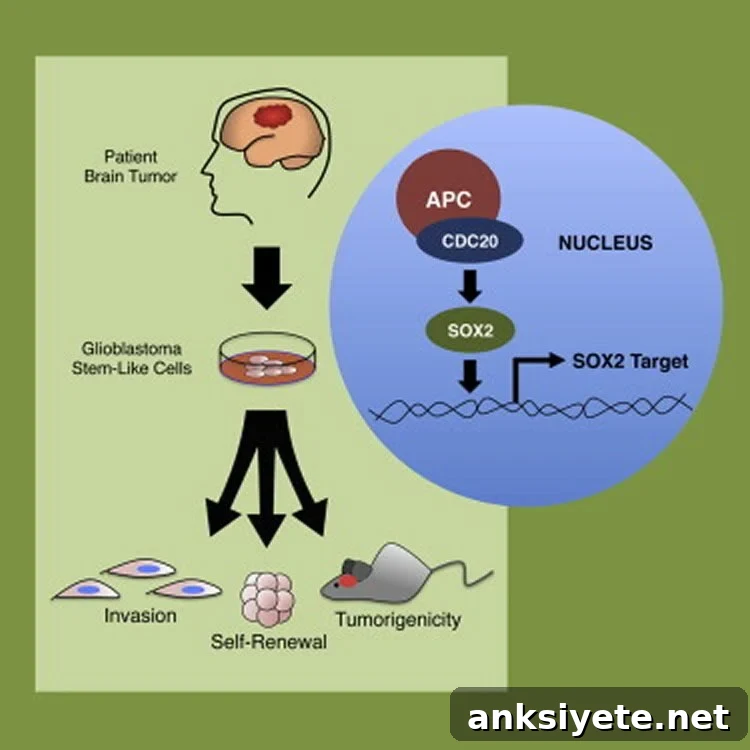
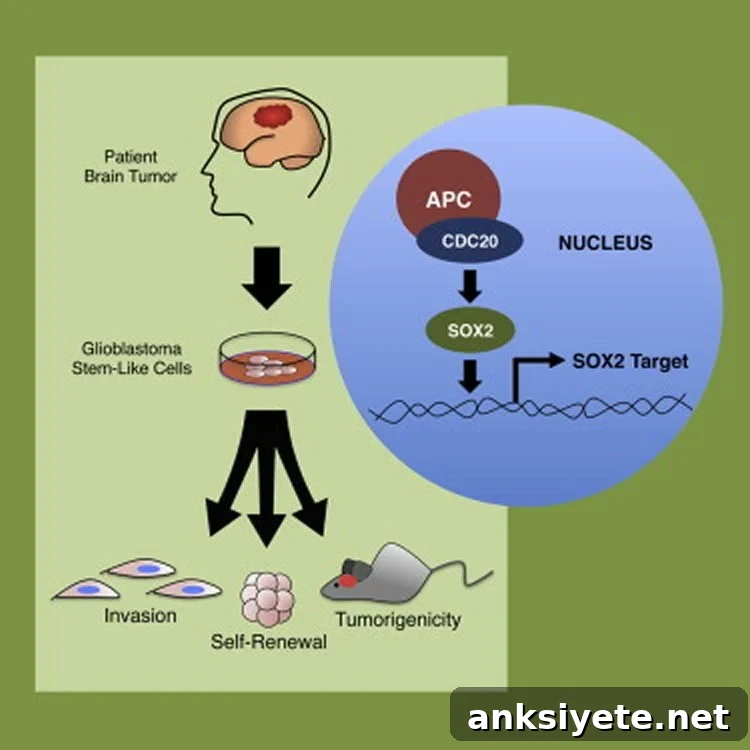
The team identified a protein called SOX2 that is active in glioblastoma stem-like cells as well as in healthy stem cells elsewhere in the body. SOX2 is a transcription factor known to support self-renewal and pluripotency in stem cells.
Further experiments revealed that the production of SOX2 in tumor stem cells is controlled by another protein, CDC20, which acts through the anaphase-promoting complex (APC). When CDC20 levels were increased, SOX2 expression rose and tumor cells became more capable of forming aggressive growths after being transplanted into mice. Conversely, reducing CDC20 levels curtailed SOX2 production and sharply diminished the stem-like cells’ ability to form tumors.
“The rate of growth in some tumors lacking CDC20 dropped by 95 percent compared with tumors with more typical levels of CDC20,” Kim said.
Analysis of human glioblastoma samples supported the experimental findings: patients whose tumors showed high CDC20 expression tended to have shorter survival after diagnosis, indicating that CDC20 may hold prognostic value in certain glioblastoma subtypes.
Kim’s laboratory is now testing strategies to block CDC20 activity in glioblastoma. One approach under investigation is RNA interference, a method that selectively reduces production of target proteins. RNA interference and related molecular therapies are already being evaluated in clinical trials for other cancers and diseases.
Funding: This research was supported by the National Institutes of Health (NIH), grants K08NS08110, K01AG033724 and P50CA094056; the American Cancer Society; Voices Against Brain Cancer; the Elsa U. Pardee Foundation; the Concern Foundation; and the Duesenberg Research Fund.
Source: Michael C. Purdy – WUSTL
Image Credit: The researchers / Cell Reports
Original Research: “A CDC20-APC/SOX2 Signaling Axis Regulates Human Glioblastoma Stem-like Cells,” Mao DD et al., Cell Reports. Published online June 11, 2015. doi:10.1016/j.celrep.2015.05.027
Abstract
A CDC20-APC/SOX2 Signaling Axis Regulates Human Glioblastoma Stem-like Cells
Highlights
• CDC20-APC drives the invasiveness and self-renewal of glioblastoma stem-like cells
• CDC20 is essential for the in vivo tumorigenicity of glioblastoma stem-like cells
• CDC20-APC operates through SOX2 to control glioblastoma stem-like cell function
• CDC20 is prognostic of overall survival in Proneural subtype glioblastoma patients
Summary
Glioblastoma contains a dynamic subpopulation of glioblastoma stem-like cells (GSCs) that can propagate tumors in vivo and resist standard chemoradiation. Identifying the cell-intrinsic mechanisms that sustain this clinically important cell state could point to new therapeutic strategies. The researchers demonstrate that the mitotic E3 ubiquitin ligase CDC20, acting with the anaphase-promoting complex (CDC20-APC), promotes invasiveness and self-renewal of patient-derived GSCs. CDC20 knockdown reduced, and CDC20 overexpression increased, the ability of human GSCs to form brain tumors in an orthotopic xenograft model. CDC20-APC controls GSC invasion and self-renewal by regulating the pluripotency transcription factor SOX2. These results define a CDC20-APC/SOX2 signaling axis that governs key biological properties of GSCs and suggest that targeting CDC20-APC could be a promising strategy in glioblastoma treatment.