
Summary: Researchers report that a woman’s attraction to a man can increase when his photo receives higher ratings from others. The same social influence was observed for abstract art.
Source: University at St. Andrews.
Researchers from the Universities of St Andrews, Durham, Exeter and Arizona State report that people’s preferences are shaped by others’ choices: men receive an “attractiveness boost” when chosen by others, and the same effect applies to non-social stimuli such as abstract artwork.
A team led by Dr Kate Cross from the School of Psychology and Neuroscience at the University of St Andrews published a study in Scientific Reports (29 January) that questions the idea that human mate-choice copying is a specialised evolutionary adaptation favouring women who prefer men already chosen by other women.
Mate-choice copying refers to a tendency seen in many animals, where an individual finds a potential mate more attractive if that mate has already been chosen by another. In birds and fish, for example, this behaviour can help females identify high-quality males and may offer an evolutionary advantage by guiding mate selection toward proven partners.
Previous human studies suggested that women may be particularly drawn to men who are already partnered, on the assumption that those men have desirable qualities such as faithfulness or kindness. The new research casts doubt on whether this effect is specific to mate choice. Instead, it proposes that human judgments of attractiveness may be shaped by a broader social influence: people copy others’ preferences across different types of stimuli, not only potential mates.
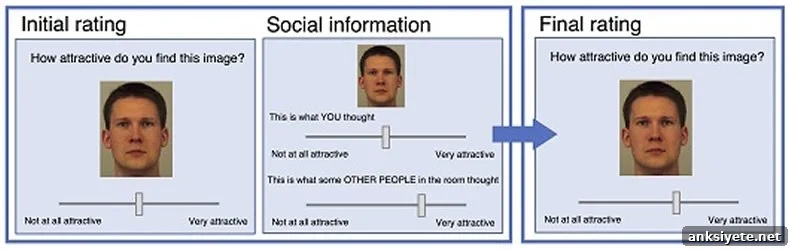
In the experiment, heterosexual women provided attractiveness ratings for photographs of men’s faces, images of men’s hands, and abstract artworks. After participants saw genuine social information — real-time ratings supplied by peers — their judgments changed. Faces were rated higher when peers had rated them highly, but so were images of hands and abstract art. In other words, social information influenced preferences across all categories tested, and faces were not uniquely affected.
Dr Cross, the study’s lead author, explained: “Women in our study judged men’s faces as more attractive when other women had given the face high ratings. Crucially, the same pattern emerged for abstract artworks. Women appear to copy one another’s preferences, but this may reflect a general tendency to be influenced by the opinions of others rather than a specialised mate-choice mechanism.”
The researchers also tested whether sexual orientation affected the pattern. Including lesbian and bisexual women did not change the results, suggesting that the same social influence operates regardless of whether participants consider men to be potential partners. This finding supports the interpretation that social conformity or general social learning, rather than a mate-specific cognitive adaptation, underlies the observed effect.
Dr Sally Street, Assistant Professor in the Department of Anthropology at Durham University and a co-author of the paper, commented: “Social influence affects many areas of our lives, and partner choice could be one of them. At present, however, there is no clear experimental evidence to confirm a specialised mate-choice copying mechanism in humans.”
The study’s results encourage a broader view of how social information shapes preferences. When people rate attractiveness—whether of faces, body parts, or artworks—the opinions of others play a significant role. This suggests that social learning in humans may be domain-general, applying across diverse stimuli, rather than confined to mate selection.
Source: University at St. Andrews
Publisher: Organized by NeuroscienceNews.com.
Image source: Image adapted from the University at St. Andrews news release.
Original research: Open access research published in Scientific Reports.
doi: 10.1038/s41598-018-19770-8
University at St. Andrews. “Mate-choice copying in humans – Are all the taken men good?” NeuroscienceNews, 29 January 2018.
Abstract
Human mate-choice copying is domain-general social learning
Women in this study copied other women’s preferences for men’s faces, but this copying extended equally to preferences for images of men’s hands and for abstract art. Previous interpretations of mate-choice copying in humans have suggested the presence of psychological adaptations specialised for processing social information related to mate selection, with faces thought to be particularly salient. However, no prior experiment directly compared copying of face preferences with copying of other types of preferences, and earlier work often relied on artificial social cues rather than genuine peer responses. This study collected attractiveness ratings for men’s faces, men’s hands, and abstract art from heterosexual women before and after they viewed authentic social information gathered in real time from peers. Social information influenced ratings in all categories to a similar degree, suggesting that evidence for domain-specific social learning mechanisms in humans is weaker than previously proposed.