
Summary: Comparing the transcriptomes—the full map of gene activity—across many brain disorders reveals shared molecular signatures, clarifies relationships among diseases, and offers a promising path toward more accurate diagnosis and improved treatment strategies.
Source: PLOS
New research from Yashar Zeighami and colleagues at McGill University presents a molecular approach to characterize and compare brain diseases.
Published in PLOS Biology on April 20, the study analyzes disease-specific transcriptomes—the patterns of RNA expression from affected brain regions—for 40 human brain disorders. By mapping where and in which cell types disease-associated genes are active, the researchers derived a transcriptome-based classification that groups diseases according to shared molecular and cellular signatures rather than only by clinical symptoms. This transcriptomic perspective helps explain disease mechanisms, reveals links among seemingly different conditions, and could improve diagnostic accuracy and therapeutic decision-making.
Traditional clinical classification of brain diseases is often challenging because many conditions share overlapping symptoms and arise from complex mixes of genetic and environmental risk factors. For example, Parkinson’s disease and dementia with Lewy bodies are both neurodegenerative disorders that can present with tremor and rigidity as well as overlapping cognitive and behavioral features. Such overlap contributes to misdiagnosis and can delay appropriate treatment. The transcriptome-based method offers an independent molecular framework that complements clinical assessment and imaging.
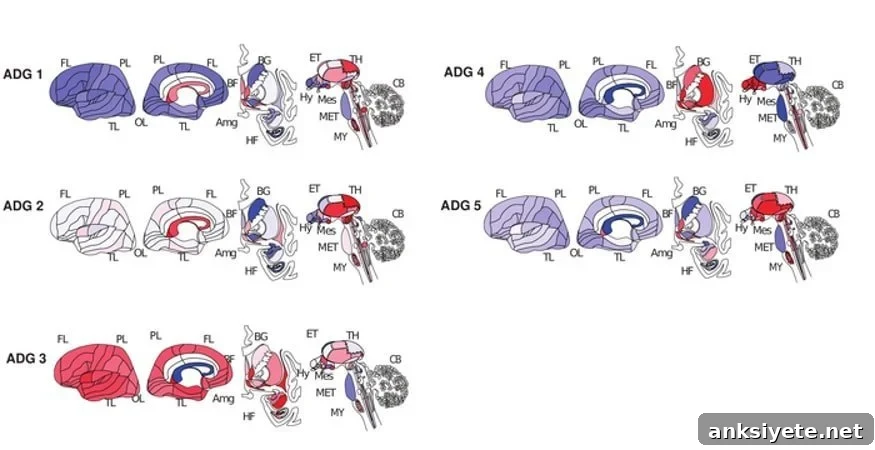
The authors compared transcriptomic profiles across 40 disorders and identified five major anatomic transcriptional groups. These groups reflect distinct anatomical and cell-type patterns of gene expression linked to disease risk. Beyond confirming known disease relationships, the analysis uncovered previously unrecognized associations. For instance, language development disorders, obsessive-compulsive disorder, and temporal lobe epilepsy were placed together in one group, indicating that risk genes for these diverse conditions are active in the same brain regions and cell types despite differing clinical presentations.
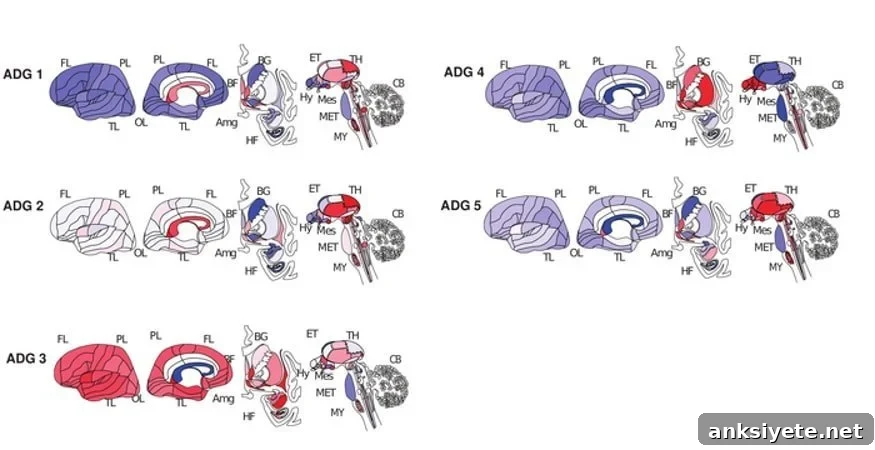
The five major transcriptional patterns identified encompass tumor-related conditions, neurodegenerative diseases, psychiatric and substance-use disorders, and two mixed groups that predominantly affect basal ganglia and hypothalamic systems. When focusing on cortical diseases, single-nucleus RNA data from the middle temporal gyrus revealed a gradient of cell-type expression that distinguishes neurodegenerative, psychiatric, and substance-abuse related disorders. Notably, psychiatric diseases showed distinct enrichment in certain excitatory neuron subtypes, highlighting how cell-type resolution adds diagnostic and mechanistic detail.
The study also compared homologous cell types between mouse and human brains. While many disease risk genes act within equivalent cell types across species, the expression patterns can be species-specific, underscoring both the value and the limits of animal models for studying human brain disorders.
By providing a reproducible, transcriptome-driven classification, this work offers a molecular strategy for grouping and comparing brain diseases that can supplement traditional clinical taxonomy. Transcriptome-based groupings may help clinicians recognize atypical presentations, predict comorbid risks, and identify candidate targets for therapeutic development. In research contexts, this approach can prioritize which disorders share underlying biological pathways and therefore might benefit from shared treatment strategies or combined study designs.
Zeighami and colleagues summarize the approach: analyzing transcription patterns of disease-associated genes reveals characteristic expression signatures across brain anatomy and cell types. These molecular signatures allow comparison and aggregation of diseases in ways that can differ from conventional phenotype-based classifications, potentially revealing novel disease relationships that matter for diagnosis and therapy.
About this genetics and neurology research news
Author: Claire Turner
Source: PLOS
Contact: Claire Turner – PLOS
Image: Image credited to Zeighami Y, et al., 2023, PLOS Biology, CC-BY 4.0
Original Research: Open access. “A comparison of anatomic and cellular transcriptome structures across 40 human brain diseases” by Yashar Zeighami et al., PLOS Biology
Abstract
A comparison of anatomic and cellular transcriptome structures across 40 human brain diseases
Genes linked to risk for brain disorders exhibit distinct expression patterns that reflect anatomical distribution and cell-type specificity. Brain-wide transcriptomic patterns provide molecular signatures—based on differential co-expression—that are often unique to each disease. Comparing these signatures allows diseases to be grouped and aggregated by shared molecular profiles, sometimes uniting conditions from varied clinical classes.
Analyzing 40 common human brain diseases, the study identifies five principal transcriptional patterns that correspond to tumor-related, neurodegenerative, psychiatric and substance-use disorders, and two mixed groups affecting basal ganglia and hypothalamic regions. For cortex-enriched diseases, single-nucleus data from the middle temporal gyrus reveal a cell-type expression gradient that separates neurodegenerative, psychiatric, and substance-abuse conditions, with specific excitatory neuron populations distinguishing psychiatric disorders.
Cross-species mapping indicates that many disease risk genes act within conserved cell types while exhibiting species-specific expression nuances. Overall, these results document structural and cellular transcriptomic relationships of disease-associated genes in the adult brain and propose a molecular framework for classifying and comparing brain disorders, with potential to uncover new disease associations and guide future diagnostic and therapeutic work.