
Summary: New research maps how anxiety shifts decision-making in the brain, biasing choices toward avoidance and pessimism.
Source: Kyoto University
Is a higher-paying job worth an extra hour of commuting each day? Many decisions force us to weigh potential rewards against anticipated discomfort. New findings show that anxiety tilts this internal cost–benefit balance, making people more likely to avoid options they judge as risky or unpleasant.
Previous studies have shown that mental states shape this balance: anxiety amplifies avoidant drives, while depression often reduces the motivation to pursue rewards. Yet the neural circuitry behind these shifts has been only partially understood. A team of neuroscientists at Kyoto University’s Institute for Advanced Study of Human Biology (WPI-ASHBi) has reviewed years of experimental work in nonhuman primates and rodents and linked those results to human brain data to clarify how anxiety alters choice.
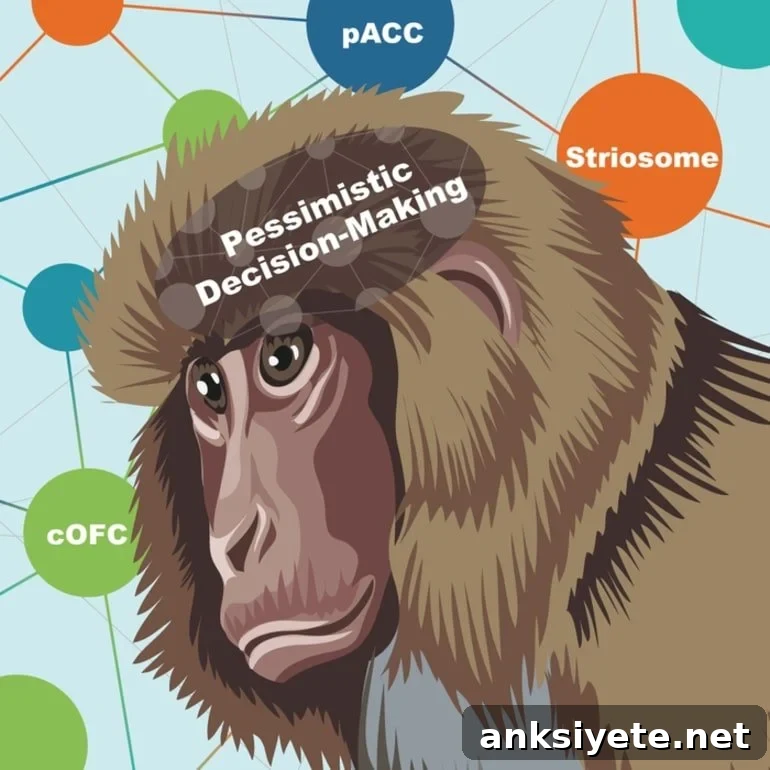
Publishing in Frontiers in Neuroscience, the researchers synthesize electrophysiology, microstimulation, and viral-tracing experiments to identify brain regions and networks that causally influence pessimistic decision-making. Their work highlights the anterior cingulate cortex (ACC)—in particular the pregenual ACC (pACC)—and its connections with striosomes in the striatum and with parts of the orbitofrontal cortex (OFC) as central nodes in this process.
Anatomically, the ACC sits in a midline position of the frontal lobes and integrates emotional and cognitive signals from many brain regions. The research group recorded neuronal activity in rhesus macaques performing a modified approach–avoidance task in which each option combined a food reward with varying intensities of an aversive air blast. Monkeys chose with a joystick while visual cues indicated the trade-offs, allowing researchers to quantify the amount of discomfort the animals would tolerate for a given reward.
Neural recordings revealed distinct populations of ACC neurons whose activity tracked reward magnitude and punishment level. Neurons that signaled avoidance and pessimistic evaluation were concentrated in the pACC, a region previously implicated in human mood and anxiety disorders. Applying low-level microstimulation in the pACC shifted monkeys’ behavior toward rejection of reward options—an experimentally induced pessimism that mimicked anxiety-related avoidance. Notably, this effect was reversible with diazepam, an anxiolytic drug, demonstrating a causal link between pACC activation and pessimistic choice.
To map how the pACC influences other brain areas, the team used anterograde viral tracers that cause infected neurons to express fluorescent markers, revealing projection pathways under the microscope. These tracing experiments showed that effective sites in the pACC project to striosome compartments within the anterior striatum. Striosomes have long been enigmatic, but this work connects them to decision circuits that modulate reward processing and dopamine signaling.
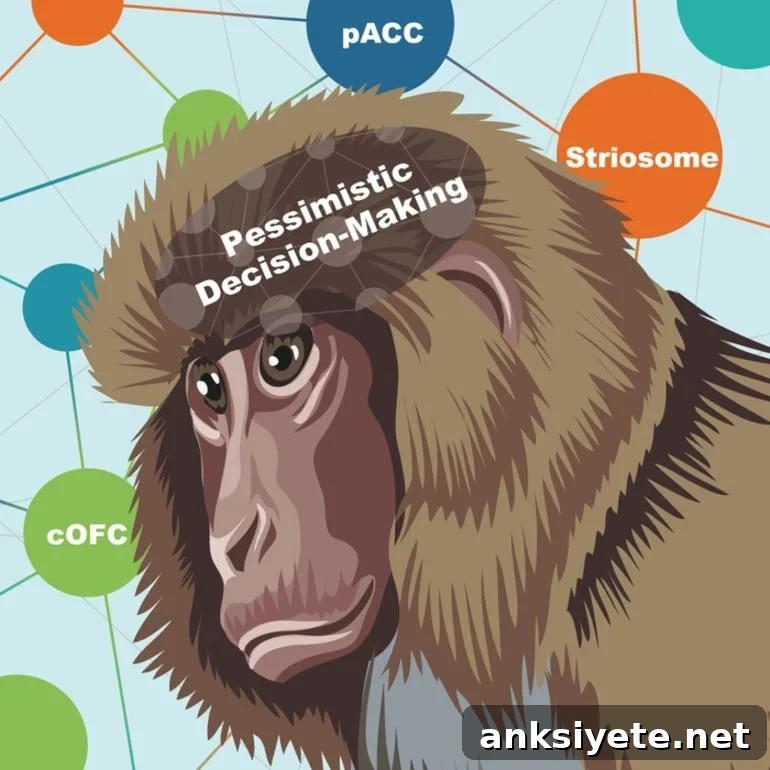
The researchers also observed a parallel influence from the caudal orbitofrontal cortex (cOFC). Microstimulation and tracing in this OFC subregion produced similar increases in avoidance and shared many downstream connections with the pACC, including projections to the striosome-rich anterior striatum, portions of the caudate tail, subgenual ACC, amygdala, and thalamus. These overlapping connectivity patterns suggest that pACC and cOFC act as coordinated nodes within a broader network that can bias choices toward pessimism under anxious conditions.
Findings from macaques were compared with human neuroimaging literature and show strong parallels in activation and connectivity patterns, supporting the idea that similar mechanisms underlie anxiety-linked decision biases across primates. By identifying specific circuit elements—pACC, cOFC, and striosomes—that causally modify approach–avoidance choices, the study points to network-targeted strategies for treating maladaptive anxiety and related disorders.
Ken-ichi Amemori, associate professor at Kyoto University’s ASHBi, emphasizes the clinical relevance: “With rising rates of anxiety, understanding how anxious states change decision-making is crucial. Our primate studies identify specific cortical and striatal nodes that drive avoidant behavior, offering targets for future interventions that aim to normalize these pathways.”
About this anxiety research news
Source: Kyoto University
Contact: Tomoki Shimizu – Kyoto University
Image: The image is credited to Kyoto University
Original Research: Open access.
“Causal Evidence for Induction of Pessimistic Decision-Making in Primates by the Network of Frontal Cortex and Striosomes” by Amemori et al. Frontiers in Neuroscience
Abstract
Causal Evidence for Induction of Pessimistic Decision-Making in Primates by the Network of Frontal Cortex and Striosomes
Clinical imaging studies have linked anxiety disorders to coactivation across limbic cortical regions and basal ganglia, forming a large-scale brain network. How such networks causally produce anxiety-like states and alter decision-making has been unclear. This review summarizes a program of experiments in macaques that provide causal evidence linking focal cortical and striatal sites to pessimistic choices.
Using a primate-adapted approach–avoidance task, the investigators combined behavioral measures, microstimulation, and viral tract tracing to identify regions where stimulation increased avoidance. The pregenual ACC (pACC), a caudal sector of the OFC (cOFC), and parts of the caudate nucleus were among the effective sites. These cortical zones preferentially project to striosomes in the anterior striatum, which in turn connect with dopamine-rich midbrain structures implicated in reward processing.
The convergent projections from pACC and cOFC to common targets—including striosomes, caudate tail, subgenual ACC, amygdala, and thalamus—support a model in which a distributed circuit mediates pessimistic judgment by modulating dopaminergic function. These findings offer a circuit-level framework for understanding how anxiety can bias decision-making and suggest candidate pathways for targeted therapies.