
Scanning fruit fly brains reveals how neural signals shape circadian behaviors
Researchers at Washington University School of Medicine in St. Louis have uncovered how different groups of timekeeping neurons in the brain become active at distinct times of day, even though they share the same molecular clock. Their results illuminate how daily rhythms are translated into neuronal activity that drives behavior. The study was published in Science on February 26.
Daily rhythms—driven by the circadian clock—are ubiquitous across life on Earth, organizing sleep and wake cycles, hormone release, body temperature and cognitive performance. In animals, a master clock in the brain helps coordinate these rhythms. The clock’s biochemical core consists of a small set of proteins whose concentrations rise and fall on a roughly 24-hour schedule.
Yet some circadian-controlled behaviors occur more than once per day. For example, the common fruit fly (Drosophila) shows two peaks of activity each day: one in the morning and one in the evening. How a single molecular peak can produce multiple behavioral peaks has been a long-standing question.
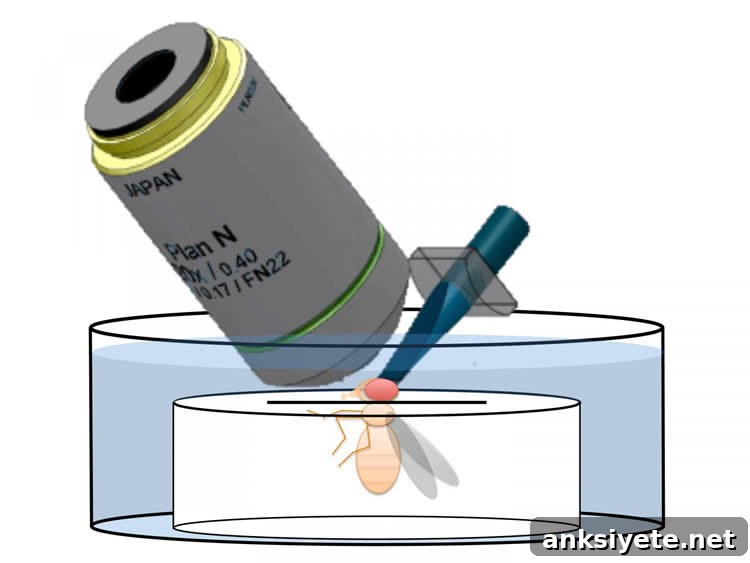
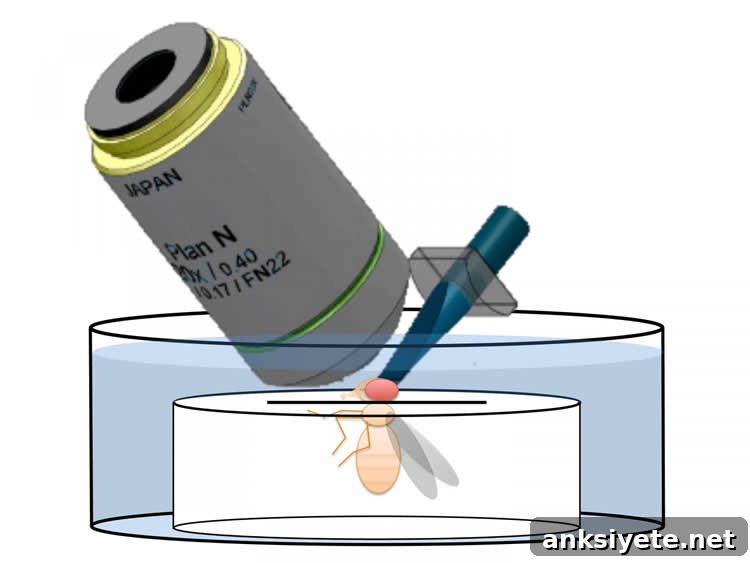
To investigate, senior investigator Paul Taghert, PhD, together with graduate student Xitong Liang and Timothy Holy, PhD, performed continuous brain imaging in living fruit flies. Liang scanned whole fly brains every 10 minutes for 24 hours, measuring intracellular calcium as a proxy for neuronal activation. Fruit flies are an ideal model for such experiments because their circadian system is compact—about 150 pacemaker neurons—compared with thousands in mammalian systems.
The imaging revealed that distinct groups of pacemaker neurons each show a unique phase of calcium activity. These phases are shaped by environmental cues such as day length and by the internal molecular clock. Notably, one group of pacemaker neurons became active roughly four hours before the fly’s morning activity peak, while another group became active about four hours before the evening peak. In other words, although molecular clock signals are synchronous across the network, the neurons’ calcium activity is staggered to time behavior at different times of day.
“Different neuronal groups partition the clock’s timing,” said Holy. “One set of cells becomes active to promote morning activity, while another set delays its peak until later in the day—even though their molecular clocks are aligned.”
Genetic experiments identified the neuropeptide pigment-dispersing factor (PDF) as a key chemical signal that helps create this temporal diversity. Morning pacemaker neurons secrete PDF, and the peptide acts on other pacemaker groups to shift when they become active. In flies lacking the PDF receptor, the normally staggered calcium waves became synchronized at dawn. That increased synchrony disrupted the normal morning-evening activity pattern, demonstrating that PDF-mediated modulation is essential for spacing timing signals across the network.
These observations challenge the earlier assumption that neuronal activity simply mirrors the peak expression of clock proteins. “The prevailing view was that cellular activity follows the molecular clock,” Taghert explained. “Our data show that some neurons decouple their activity from the molecular peak to spread timing signals across the day.”
Achieving these measurements required advances in imaging technology. Holy’s lab developed a microscope capable of gently illuminating the tiny fly brain for extended periods, minimizing photodamage while capturing high-quality images. The system illuminates only the brain region in focus and rapidly moves between regions, covering the entire fly brain in under a second. This ability to monitor activity across distant brain areas over long time spans made the study possible.
Because the biochemical foundations of circadian timing are conserved across species, the neuronal mechanism revealed in Drosophila may point to a broader principle by which circadian networks generate multiple behavioral outputs from a single molecular rhythm. Further research will determine how widely this mechanism applies to other animals.
Funding: This work was supported by the Washington University McDonnell Center for Cellular and Molecular Neurobiology and by the National Institutes of Health (NIH), grants R01 NS068409, R01 DP1DA035081 and R01 MH067122-11.
Source: Judy Martin Finch, Washington University School of Medicine
Image credit: Taghert lab, Washington University
Original research: Liang X., Holy T. E., and Taghert P. H., “Synchronous Drosophila circadian pacemakers display nonsynchronous Ca2+ rhythms in vivo,” Science, published online February 26, 2016. DOI: 10.1126/science.aad3997.
Abstract (summary)
In Drosophila, a network of roughly 150 pacemaker neurons translates molecular clock signals into circadian behavior. Brainwide calcium imaging in vivo over 24 hours showed that pacemaker groups exhibit daily intracellular Ca2+ rhythms timed by molecular clocks and environmental cues—but these rhythms are not synchronous. Each group has its own activation phase, with morning- and evening-associated groups peaking about four hours before the corresponding behavioral activity. Loss of the receptor for the neuropeptide PDF increases synchrony of Ca2+ waves, indicating that neuropeptide signaling is necessary to sequentially time outputs from an otherwise synchronous molecular clock network.