
Summary: Researchers report that when copper is lacking, fat accumulates in fat cells instead of being released and used for energy.
Source: UC Berkeley.
Copper puts a brake on a brake of fat burning, suggesting a possible role in obesity and diabetes.
Could insufficient copper contribute to the rising rates of obesity?
Although small amounts of copper are essential to health and are found in foods such as oysters, liver, beans and nuts, its role in metabolism has been debated. Some studies suggested copper enhances fat burning, while others indicated it could suppress it. New research from the University of California, Berkeley, Lawrence Berkeley National Laboratory and the Howard Hughes Medical Institute clarifies copper’s critical role: copper helps mobilize stored fat from adipocytes (fat cells) into the bloodstream so it can be used as energy.
When copper is deficient, fat accumulates in adipocytes and is not efficiently mobilized, says Christopher Chang, Class of 1942 Chair and professor of chemistry and molecular and cell biology at UC Berkeley. Chang, who is also a faculty scientist at Berkeley Lab and an HHMI investigator, explains that copper serves as a signaling molecule that activates the fat-burning process. “Our study shows definitively how copper works — it’s a signal that turns on fat cells,” he said. “If we could find ways to increase the efficiency of fat burning, that could have important implications for addressing obesity and diabetes.”
The study was published online and appears in the July print issue of Nature Chemical Biology. Beyond this metabolic role, the findings reinforce broader evidence that copper functions as a signaling element in the body. Chang’s earlier work showed copper helps regulate neuronal activity by preventing over-excitation of nerve cells. Together these discoveries suggest copper joins sodium, potassium, calcium and zinc as an element that participates in cellular signaling.
Researchers increasingly see links between the nervous system and metabolic disease. “Some of us are now thinking about obesity as having a neurological component in addition to metabolic factors,” Chang said. Neural regulation of fat tissue may explain connections between the brain, metabolic function and inflammatory processes, and it opens new possibilities for basic science and therapeutic approaches.
Chang cautions against self-prescribing copper supplements based on these findings: excess copper can disrupt the balance of other essential minerals such as zinc and can be harmful.
Copper-related diseases
Motivated by an enduring interest in how metals influence biology, Chang investigated fat metabolism after learning that copper is sometimes added to cattle feed to influence weight gain. To study the mechanism, his team examined mice that carry a genetic defect producing symptoms similar to Wilson’s disease, a rare human disorder. In both the mouse model and Wilson’s disease, a mutated enzyme that normally transports copper in and out of cells causes copper to accumulate in the liver, often to toxic levels. These conditions are also associated with enlarged fat cells.
Postdoctoral researchers Lakshmi Krishnamoorthy and Joseph Cotruvo Jr. helped show that in the mice, copper becomes concentrated in the liver, leaving fat cells relatively starved for copper. As a result, fat tissue cannot properly regulate storage and breakdown of lipids in organs such as the stomach and pancreas, and blood lipid levels are lower than normal.
“Lipolysis is the breakdown of larger fat stores into smaller molecules that can circulate and be used as energy throughout the body,” Chang explained. “In our Wilson’s disease mouse model, fat cells with low copper were less able to carry out lipolysis compared with normal mice.”
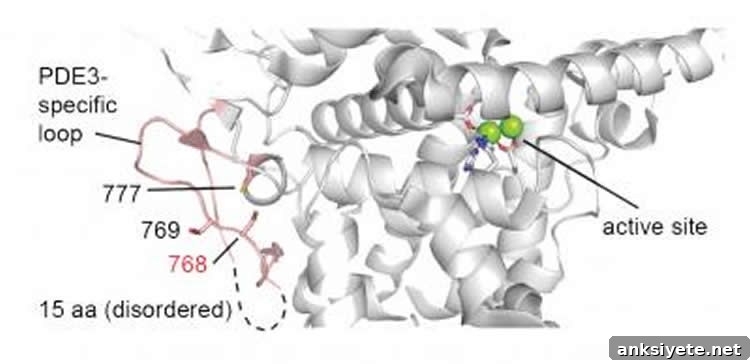
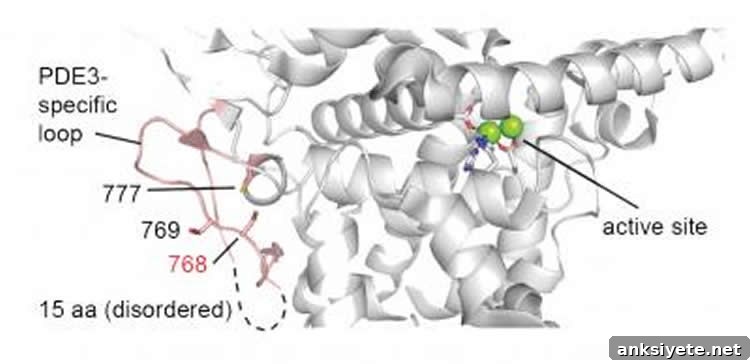
The team discovered the molecular mechanism: copper lifts a biochemical brake on fat burning. Normally, the second messenger cyclic AMP (cAMP) activates enzymes that break down stored fats. The phosphodiesterase PDE3 (specifically PDE3B in adipocytes) degrades cAMP, acting as a brake to prevent unnecessary fat breakdown. Copper inhibits PDE3B, thereby blocking the enzyme that degrades cAMP — in effect “putting a brake on a brake” — which allows cAMP levels to rise and stimulates lipolysis.
Biochemical experiments identified a conserved cysteine residue in a PDE3-specific loop that is essential for copper-dependent inhibition of PDE3B. These results demonstrate that copper directly modulates enzyme activity to regulate cAMP-dependent lipolysis.
Chang and colleagues continue to explore copper’s roles in the brain and in peripheral metabolism, including possible strategies to target the copper regulatory pathway to treat neurodegenerative disorders and metabolic diseases. They are also investigating how copper influences perception, sleep and the connections between the central and peripheral nervous systems that may underlie disease processes.
Funding: This work was supported by the National Institutes of Health (grant numbers GM 79465, GM067166, GM101502).
Source: Robert Sanders, UC Berkeley.
Image credit: Lakshmipriya Krishnamoorthy and Joseph Cotruvo Jr., UC Berkeley.
Abstract
Copper regulates cyclic-AMP-dependent lipolysis
Cell signaling is typically associated with redox-inactive metal ions such as sodium, potassium, calcium and zinc, while redox-active transition metals like copper have been viewed mainly as static enzyme cofactors. This study reports that copper is an endogenous regulator of lipolysis, an essential process for maintaining body weight and energy balance. Using a mouse model of genetic copper misregulation, together with pharmacological manipulation of copper status and imaging in 3T3-L1 white adipocytes, the researchers found that copper controls lipolysis by modulating the second messenger cyclic AMP (cAMP) through inhibition of the cAMP-degrading phosphodiesterase PDE3B. Biochemical characterization of the copper–PDE3B interaction demonstrates copper-dependent inhibition of enzyme activity and identifies a conserved cysteine residue in a PDE3-specific loop as critical for the copper-dependent lipolytic phenotype.
“Copper regulates cyclic-AMP-dependent lipolysis” by Lakshmi Krishnamoorthy, Joseph A. Cotruvo Jr., Jefferson Chan, Harini Kaluarachchi, Abigael Muchenditsi, Venkata S. Pendyala, Shang Jia, Allegra T. Aron, Cheri M. Ackerman, Mark N. Vander Wal, Timothy Guan, Lukas P. Smaga, Samouil L. Farhi, Elizabeth J. New, Svetlana Lutsenko and Christopher J. Chang. Nature Chemical Biology. Published online June 6, 2016.