
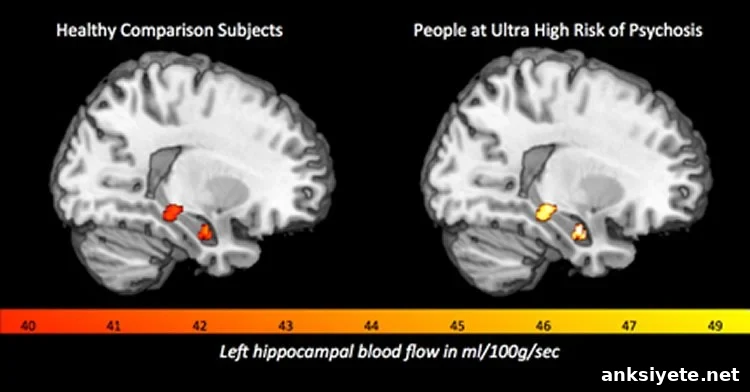
Scientists from King’s College London and the University of Roehampton have identified a brain mechanism that may be linked to the onset and progression of psychosis.
Using a magnetic resonance imaging (MRI) technique known as pseudo-continuous arterial spin labeling, researchers measured resting regional cerebral blood flow (rCBF) in young people considered at ultra-high risk for psychosis and compared them with healthy volunteers. The study found elevated or “hyperactive” blood flow in the hippocampus, striatum (basal ganglia) and midbrain among the at-risk group. These regions are strongly implicated in psychotic disorders such as schizophrenia.
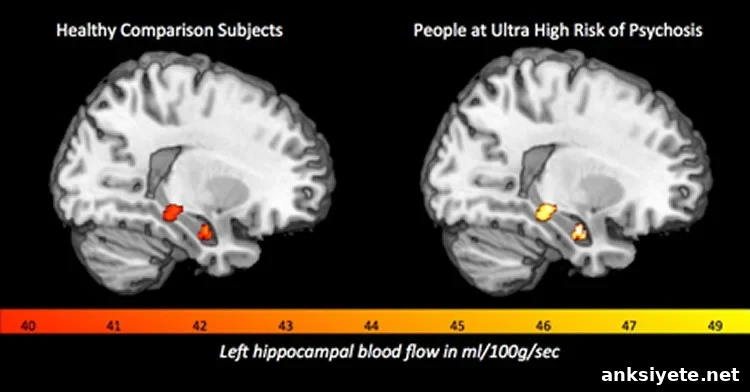
The study evaluated 52 individuals regarded as ultra high risk for psychosis and 27 healthy controls. Participants underwent baseline MRI scans and were reassessed after a mean follow-up period of about 17–18 months to determine how blood flow patterns evolved alongside clinical symptoms. Symptom severity was measured using the Comprehensive Assessment of At-Risk Mental States.
At baseline, the ultra-high-risk group showed significantly higher resting blood flow in the hippocampus, basal ganglia, and midbrain compared with healthy controls. At follow-up, those participants who experienced symptomatic improvement showed reductions in hippocampal and ventral striatal rCBF. In particular, individuals whose symptoms had resolved and who no longer met ultra-high-risk criteria displayed a longitudinal decrease in left hippocampal blood flow to levels comparable with healthy volunteers. By contrast, participants who remained at high risk or who transitioned to psychosis did not show this normalization.
These human imaging results align with prior animal research that suggests hippocampal hyperactivity can drive downstream changes in midbrain and basal ganglia circuits, potentially producing alterations in subcortical dopamine signaling associated with psychotic symptoms. The study therefore provides important evidence linking increased resting activity in these brain regions to both risk for psychosis and to clinical course.
Professor Paul Allen (Institute of Psychiatry, Psychology & Neuroscience, King’s College London and University of Roehampton) noted that the findings highlight important neurobiological differences between healthy people and those at ultra high risk of psychosis and help clarify mechanisms that may underlie illness development. Professor Philip McGuire (IoPPN, King’s College London) emphasized the potential clinical implications: brain scanning could assist clinicians in predicting whether individuals at increased risk will develop a psychotic disorder or recover, and understanding these early brain changes can guide development of preventive treatments.
Source: Jack Stonebridge – King’s College London
Image source: The image is credited to the researchers
Original research: Abstract for “Resting Hyperperfusion of the Hippocampus, Midbrain, and Basal Ganglia in People at High Risk for Psychosis” by Paul Allen, Ph.D.; Christopher A. Chaddock, Ph.D.; Alice Egerton, Ph.D.; Oliver D. Howes, M.D., Ph.D.; Ilaria Bonoldi, M.D.; Fernando Zelaya, Ph.D.; Sagnik Bhattacharyya, M.D., Ph.D.; Robin Murray, M.D.; Philip McGuire, M.D., Ph.D., published in American Journal of Psychiatry. Published online December 16, 2015. doi:10.1176/appi.ajp.2015.15040485
Abstract
Resting Hyperperfusion of the Hippocampus, Midbrain, and Basal Ganglia in People at High Risk for Psychosis
Objective:
Animal models indicate that psychosis development involves hippocampal hyperactivity that drives increased activity in the midbrain and basal ganglia. This study tested that hypothesis in humans by measuring resting perfusion in those brain regions in people at high risk for psychosis.
Method:
Pseudo-continuous arterial spin labeling imaging measured resting regional cerebral blood flow in 52 individuals at ultra-high risk for psychosis and 27 healthy volunteers. Psychotic symptom severity was assessed with the Comprehensive Assessment of At-Risk Mental States. Ultra-high-risk participants were reassessed after a mean follow-up of 17 months using the same clinical and imaging measures.
Results:
At baseline, ultra-high-risk participants showed elevated rCBF in the hippocampus, basal ganglia, and midbrain compared with healthy volunteers. At follow-up, the sample showed symptomatic improvement overall and reductions in hippocampal and ventral striatal rCBF. Those who no longer met ultra-high-risk criteria exhibited a longitudinal reduction in left hippocampal rCBF that was not seen in participants who remained high risk or developed psychosis.
Conclusions:
Being at high risk for psychosis is associated with increased resting activity in the hippocampus, midbrain, and basal ganglia. Resolution of the high-risk state correlates with normalization of activity in these regions, supporting models in which hippocampal hyperactivity contributes to dysregulation of subcortical dopamine-related circuits and the emergence of psychotic symptoms.