
Your Brain on Androids
Have you ever felt uneasy walking through a wax museum, watching a lifelike robot, or viewing animated characters that look almost—but not quite—human? That unsettling sensation is commonly known as the “uncanny valley.” Researchers continue to debate why this reaction occurs, and a recent fMRI study led by Ayse Pinar Saygin at the University of California, San Diego offers new evidence about what happens in the brain when people watch an uncanny android.
What Is the Uncanny Valley?
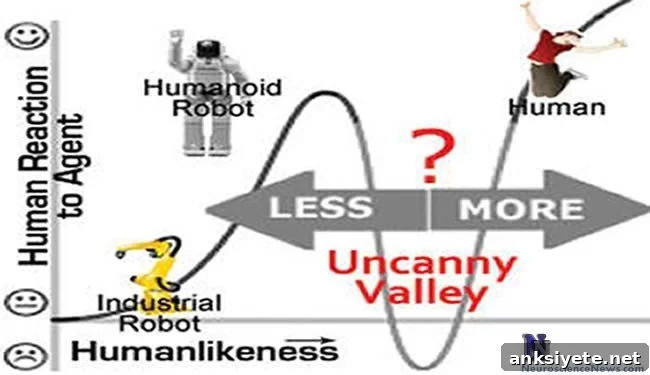
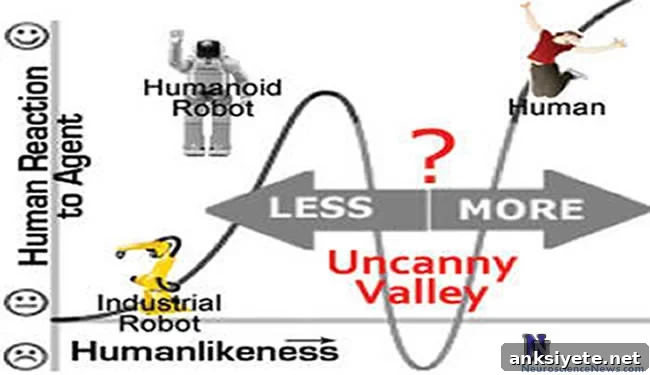
The uncanny valley describes a drop in affinity toward artificial agents as they grow increasingly humanlike. People generally respond positively to agents that share some human traits—think dolls, cartoon animals, or charismatic robots. As an agent becomes more realistic, people typically like it more. But at a certain point that trend reverses: agents that appear almost human can provoke discomfort or eeriness. Examples include some characters in the animated film “The Polar Express” and many modern androids, which can fall into that uncanny zone.
Study Design: Appearance Versus Motion
Saygin and her colleagues investigated whether the brain’s action perception system is more sensitive to human appearance or to human motion. Their core idea was to identify how brain systems that interpret others’ body movements and actions respond when appearance and motion are either consistent or mismatched.
The study recruited 20 adults between 20 and 36 years old with no prior professional exposure to robots and no extended cultural exposure to androids (for example, participants had not lived in Japan or had close ties to people from Japan). Participants viewed videos of three types of agents performing the same everyday actions—waving, nodding, drinking, and picking up a piece of paper:
- A human actor with natural biological appearance and movement.
- A clearly mechanical robot, showing metal joints and wiring, with mechanical motion.
- An android (Repliee Q2) that looked human but moved with the exact same mechanical motion as the robot.
Before scanning, each participant watched the videos outside the fMRI machine and was told which clips showed a robot and which showed a human.
Key Findings
The strongest brain responses emerged when participants watched the android—an agent with human appearance but mechanical motion. Activity increased in the parietal cortex on both sides of the brain, specifically in regions that link visual processing of body movement with motor areas that contain mirror-like neurons. These neurons are often described as “monkey-see, monkey-do” or “empathy” neurons because they respond both when an action is observed and when it is executed.
According to the authors’ interpretation, this pattern reflects a perceptual mismatch: the brain reacted strongly when appearance and motion did not align. In other words, neural systems involved in action perception appear to expect congruence between how an agent looks and how it moves.
Interpretation and Implications
Saygin summarizes the finding this way: the brain is not strictly tuned to either biological appearance or biological motion alone. Rather, it seems optimized to detect whether appearance and motion match expectations. If an agent looks human and moves like a human, the brain processes that information smoothly. If an agent looks mechanical and moves mechanically, processing is also straightforward. When appearance and motion conflict—when something looks human but moves like a robot—processing becomes difficult and elicits greater neural activity, which may underlie the uncanny feeling.
These results have practical implications for robotics, animation, and design. As humanlike artificial agents become more common, our perceptual systems might adapt to accept them. Alternatively, designers might choose to avoid overly humanlike appearance unless they can also achieve convincingly human motion. Saygin even suggests the value of “brain-test-driving” robot designs before investing heavily in development.
Future Directions
Because fMRI scanning is expensive and logistically demanding, Saygin and her team are exploring whether similar signatures of perceptual mismatch can be detected with EEG, a far more affordable and portable technique. If so, EEG could be used to guide design choices for androids and animated characters at a much lower cost.
Funding and Acknowledgments
This research was funded by the Kavli Institute for Brain and Mind at UC San Diego. Saygin also received support from the California Institute of Telecommunication and Information Technology (Calit2) at UCSD. Coauthors of the study include Thierry Chaminade (Mediterranean Institute for Cognitive Neuroscience, France), Hiroshi Ishiguro (Osaka University and ATR, Japan), Jon Driver (University College London), and Chris Firth (University of Aarhus, Denmark).
Author of Research Article: Inga Kiderra – University of California, San Diego
Source: University of California at San Diego press release
Image credit: Neuroscience News image adapted from Ayse Saygin, UC San Diego