
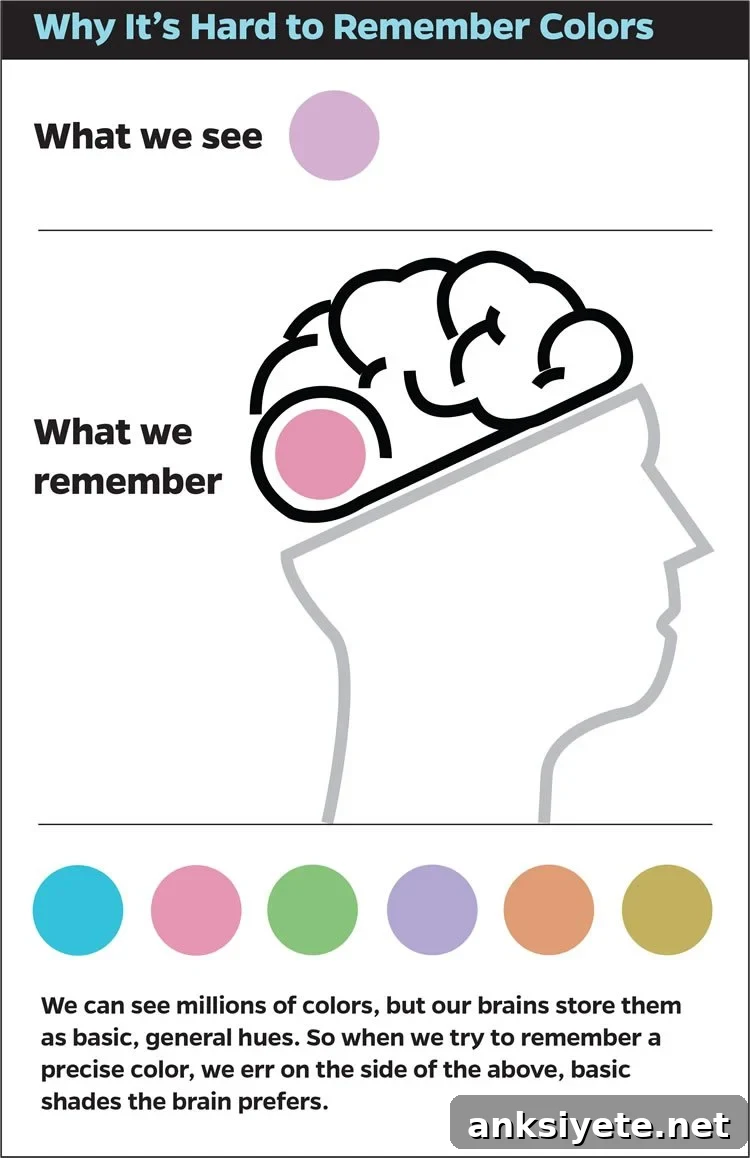
People can distinguish millions of colors, yet they struggle to remember precise shades because the brain tends to store colors as one of a few basic category exemplars, researchers led by Johns Hopkins University report.
In a study published in the Journal of Experimental Psychology: General, cognitive psychologist Jonathan Flombaum and colleagues challenge common assumptions about visual memory. Their experiments reveal that memories for color are systematically biased toward prototypical examples of basic color categories — the “best” blue, green, pink, purple, orange or yellow — rather than the exact hue a person actually saw.
Although we can perceptually tell apart subtle hues such as azure, cobalt and ultramarine, Flombaum and his team found that when people encode those hues into memory they often compress them into the nearest basic category label: “blue,” “green,” “pink,” and so on. That compression helps explain familiar failures — for example, why someone who glances at their living-room wall and then tries to match the paint at a hardware store may pick a different shade than the one on the wall.
“When I try to pick a matching paint for touch-ups, I often make a mistake,” Flombaum said. “I remember the wall as a more prototypical blue. Paint companies might call the real color a green, but in memory it becomes ‘blue.’”
Working with Gi-Yeul Bae (University of California, Davis), Maria Olkkonen (University of Pennsylvania) and Sarah R. Allred (Rutgers University), the team showed that this apparent difference in color memorability is driven by categorization. People remember colors more accurately when those colors are strong exemplars of their category — that is, when they are focal or prototypical examples of “blue,” “green,” or another basic term.
The researchers established this bias through a sequence of experiments. First, participants viewed a 180-hue color wheel and identified the most representative examples of the six basic categories: blue, pink, green, purple, orange and yellow. A separate group took part in a rapid memory task: they were shown a colored square for one-tenth of a second, maintained that color briefly while looking at a blank screen, and then attempted to select the remembered hue from the same 180-color wheel.
Across participants, responses tended to drift toward category centers — the “best” examples identified in the first task. Although viewers can discriminate many fine-grained hues when perceiving them, memory responses showed an amplified bias toward those archetypal colors even after very short delays of under a second.
Flombaum summarized the pattern: “We have very precise color perception, but to store that information our brain uses a trick. It tags the color with a coarse label. That makes our memory biased, but also practical.” In other words, the mind balances detailed perceptual input with language-driven categories, and in that tradeoff some precision is lost while categorical consistency is gained.
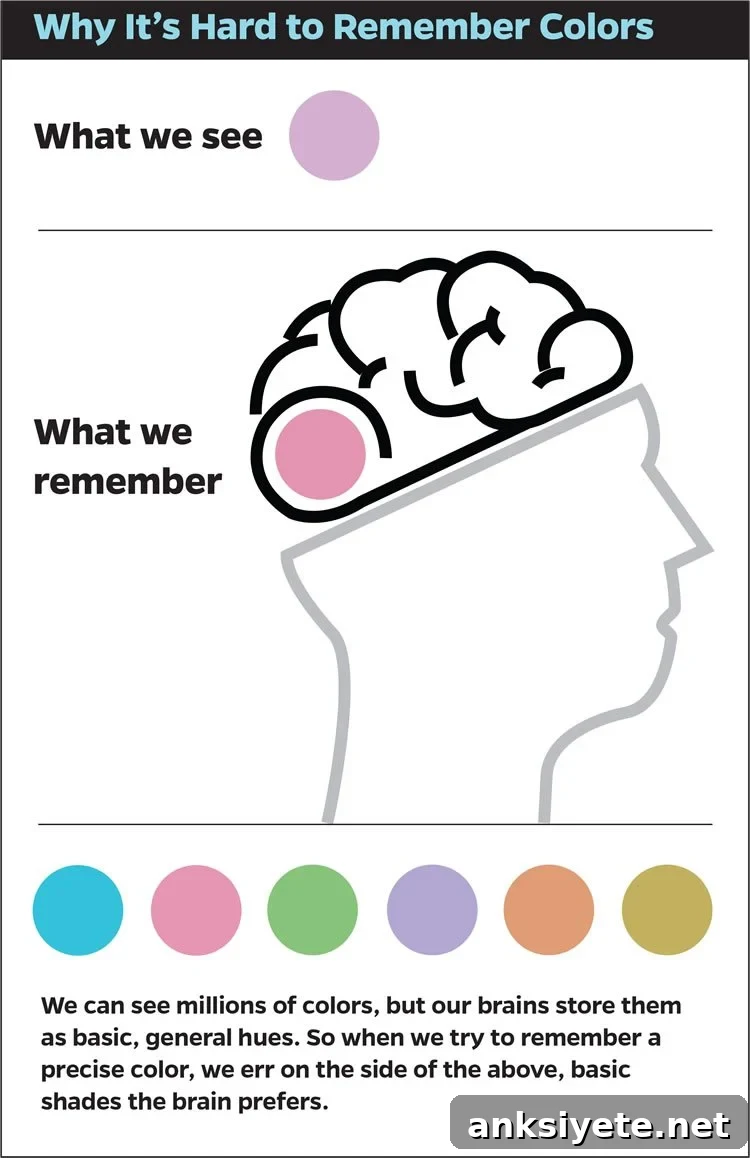
The implications extend beyond color: whenever people encounter a large number of similar items — colors, bird species, faces — later recall tends to favor more prototypical instances. The researchers emphasize that the effect does not reflect a storage capacity limit; rather, the brain seeks to reconcile precise perceptual details with a limited set of category labels. Thus, a teal object might be remembered as more blue or more green, and a coral shade might be recalled as leaning toward pink or orange.
By combining category-level labels with continuous perceptual details, the authors propose a dual-content model of color representation in working memory. This model explains why memory responses shift away from category boundaries and toward category centers, and why those category-driven biases are present even without a memory delay, becoming amplified during short-term maintenance.
Source: Jill Rosen – Johns Hopkins University
Image Credit: Johns Hopkins University
Original Research: Abstract for “Why Some Colors Appear More Memorable Than Others: A Model Combining Categories and Particulars in Color Working Memory” by Bae, Gi-Yeul; Olkkonen, Maria; Allred, Sarah R.; and Flombaum, Jonathan I. in Journal of Experimental Psychology: General. Published online May 18, 2015. doi:10.1037/xge0000076
Abstract
Why Some Colors Appear More Memorable Than Others: A Model Combining Categories and Particulars in Color Working Memory
Categorization with basic color terms is an intuitive and widely shared aspect of color perception. Yet much research on visual working memory has emphasized only continuous estimates within color space, leaving the influence of categorical labels on memory unclear. The authors propose a dual-content model in which representations integrate both category information and precise continuous estimates (“particulars”). Across four experiments, participants reproduced color targets with and without delay and standard perceptual methods identified category boundaries and focal colors. Responses drawn from working memory were biased away from category boundaries and toward category centers, a pattern also present without memory delay. The dual-content model explains these results parsimoniously and suggests that visual working memory maintenance amplifies category-related biases and the stimulus-specific variability that originates in perception.