
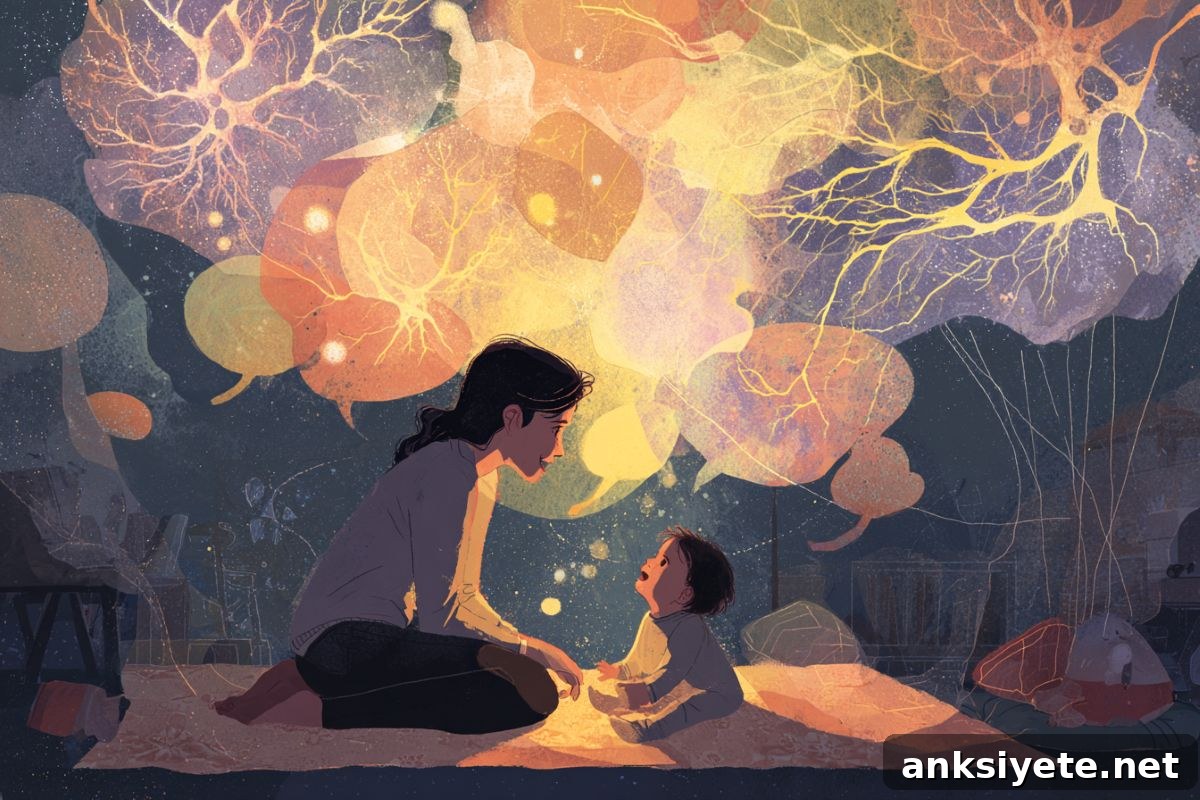
Summary: Infant babbling is more than cute noise — it is a feedback-driven learning strategy that helps build the foundations of language. New research shows that marmoset monkeys, despite their distant relation to humans, also babble and learn vocal patterns faster when adults respond. The study links this behavior to a shared pattern of early brain growth and social caregiving that supports vocal learning.
Researchers compared brain development and vocal behavior across several primate species and found that humans and marmosets experience a pronounced postnatal burst of brain growth. That timing, combined with intensive social caregiving, makes infants especially receptive to social feedback and helps explain why vocal learning through caregiver response emerges in both species.
Key facts
- Babbling feedback: Human and marmoset infants develop adult-like vocalizations more quickly when caregivers respond to their vocalizations.
- Timing of brain growth: Both species show accelerated brain growth around birth, increasing neural plasticity during the period when infants are exposed to social signals.
- Cooperative caregiving: Multiple caregivers interacting with infants create a vocally rich environment that amplifies opportunities for learning.
Source: Princeton
Babbling as active learning
When a human baby babbles and a parent answers, those exchanges do more than charm adults — they guide the development of speech. Only a few animals are known to learn vocal patterns through caregiver feedback, and until recently, vocal learning of this sort appeared rare among primates.
Research on common marmosets, a small New World monkey, changed that perspective. Marmosets use high-pitched calls to maintain contact in dense forest habitats, and field and laboratory observations revealed a babbling phase in infant marmosets similar to human infants. Newborn marmosets progress from sputtering, unstructured cries into the whistle-like calls typical of adults. Crucially, infants that received more frequent, contingent feedback from adults moved to adult-like calls faster than those who received less feedback.
Those early findings suggested a form of vocal learning in a nonhuman primate and raised an evolutionary question: how could such a learning strategy evolve independently in a species so distantly related to humans?
The role of neural altriciality
To answer that, the new study analyzed published developmental data from humans, marmosets, chimpanzees and rhesus macaques, tracking brain growth from conception through adolescence. The analysis showed that humans and marmosets share a distinctive developmental pattern: a relatively altricial brain that continues to grow rapidly around the time of birth. In contrast, chimpanzees and macaques exhibit more prenatal brain growth and less of a postnatal surge.
This postnatal period of rapid growth coincides with the earliest vocal milestones and a time when infants are highly sensitive to social input. In both humans and marmosets, infants are cared for by multiple adults who respond frequently to their calls, creating a rich social and vocal environment. That combination — a malleable, rapidly growing brain and a cooperative caregiving setting — provides the conditions in which feedback-dependent vocal learning can emerge.
Using a mathematical model, the researchers showed how the timing of brain growth and the amount of social input interact to enhance vocal learning. The model predicts that vocal learning during infancy benefits from an altricial brain and cooperative breeding practices, supporting the empirical observations from humans and marmosets.
Implications and next steps
Future work will examine whether adult marmosets use specialized, exaggerated vocal patterns when interacting with infants, analogous to the human phenomenon known as “baby talk.” Identifying adult-infant interaction patterns in marmosets would deepen understanding of how social feedback shapes vocal development and illuminate the pathways by which infants move from early cooing and babbling to intentional, socially meaningful communication.
The study emphasizes that these findings concern vocal learning during infancy, a window when brains are particularly plastic and receptive to social influence. It does not argue that other primates cannot modify their calls later in life, but highlights infancy as a critical period for feedback-driven vocal development.
Funding: This work was supported by the National Institutes of Health (R01NS054898).
About this language and evolutionary neuroscience research news
Author: Daniel Vahaba
Source: Princeton
Contact: Daniel Vahaba – Princeton
Image: The image is credited to Neuroscience News
Original research: Closed access. “Altricial brains and the evolution of infant vocal learning” by Asif Ghazanfar et al., Proceedings of the National Academy of Sciences.
Abstract
Altricial brains and the evolution of infant vocal learning
Vocal development in human infants is strongly influenced by caregiver interactions that reinforce more speech-like sounds. This developmental trajectory differs from that of closely related apes and cercopithecoid monkeys, where social feedback appears to play little role in vocal development. Marmoset monkeys, however, show socially guided vocal learning early in life.
The authors hypothesize that the evolution of infant vocal learning in humans and marmosets is enabled by neurally altricial births and a cooperative breeding social environment. Comparative analyses indicate that human and marmoset brains grow faster around birth relative to chimpanzees and rhesus macaques, and that this timing overlaps with key vocal learning milestones. A formal model demonstrates how vocal learning benefits from an altricial brain and rich social vocal input. The data support the idea that infant vocal learning in these species arose from the combination of postnatal neural development and a vocally interactive caregiving environment.