
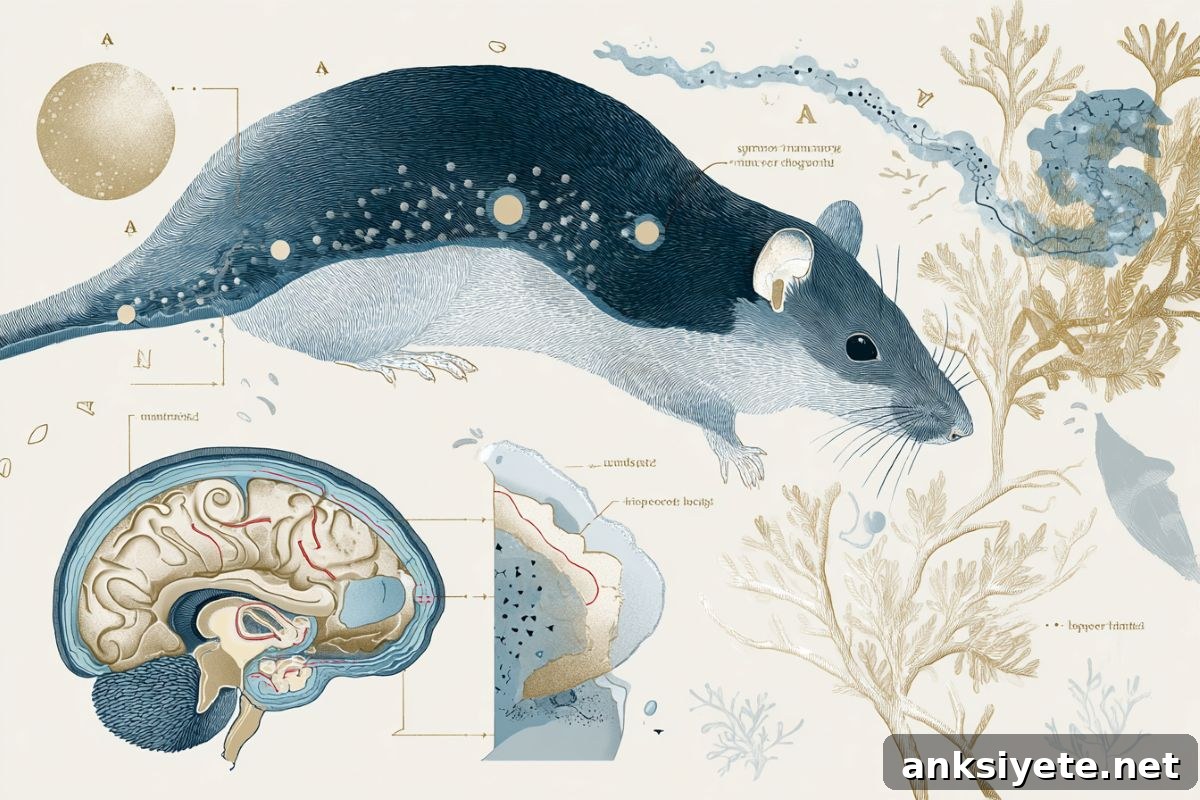
Summary: Researchers used non-invasive MRI to investigate a rare seasonal process in common shrews in which their brains shrink in winter and regrow in spring. The scans and tissue analyses point to redistribution of water—rather than cell death—as the primary mechanism behind this reversible shrinkage. The study highlights aquaporin‑4, a water-regulating protein, as likely involved, and suggests this natural model of reversible brain volume change could offer insights relevant to human neurodegenerative diseases.
Common shrews lose roughly nine percent of their brain volume during winter months, yet their brain cells remain viable. By combining high-resolution MRI with microscopic tissue analysis, the study demonstrates that water shifts out of cells during the shrinkage phase and returns during regrowth. Because similar patterns of brain volume loss and altered water balance occur in conditions such as Alzheimer’s and Parkinson’s disease, uncovering how shrews avoid permanent damage may inspire new directions for treatment research.
Key Facts:
- Brain shrinkage without cell death: Winter brain volume drops by about 9% in common shrews, but cell counts do not decline.
- Water redistribution: Evidence points to reduced intracellular water and increased extracellular fluid as the core cause of volume change.
- Aquaporin‑4 involvement: The water-channel protein aquaporin‑4 appears to help move water out of cells during shrinkage and is also implicated in human brain disease.
Source: Max Planck Institute
Dehnel’s phenomenon—the seasonal shrinking and regrowth of the brain—has long puzzled biologists. Common shrews are among the few mammals known to undergo this striking, reversible resizing of brain tissue.
How can a brain lose measurable volume and later recover without sustaining lasting harm? The study addressed this question by following wild common shrews across seasons using diffusion microstructure imaging (DMI), a form of MRI sensitive to water movement and tissue microstructure.
“Our animals lost about nine percent of brain volume in winter, but the cells did not die,” explains Dr. Cecilia Baldoni, first author and postdoctoral researcher at the Max Planck Institute of Animal Behavior. “Instead, the cells lost water.”
Whereas water loss in human neurodegenerative disease typically accompanies irreversible damage, shrews show an opposite outcome: cells shrink but remain alive, and some regions later grow back. Microscopy confirmed that cell numbers remained stable across seasons, indicating that shrinkage reflects reduced cell size and increased extracellular space rather than neuronal loss.
Peering inside a shrinking brain
Dehnel’s phenomenon has been documented in only a handful of small mammals, including some shrews, European moles, and mustelids like stoats and weasels. Among these species, common shrews are the most extensively studied. The prevailing ecological interpretation is that seasonal brain resizing reduces metabolic demand during lean winter months.
To track these changes directly, researchers captured wild common shrews in Germany during summer, scanned their brains with high-resolution MRI, and then re-scanned the same individuals after recapture in winter. Using DMI allowed the team to quantify shifts in water diffusion—measures such as mean diffusivity and fractional anisotropy—that reflect changes in intracellular and extracellular water content.
“Following the same animals across seasons gave us a clear view of how individual brains change,” says Prof. Dominik von Elverfeldt, who led the imaging work. The imaging findings were validated by histological examination of brain tissue sampled in summer and winter.
How shrews pull off Dehnel’s
Overall brain volume dropped by nearly nine percent in winter, primarily driven by water moving out of cells. Importantly, shrinkage was not uniform: many brain regions displayed the predicted pattern of reduced intracellular water and expanded extracellular space, but the neocortex and cerebellum maintained a more stable water balance. These regions support cognition and motor control, suggesting shrews preserve functionally critical areas while economizing elsewhere.
“It’s like turning down the heating in less essential rooms while keeping the key rooms warm,” says Dina Dechmann, a group leader who has studied Dehnel’s phenomenon for over a decade. The uneven pattern helps explain how shrews continue to forage, escape predators, and navigate despite a smaller brain volume.
Associate Prof. John Nieland, an expert on human brain disorders, notes the striking parallel to human disease: an almost ten percent reduction in brain volume is commonly tied to severe loss of function in conditions such as Alzheimer’s, yet shrews tolerate and reverse similar changes. The presence of aquaporin‑4 in shrews’ shrinking brains—mirrored by elevated levels in many diseased human brains—points to shared molecular players that control brain water homeostasis.
Potential path to medical treatment?
For neurologists, the natural reversal of brain shrinkage in shrews opens an intriguing avenue of research. Many human disorders, including multiple sclerosis, Parkinson’s disease, amyotrophic lateral sclerosis (ALS), and Alzheimer’s disease, involve progressive loss of brain volume often associated with altered water distribution. To date there are no therapies that reliably halt or reverse that loss.
The research team sees the shrew as a promising model to study mechanisms that both prevent damage during volume loss and trigger regrowth. Their next phase of work will focus on the spring regrowth period to identify cellular and molecular pathways that restore brain size and function. Understanding those processes may reveal strategies that one day inform regenerative approaches for human neurodegenerative conditions.
About this neuroscience and neuroplasticity research news
Author: Carla Avolio
Source: Max Planck Institute
Contact: Carla Avolio – Max Planck Institute
Image: Image credited to Neuroscience News
Original Research: Open access.
“Programmed seasonal brain shrinkage in the common shrew via water loss without cell death” by Cecilia Baldoni et al., published in Current Biology.
Abstract
Programmed seasonal brain shrinkage in the common shrew via water loss without cell death
Brain plasticity typically involves changes in function and microstructure rather than major size differences. Dehnel’s phenomenon is a notable exception, where small mammals seasonally and reversibly reduce brain size to lower metabolic demands in winter. Although volumetric changes were known, the microstructural basis for this adaptation was unclear. Using diffusion microstructure imaging (DMI), the study reveals increased mean diffusivity and decreased fractional anisotropy in winter brains, consistent with reduced intracellular water and stable cell numbers. These results show that shrews reorganize tissue—shrinking cell size while maintaining cell viability—allowing survival during scarcity without enduring functional loss. Insights from the regrowth phase may have implications for understanding and potentially treating neurodegenerative diseases.