
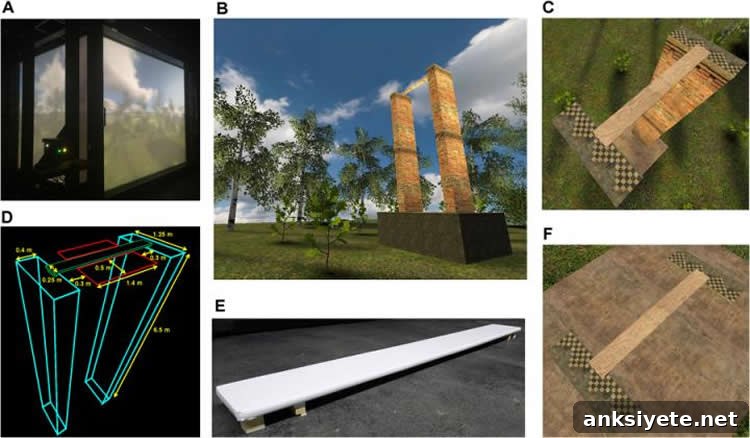
Summary: New research shows that the way our body moves and the spatial context we occupy combine to shape emotions and how we explore an environment.
Source: Cell Press.
Body and space interact to shape emotion and exploration
How we feel in an environment — whether calm, pleased, anxious or frightened — and how we choose to look around it are influenced not only by external stimuli but also by the brain’s combined interpretation of bodily signals and spatial information. A recent study using immersive virtual reality reports that gait-related sensory input and the perceived spatial context work together to regulate both emotional experience and exploratory head movements.
The study, published in Heliyon, was led by Dr. Martin Dobricki of the University of Würzburg. The research team proposed that emotional reactions and exploratory behavior are not simply automatic responses to the environment. Instead, the brain appears to integrate information about the body’s movements with the layout and perceived risk of the surrounding space to guide feelings and where we direct our attention.
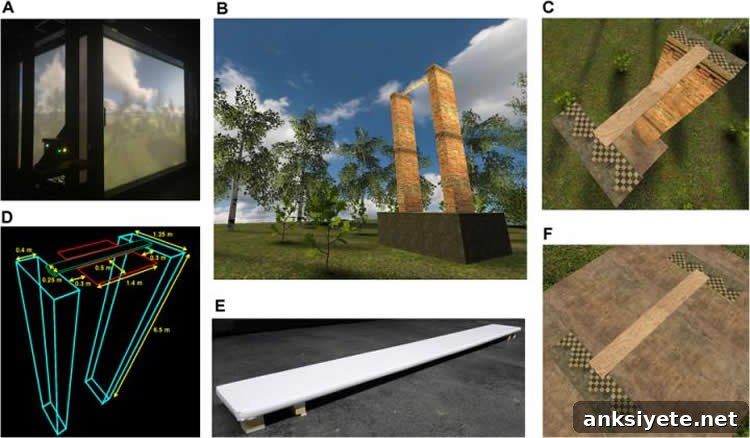
To test this idea, volunteers explored a life-sized virtual forest clearing while physically walking between two raised platforms connected by a narrow plank. The same virtual scene was presented in two spatial contexts: either at ground level or atop two high bridge piers. The experiment manipulated the participants’ gait by projecting the virtual plank onto either a rigid floor or a physically bouncy plank, producing either a smooth or a bouncy walking experience.
Results showed a clear interaction between gait and spatial context. When the scene was perceived as high above the ground, a bouncy gait intensified negative feelings and led participants to orient their heads more below the horizon, indicating downward-focused exploration. In contrast, the same bouncy gait produced more positive feelings when the scene was presented at ground level and increased head orientation toward and above the horizon, reflecting upward and outward exploration.
The authors describe this as a sensorimotor body-environment interaction: sensory signals about how the body moves (for example, whether walking feels bouncy or steady) combine with sensory information about the surrounding space (such as perceived height or safety) to influence emotional valence and the pattern of exploratory head movements. In other words, the same bodily sensation can produce different emotional and attentional outcomes depending on the spatial context in which it occurs.
These findings have practical implications. For example, exposure therapies for fear of heights commonly use virtual environments to help patients confront and adapt to fear-provoking situations. The research suggests that modifying the physical floor — for instance, adding a bouncy surface — could amplify emotional responses in a controlled way and potentially enhance therapeutic effects. The authors caution that further research is needed to evaluate clinical applications and to better understand how different combinations of bodily and spatial cues affect emotion regulation.
Dr. Dobricki commented that their results challenge the idea of humans as simple stimulus-response systems. Instead, emotions and behaviors emerge from the brain’s interdependent perception of the body in relation to the world. He and his coauthor, Paul Pauli, hope these findings will encourage new lines of inquiry into how body-environment interactions shape feelings, attention and behavior — for example, by asking whether asking emotion-evoking questions while people perform different movements (sitting, walking, swimming) produces systematic differences in emotional reports.
Source: Mary Beth O’Leary – Cell Press
Image source: Image credited to Heliyon, Dobricki et al.
Original research: “Sensorimotor body-environment interaction serves to regulate emotional experience and exploratory behavior” by Martin Dobricki and Paul Pauli, Heliyon. Published online October 13, 2016. doi:10.1016/j.heliyon.2016.e00173
Cell Press (2016, October 13). Virtual Reality Study Finds Perceptions of Body and Environment Affect How We Feel. NeuroscienceNews.
Abstract
Sensorimotor body-environment interaction serves to regulate emotional experience and exploratory behavior
Most animals, including humans, regularly explore environments that they judge pleasant, aversive, arousing or frightening. The authors hypothesized that both exploratory behavior and emotional experience are regulated by the interdependent perception of one’s body and the spatial context, such as the presence of a cliff. To investigate, healthy volunteers physically walked through a life-sized virtual forest glade while crossing a narrow plank between two platforms. The scene was presented either at ground level or atop high bridge piers. The virtual plank was projected onto either a rigid physical floor or a bouncy physical plank, producing smooth or bouncy gait experiences. In the height context, bouncy gait increased head orientation below the horizon and intensified negative experience; in the ground context, bouncy gait increased head orientation toward and above the horizon and enhanced positive experience. These results suggest the human brain uses the interaction of gait-related sensory input and spatial context to regulate emotional experience and exploratory behavior through head motion.
“Sensorimotor body-environment interaction serves to regulate emotional experience and exploratory behavior” by Martin Dobricki and Paul Pauli. Heliyon. Published online October 13, 2016. doi:10.1016/j.heliyon.2016.e00173