
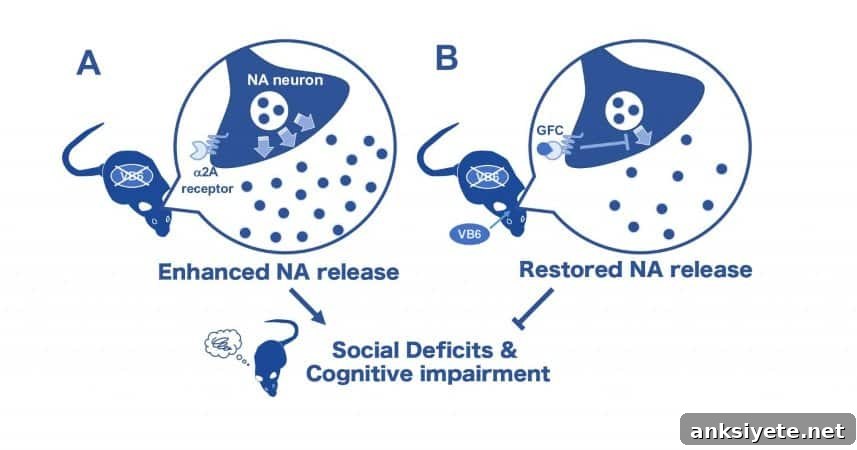
Summary: New research indicates vitamin B6 deficiency may play a role in the emergence of schizophrenia-like symptoms by altering noradrenergic signaling.
Source: TMIMS
Schizophrenia is a complex psychiatric disorder marked by positive symptoms (hallucinations, delusions), negative symptoms (apathy, flattened affect), and cognitive impairments.
Recent clinical data indicate that a significant subset of people with schizophrenia have reduced peripheral vitamin B6 (VB6, pyridoxal) levels compared with healthy controls. More than 35% of patients in these studies met clinical criteria for low VB6 (males: < 6 ng/ml; females: < 4 ng/ml). Lower VB6 levels correlated with higher symptom severity on the Positive and Negative Syndrome Scale (PANSS), suggesting VB6 deficiency could contribute to the development or exacerbation of psychotic symptoms.
To investigate mechanisms linking VB6 deficiency and schizophrenia-like behaviors, researchers created a mouse model of VB6 deficiency by feeding animals a diet lacking vitamin B6. After four weeks on the VB6-deficient diet, plasma VB6 in these mice fell to approximately 3% of control values. These VB6(-) mice developed measurable social deficits and cognitive impairments compared with controls.
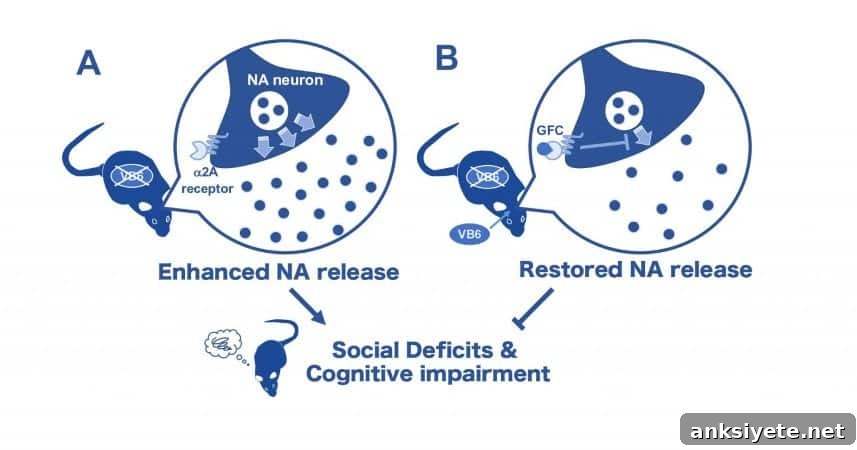
Biochemical analysis revealed a marked increase in 3-methoxy-4-hydroxyphenylglycol (MHPG) in the brains of VB6(-) mice, consistent with elevated noradrenaline (NA) turnover. In vivo microdialysis confirmed increased NA release in the prefrontal cortex and striatum—regions centrally involved in social behavior, cognition, and the pathophysiology of schizophrenia. These results indicate that VB6 deficiency enhances noradrenergic neuronal activity in the brain.
To determine whether restoring central VB6 or suppressing excessive NA release could reverse these effects, the team tested two interventions. Direct infusion of VB6 into the brain using an osmotic pump reduced NA hyperactivity and improved behavioral deficits. Separately, administration of guanfacine, an α2A adrenergic receptor agonist known to limit NA release, also normalized NAergic activity in the frontal cortex and ameliorated social and cognitive disturbances in VB6(-) mice. Together, these findings implicate elevated noradrenergic signaling as a mechanistic link between VB6 deficiency and schizophrenia-like behavioral changes.
Clinically, the subset of patients with schizophrenia who exhibit low VB6 levels tend to show more severe symptoms and greater treatment resistance. The preclinical evidence from this mouse model suggests that targeting the noradrenergic system could be an effective therapeutic strategy for these individuals. The research team is pursuing clinical studies of VB6 supplementation—described as “VB6 treatment for schizophrenia”—to evaluate safety and efficacy in patients with documented VB6 deficiency.
Overall, this body of work supports a model in which inadequate dietary or peripheral VB6 leads to central VB6 depletion, increased NA metabolism and release, and resulting social and cognitive impairments. Interventions that restore VB6 in the central nervous system or dampen excessive NAergic signaling show promise for reversing these deficits in the animal model and provide a rationale for targeted clinical approaches in affected patients.
About this neuroscience research news
Source: TMIMS
Contact: Kazuya Toriumi – TMIMS
Image credit: TMIMS
Original Research: Open access. Title: “Vitamin B6 deficiency hyperactivates the noradrenergic system, leading to social deficits and cognitive impairment” by Kazuya Toriumi, Mitsuhiro Miyashita, Kazuhiro Suzuki, Nao Yamasaki, Misako Yasumura, Yasue Horiuchi, Akane Yoshikawa, Mai Asakura, Noriyoshi Usui, Masanari Itokawa & Makoto Arai. Published in Translational Psychiatry.
Abstract
Vitamin B6 deficiency hyperactivates the noradrenergic system, leading to social deficits and cognitive impairment
A defined subset of patients with schizophrenia exhibits lower peripheral vitamin B6 (VB6) levels than healthy controls, and lower VB6 is associated with greater symptom severity on PANSS. To probe causal links, researchers generated VB6-deficient mice by using a VB6-free diet. After four weeks, plasma VB6 dropped to roughly 3% of control levels, and affected mice developed social and cognitive deficits. Brain biochemistry showed elevated MHPG, indicating increased noradrenaline metabolism; in vivo microdialysis confirmed heightened NA release in the prefrontal cortex and striatum. Delivering VB6 directly to the brain and pharmacologically suppressing NA release with the α2A agonist guanfacine both reduced NA hyperactivity and improved behavioral outcomes. These results support the hypothesis that VB6 deficiency enhances noradrenergic signaling and that targeting this pathway may offer a novel therapeutic approach for the VB6-deficient subgroup of schizophrenia patients.