
Summary: Understanding the complexity of the human microbiome may help unlock many mysteries behind physical health and psychological illnesses.
Source: The Conversation
Bacteria are central to life on Earth and form essential building blocks that shape living organisms.
Both the mitochondrion — the cellular structure that produces energy in most organisms — and the chloroplast — the organelle that captures solar energy in plants — have origins that trace back to bacterial ancestors. These ancient microbes set the stage for the biodiversity we observe today.
Microbes inhabit all multicellular life, performing a wide range of essential functions such as aiding digestion and participating in biochemical signaling. The community of microbes associated with a host is known as the microbiome. Microbiomes exist in organisms as simple as hydra and as complex as humans, elephants, and trees.
Human microbiome
Microbes are present in humans from the earliest stages of life and influence many aspects of our biology. The human microbiome comprises viruses, bacteria, and fungi that form communities on and within the body.
Although these microbes have always been part of our anatomy, only recent advances in molecular imaging and next-generation genetic sequencing have allowed us to see and characterize them in detail. These tools reveal how microbial communities operate and carry out vital tasks that support human health.
Considered together, the human microbiome is one of the largest organs in the body, weighing roughly two to three kilograms in an average adult. Though invisible to the eye, its presence is sometimes noticeable through sounds or odors associated with microbial activity.
The microbiome contributes to many traits that make each person unique. Its composition changes throughout life, and a loss of microbial diversity is often linked with aging and disease. In general, healthy people—especially long-lived individuals—tend to host a wider variety of microbial species than those in poorer health.
Location-specific functions
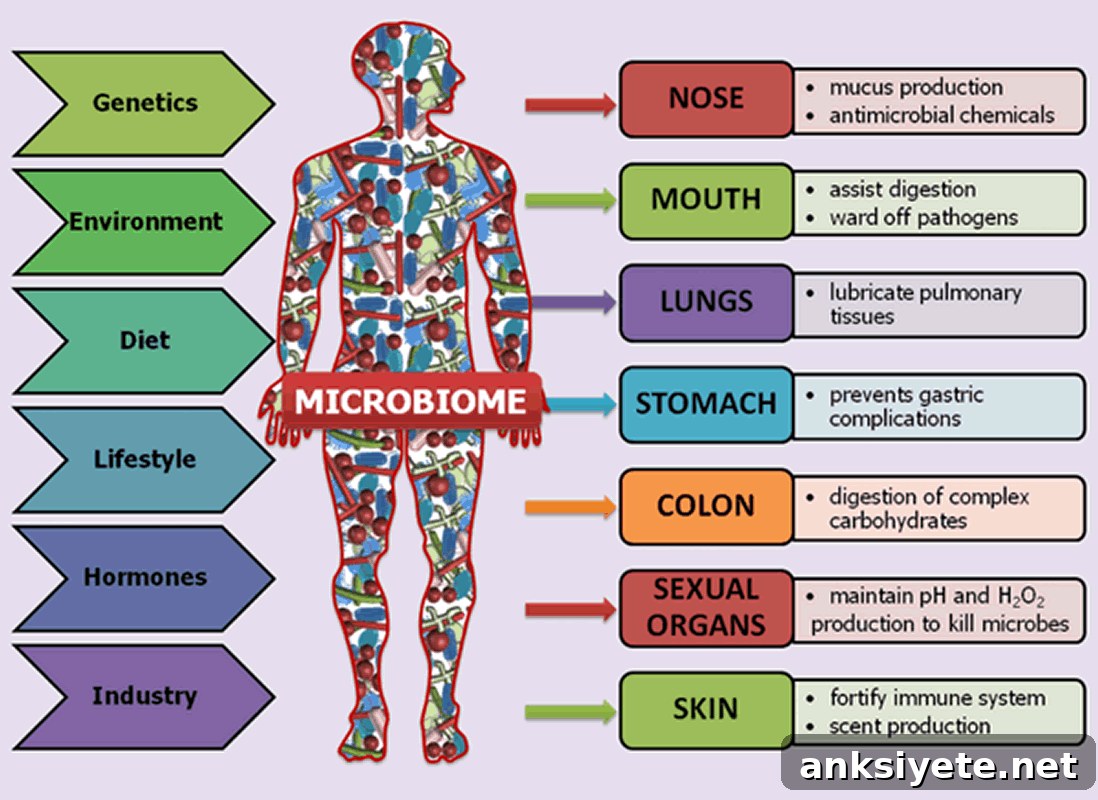
Microbial communities work in concert with different organs to support normal bodily functions. Skin microbes form a protective layer that helps prevent invasion by opportunistic pathogens, assists in wound healing, and contributes to immune defense. They also produce small signaling molecules that can interact with the nervous system and influence local physiology.
The gut houses the largest and most diverse microbial population in the body and depends on these microbes to perform key digestive functions. Gut microbes provide enzymes that break down complex carbohydrates and help extract nutrients from food. Over a lifetime, an average person consumes tens of tonnes of food, and digestive efficiency relies in large part on microbial activity.
Intestinal microbes also synthesize important compounds such as certain vitamins (for example, vitamin B12), hormones, neurotransmitters, and a variety of metabolites that support normal development and metabolism. They can also affect the way orally administered drugs are metabolized, because medications encounter the gut microbiome before reaching their intended targets.
Molecules produced by microbes, such as short-chain fatty acids, play key roles in normal growth, immune regulation, and energy balance.
Microbial communities are both site-specific and individualized. Different body sites provide distinct environments that favor particular microbes: the oily forehead often hosts Propionibacteria, the moist nasal passages favor Corynebacteria, the acidic stomach supports acid-tolerant species, and the colon is dominated by anaerobic organisms. These specialized niches help explain why microbial composition varies so much across the body.
Understanding the microbiome
The microbiome is shaped by many factors including genetics, geography, diet, and lifestyle. Early efforts to fingerprint individual microbiomes are still developing, but it is already clear that urban and rural residents, for example, typically harbor different microbial communities. Like any other organ, the microbiome can become disrupted—a condition known as dysbiosis—which has been associated with conditions such as obesity, irritable bowel syndrome, dermatitis, and certain neurological imbalances. In some cases, interventions with probiotics and prebiotics can help rebalance microbial communities and improve symptoms.
Although the microbiome has only recently been characterized in detail, expanding our understanding of its functions and origins promises to reshape health care, nutrition, and disease prevention. Identifying the roles of individual microbial species could enable personalized microbial profiling—potentially as transformative as the discovery of blood groups in the last century. Such microbial fingerprinting might lead to more precise diagnostics and individualized treatments.
Deliberate manipulation of beneficial microbial communities—sometimes called microbiome engineering—could become a route to improving health, supporting organ function, modifying metabolic traits, and enhancing drug effectiveness. Already, skincare products that include beneficial microbes and targeted nutritional supplements are being marketed as personalized therapies. Tracking microbes and their metabolites may also emerge as a useful strategy for monitoring health and behavior in clinical and research settings.
We stand at the dawn of a potential health revolution driven by microbiome science. As research advances, the integration of microbiome knowledge into everyday medical practice and public health policy could produce wide-ranging benefits for individual and societal well-being.
Funding: Vasu Appanna receives funding from the Northern Ontario Heritage Fund. Professor of Biochemistry, Laurentian University, Sudbury, Ontario, Canada.
Source:
The Conversation
Media Contacts:
Vasu Appanna – The Conversation
Image Source:
The image is credited to Vasu Appanna.