Summary: New research finds that men with developmental dyslexia show weaker structural connections between the left auditory thalamus and the auditory motion-sensitive area of the cortex, a finding that highlights the role of early sensory pathways in reading ability.
Altered Left Auditory Thalamus–Cortex Connectivity in Men with Dyslexia
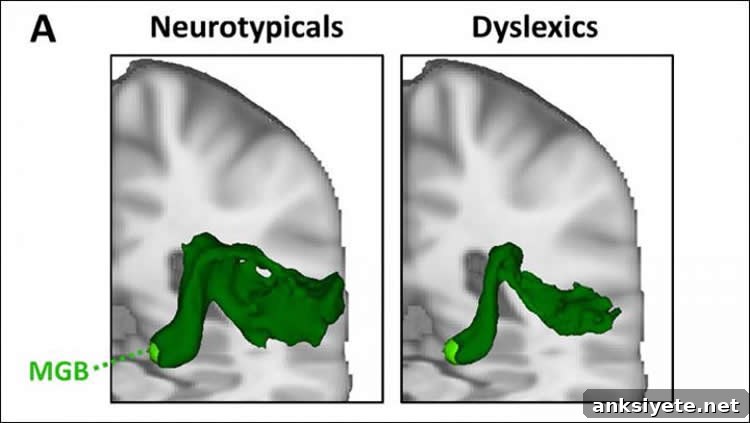
New findings published in the Journal of Neuroscience show that adult men with developmental dyslexia have reduced structural connectivity between a subcortical auditory relay—the left medial geniculate body (MGB)—and a motion-sensitive region of the auditory cortex, the left planum temporale (mPT). This study extends prior observations of cortico-thalamic alterations in the visual system and strengthens the view that atypical early sensory processing contributes to difficulties in reading and related tasks.
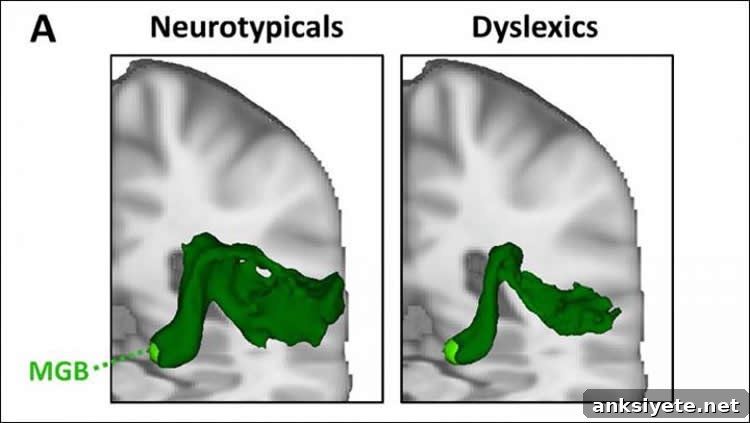
The research, led by Nadja Tschentscher and colleagues, used diffusion tensor imaging (DTI) and probabilistic tractography to map white matter pathways connecting the left MGB and left mPT. Compared with typical readers, the male participants with developmental dyslexia showed a significant reduction in the structural strength of this cortico-thalamic auditory pathway. Importantly, in typical readers the strength of left MGB–mPT connectivity correlated with measures of reading fluency, while the same relationship was not observed in the dyslexic group.
These results complement earlier work documenting reduced responses in the left auditory thalamus during speech processing in dyslexia and parallel findings in the visual system, where reduced connectivity between the left lateral geniculate nucleus (LGN) and the motion-sensitive visual cortex (V5/MT) has been reported. In the visual pathway, stronger LGN–V5/MT connectivity was previously linked to quicker rapid automatized naming (RAN) performance, a task that predicts reading proficiency. The current study tested two related hypotheses: first, that dyslexic readers would show reduced left MGB–mPT connectivity; second, that connectivity strength would correlate with rapid naming and related measures of reading ability. The first hypothesis was supported: dyslexic men showed weaker left MGB–mPT structural connections. The second hypothesis was only partially supported, because connectivity strength predicted faster rapid naming scores in neurotypical readers but not in the dyslexic group.
Abstract (Rewritten)
Developmental dyslexia involves persistent difficulties in acquiring typical reading and writing skills. Research has often focused on cortical differences, but recent evidence implicates altered function in subcortical sensory structures as well. Prior studies found reduced functional responses in the left auditory thalamus (MGB) during speech processing among people with dyslexia and reduced structural connectivity between the visual thalamus (LGN) and motion-sensitive cortex (V5/MT) in the visual modality. Building on these findings, the present study used DTI-based probabilistic tractography to examine whether dyslexic adults show reduced white matter connectivity between the left MGB and the motion-sensitive portion of the left planum temporale (mPT), and whether connectivity strength relates to rapid naming performance (RANln), a measure strongly associated with reading skill. The results show that male adults with developmental dyslexia have reduced left MGB–mPT structural connectivity compared to typical readers. While stronger connectivity predicted faster rapid naming in neurotypical readers, this association did not hold for the dyslexic group. These findings indicate that reduced cortico-thalamic connectivity in the auditory domain is a characteristic of developmental dyslexia and that cortico-subcortical pathways contribute to reading-related abilities in typical readers.
Significance
Developmental dyslexia is one of the most prevalent learning disabilities. This study adds important evidence that dyslexia is not limited to cortical differences; subcortical sensory pathways, such as the auditory thalamus and its connections to auditory cortex, are also affected. The observed reduction in white matter connectivity between left MGB and left mPT highlights the role of cortico-thalamic interactions in processing spectrotemporally complex sounds—processing that is foundational for accurate and fluent reading. The association between pathway strength and reading fluency in neurotypical readers underscores how variation in early sensory wiring supports literacy skills.
Funding: Max Planck Society; European Research Council.
Source / Publisher: Society for Neuroscience (SfN); coverage organized by NeuroscienceNews.com.
Original research: Tschentscher, N., Ruisinger, A., Blank, H., Díaz, B., & von Kriegstein, K. “Reduced structural connectivity between left auditory thalamus and the motion-sensitive planum temporale in developmental dyslexia.” Journal of Neuroscience. Published January 14, 2019. doi: 10.1523/JNEUROSCI.1435-18.2018
MLA: SfN. “Diving Deeper Into Developmental Dyslexia.” Neuroscience News, 14 January 2019.
APA: SfN (2019, January 14). Diving Deeper Into Developmental Dyslexia. Neuroscience News.
Chicago: SfN. “Diving Deeper Into Developmental Dyslexia.” Neuroscience News. January 14, 2019.