
Summary: Research indicates that loss of tiny blood vessels in the retina may reflect changes in brain health associated with Alzheimer’s disease.
Source: Duke University Medical Center
A routine eye scan could someday help detect early signs of Alzheimer’s disease as well as check a patient’s vision.
A study of more than 200 participants at the Duke Eye Center, published March 11 in the journal Ophthalmology Retina, found that people with Alzheimer’s disease had a reduced density of retinal blood vessels compared with healthy control participants.
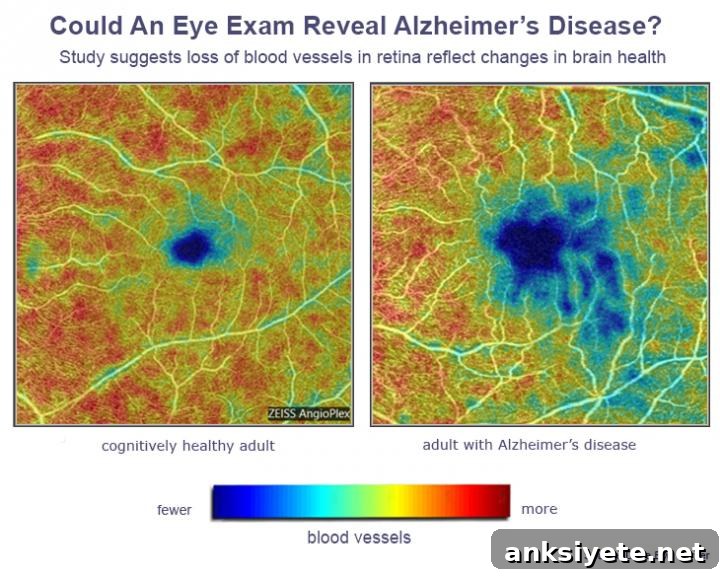
In the study, investigators used optical coherence tomography angiography (OCTA), a noninvasive imaging method that captures high-resolution images of blood flow in each layer of the retina. In 133 control participants with healthy cognitive function, the retinal microvasculature formed a dense, interconnected network across the back of the eye. By contrast, the retinas of 39 people diagnosed with Alzheimer’s disease showed visibly sparser vascular networks, with some regions showing pronounced reductions in vessel density.
“We are detecting blood vessels that are not visible during a standard eye exam,” said Sharon Fekrat, M.D., a Duke ophthalmologist and retinal surgeon and the study’s senior author. “Using newer, noninvasive OCTA technology, we can obtain high-resolution images of the retina’s smallest blood vessels in just a few minutes. These retinal microvascular changes could reflect similar small-vessel alterations in the brain, potentially appearing before measurable cognitive decline.”
The researchers compared vascular measurements across three groups: cognitively healthy control participants, people with mild cognitive impairment (MCI), and people with Alzheimer’s disease. After accounting for age, sex, and education level, vessel density differences between the Alzheimer’s group and the control group were statistically significant. The study also observed distinctions between Alzheimer’s disease and mild cognitive impairment, a condition often considered a precursor to dementia.
With nearly 6 million Americans currently living with Alzheimer’s disease and limited options for early, noninvasive detection, identifying reliable biomarkers is a high priority. Because the retina is an anatomical extension of the brain, retinal imaging has become an attractive area of research. Prior studies have reported retinal nerve layer thinning and other ocular changes in people with cognitive decline; this Duke study focused specifically on the microvascular network within the retina.
Dilraj S. Grewal, M.D., a Duke ophthalmologist, retinal surgeon, and lead author of the study, explained the potential advantage of OCTA: “OCTA can reveal changes in tiny capillaries—many less than half the width of a human hair—so it may detect microvascular abnormalities earlier than brain imaging techniques like MRI or cerebral angiography, which typically visualize larger vessels. Brain imaging can be more invasive, costly, or less sensitive to these early microvascular changes.”
Because OCTA is noninvasive, relatively quick, and increasingly available in ophthalmology clinics, it could become a practical tool for screening or longitudinal monitoring. “Our ultimate aim is to use retinal OCTA to identify Alzheimer’s disease at an earlier stage, before memory symptoms become apparent, and to track microvascular changes over time in participants enrolled in clinical trials of new therapies,” Fekrat said.
Study authors include Sharon Fekrat, M.D., Dilraj S. Grewal, M.D., Stephen P. Yoon, Atalie C. Thompson, Bryce W. Polascik, Cynthia Dunn, and James R. Burke. The research team reports controlling for demographic factors and using standardized OCTA protocols to quantify retinal vessel density across participant groups.
Source:
Duke University Medical Center
Media Contact:
Samiha Khanna – Duke University Medical Center
Image Source:
Optical coherence tomography angiography (OCTA) images captured by Duke Eye Center for this study. The full study was published March 11 in Ophthalmology Retina.
Original Research: Paywalled
Retinal Microvascular and Neurodegenerative Changes in Alzheimer’s Disease and Mild Cognitive Impairment Compared with Control Participants
Presented at the Association for Research in Vision and Ophthalmology Annual Meeting (April–May 2018) and other professional meetings. DOI: 10.1016/j.oret.2019.02.002
Funding and disclosures: The study was supported in part by the National Institutes of Health (grant P30EY005722), Research to Prevent Blindness (unrestricted grant to Duke University), and the Karen L. Wrenn Alzheimer’s Disease Award. Financial disclosures include support to D.S.G. from Allergan and Alimera. The funding organizations did not influence study design or conduct.