
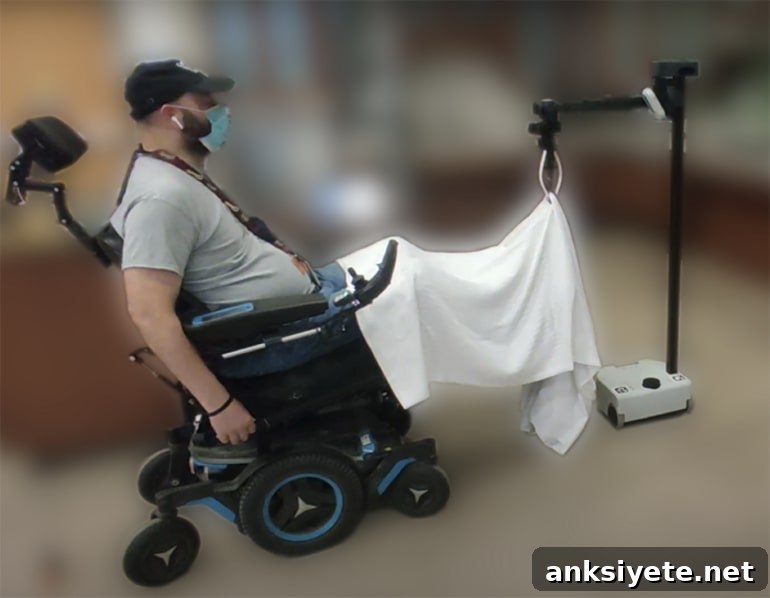
Summary: A new head-worn device enables people with movement disorders and paralysis to operate mobile manipulators more effectively, increasing independence, safety, and quality of life.
Source: Carnegie Mellon University
More than five million people in the United States live with some form of paralysis and often face barriers when performing routine activities such as reaching for a glass, dressing, or managing objects around the home.
Researchers at Carnegie Mellon University’s Robotics Institute have developed a practical assistive interface designed to expand autonomy for individuals with motor impairments. The solution is a head-worn device that combines intuitive head-motion sensing with voice commands to teleoperate a mobile manipulator, giving users a hands-free way to control a robot arm and mobile base.
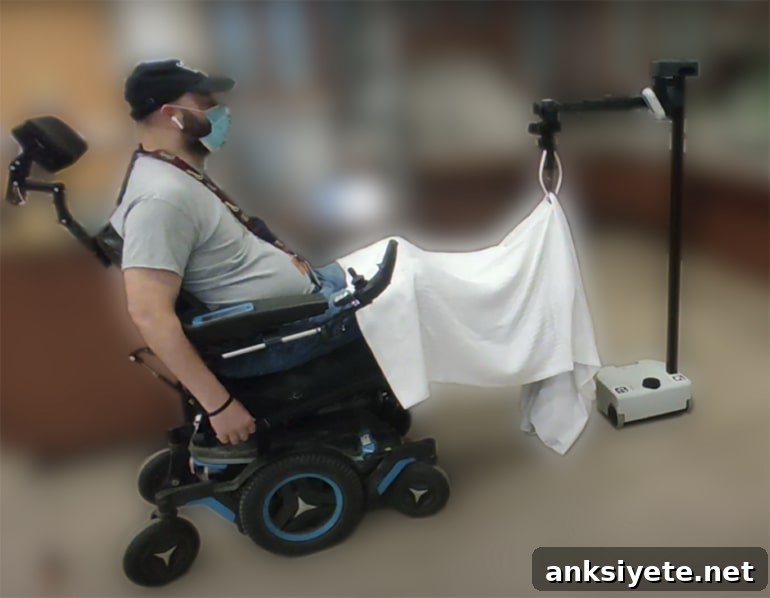
Traditional control interfaces for teleoperated robots often depend on fine motor skills — for example, hand-operated joysticks, touchscreens, or complex web interfaces. These modalities can exclude people who have limited hand or finger movement. The head-worn assistive teleoperation system, called HAT, is explicitly designed to reduce that dependency by using two primary input channels: a lightweight head-worn sensor that detects intentional head motion and a hands-free microphone for speech recognition. Together, these channels provide an accessible, low-effort way to guide a mobile manipulator through everyday tasks.
Because HAT emphasizes simple, natural inputs, it can lower cognitive and physical demands on users. Head movements are mapped to robot motion in a way that minimizes accidental commands, and voice commands allow users to trigger higher-level actions or switch control modes without needing manual interfaces. The combined approach supports precise manipulation when required, while still remaining approachable for people with a wide range of motor abilities.
The work is led by robotics Ph.D. student Akhil Padmanabha and includes collaborators Qin Wang, Daphne Han, Jashkumar Diyora, Kriti Kacker, Hamza Khalid, Liang-Jung Chen, Carmel Majidi and Zackory Erickson. In a human study, participants both with and without motor impairments used HAT to perform a range of household and self-care tasks. The system demonstrated low error rates, required minimal physical effort from users, and rated highly for ease of use by participants. These encouraging results indicate HAT’s potential to be adopted as an assistive option for people who cannot use traditional, hand-based interfaces.
Beyond immediate usability, the HAT concept highlights broader benefits for assistive robotics and accessible technology. Mobile manipulators controlled in a stable, intuitive manner can help reduce caregiver dependence, enable safer and more independent daily living, and expand participation in routine activities. The head-worn hardware is lightweight and intended to be nonintrusive, making it suitable for long-term daily use in homes, assisted living environments, or rehabilitation centers.
The research team plans to continue refining HAT to improve robustness, personalization, and adaptability across different users and settings. Future development paths include optimizing sensor calibration, refining speech recognition for diverse voices, and integrating adaptive control strategies that learn a user’s preferred mappings between head gestures and robot actions. These improvements could further shorten training time and improve long-term satisfaction for users with diverse needs.
The full paper, titled “HAT: Head-Worn Assistive Teleoperation of Mobile Manipulators,” will be presented at the IEEE International Conference on Robotics and Automation (ICRA). The presentation will share technical details, human-subject study methodology, and user feedback collected during testing, offering insight into how head-worn assistive teleoperation can become a practical tool for increasing independence among people with motor impairments.
About this neurotech research news
Author: Aaron Aupperlee
Source: Carnegie Mellon University
Contact: Aaron Aupperlee – Carnegie Mellon University
Image: The image is credited to Carnegie Mellon University
Original Research: The findings will be presented at the 2023 IEEE International Conference on Robotics and Automation (ICRA)