
Summary: Using high-resolution live imaging of embryonic mouse cortex, researchers discovered an active, multi-layered pyramidal neuron circuit that forms far earlier than expected. Genetically disrupting this circuit produces anatomical and functional changes resembling those observed in autism spectrum disorder.
Source: IOB
Researchers applied a new single-cell, in vivo approach to live embryonic mouse brains and uncovered an unexpectedly early, functional multi-layer cortical circuit.
When the team genetically perturbed this embryonic circuit, the resulting changes resembled cortical features associated with autism. The study, conducted at the Institute of Molecular and Clinical Ophthalmology Basel (IOB), is published in Cell.
“Mapping the precise development of cortical cell types and the circuits they form is essential for understanding autism and other neurodevelopmental disorders,” says Botond Roska, Director at IOB and the paper’s corresponding author. “Our results provide new evidence that embryonic circuits can be involved in disease etiology.”
Autism spectrum disorder is frequently linked to atypical cortical circuitry. The cortex—responsible for sensory processing, cognition, and higher-order behaviors—is dominated by excitatory pyramidal neurons. How and when these pyramidal neurons first assemble into active circuits during embryonic development has been poorly understood.
Studying those early events presents technical challenges. Cortical pyramidal neurons are tiny—about a tenth of the width of a human hair—and any motion during experiments can corrupt activity measurements. To preserve physiological conditions while stabilizing embryos for imaging, the researchers developed a novel surgical setup: embryos were held inside agar-stabilized three-dimensional supports positioned within the mother’s abdominal cavity, maintaining normal embryonic blood flow and temperature during recordings.
The textbook model of cortical formation describes an “inside-out” pattern: the deepest cortical layers form first and later-born neurons migrate outward, becoming active as they settle and establish synaptic connections. However, the team observed a distinct pattern of early activity that diverged from this traditional view.
Focusing on Rbp4-Cre–labeled pyramidal neurons destined for layer 5, the researchers found a transient but highly active multi-layer circuit present well before the cortex completed its six-layered organization. This early motif displayed strong correlated activity across two embryonic sublayers—a deep layer and a superficial layer—indicating functional connectivity existed before neurons reached their adult laminar positions.
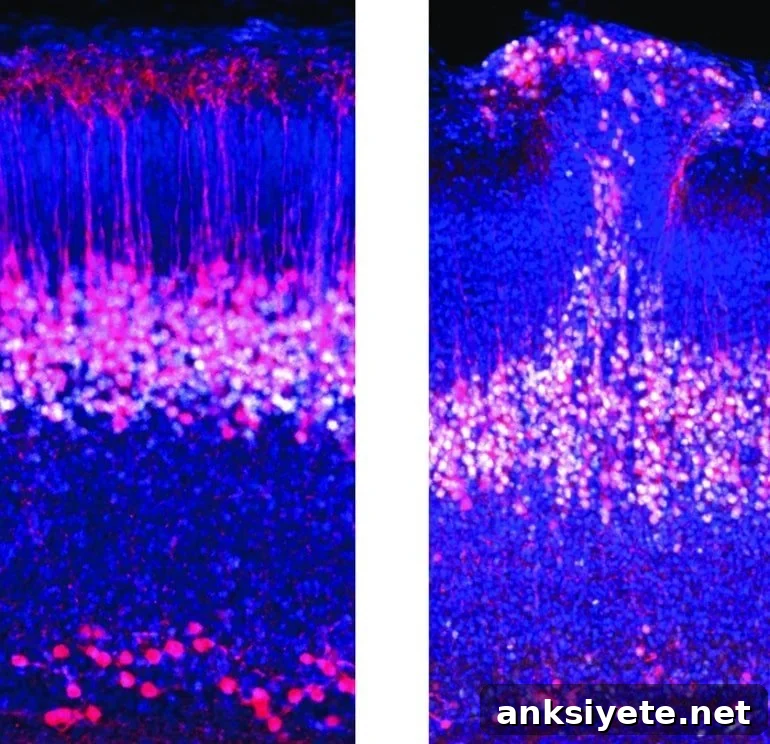
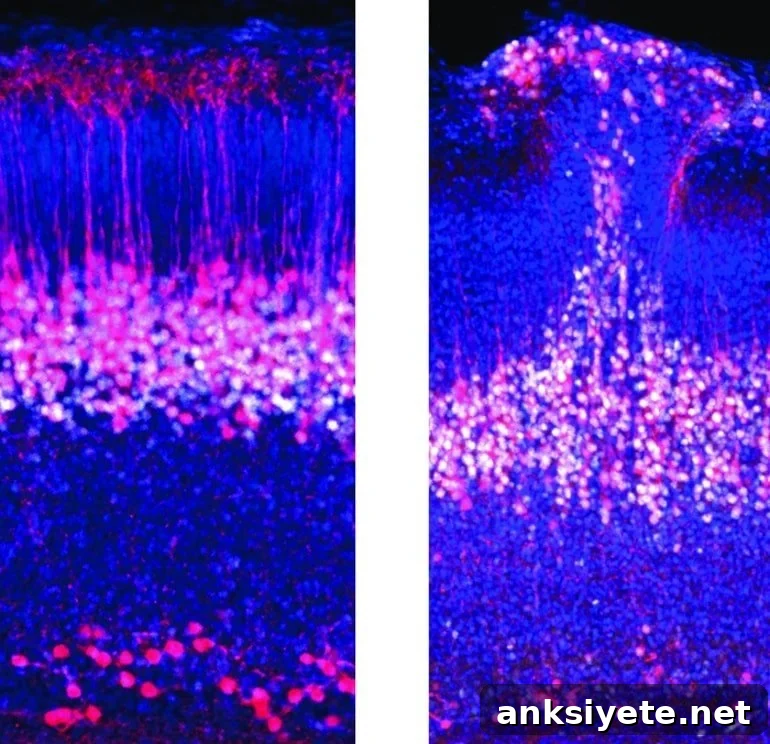
The transient circuit initially comprised two layers. As development progressed, the superficial layer became silent and disappeared, allowing the classical layer-by-layer cortical maturation to continue. A third, intermediate layer then emerged and ultimately formed mature layer 5.
To probe the circuit’s relevance to neurodevelopmental disease, the team examined mouse lines lacking one or both copies of autism-associated genes Chd8 and Grin2b, which are strongly implicated in human autism. In these knock-out mice, the superficial component of the early circuit failed to disappear and persisted throughout embryonic development. The disturbed mice also displayed patchy cortical disorganization reminiscent of abnormalities reported in some human autism cases.
Electrophysiological recordings and two-photon calcium imaging revealed that embryonic Rbp4-Cre neurons have active somas and processes, voltage-gated conductances sensitive to tetrodotoxin, and functional glutamatergic synapses from the earliest stages examined. Transcriptomic profiling showed these embryonic neurons express many autism-associated genes. Genetic perturbations of those genes interfered with the developmental switch from the initial multi-layer motif to the later adult-like organization.
These results indicate that pyramidal neurons form active, transient, multi-layered pyramidal-to-pyramidal circuits at the very inception of the neocortex, and that disruptions to these embryonic circuits can lead to persistent changes in cortical organization. The work highlights a potential developmental window during which genetic risk factors for autism can alter circuit assembly and cortical patterning.
“Our next steps are to dissect the roles of the superficial and deep components of this early circuit and to manipulate them independently,” Roska explains. “Understanding how each layer contributes to later cortical architecture will help clarify the origins of neurodevelopmental disorders.”
About this neurodevelopment research news
Author: Clara Vuille-dit-Bille
Source: IOB
Contact: Clara Vuille-dit-Bille – IOB
Image: The image is credited to Institute of Molecular and Clinical Ophthalmology Basel (IOB)
Original Research: Closed access. “Pyramidal neurons form active, transient, multilayered circuits perturbed by autism-associated mutations at the inception of neocortex” by Botond Roska et al., published in Cell.
Abstract
Pyramidal neurons form active, transient, multilayered circuits perturbed by autism-associated mutations at the inception of neocortex
Highlights
- Mouse embryonic pyramidal neurons show two distinct phases of circuit assembly in vivo
- Pyramidal neurons first create a multi-layered circuit before classic cortical lamination begins
- This early circuit is transiently active, with functional synapses and voltage-gated conductances
- Mutations in autism-associated genes disrupt the normal transition between the two developmental phases
Summary
Cortical circuits are dominated by pyramidal-to-pyramidal connections, but how these excitatory networks assemble during embryogenesis has remained unclear. This study shows that embryonic Rbp4-Cre cortical neurons—transcriptomically similar to adult layer 5 pyramidal neurons—undergo two coordinated phases of circuit formation in vivo. At embryonic day 14.5, these neurons form a multi-layered motif composed exclusively of embryonic near-projecting–type neurons. By embryonic day 17.5, the circuitry transitions to a motif that includes all three embryonic cell types, resembling the diversity of adult layer 5.
In vivo patch-clamp recordings and two-photon calcium imaging demonstrate active somata and neurites, tetrodotoxin-sensitive voltage-gated conductances, and functioning glutamatergic synapses from the earliest stage examined. These embryonic neurons express numerous autism-associated genes, and genetic perturbation of those genes disrupts the switch between early and later motifs. The findings imply that transient embryonic pyramidal circuits are critical for proper cortical patterning and that their disruption may contribute to neurodevelopmental disorders such as autism spectrum disorder.