Mice carrying a human stuttering-associated gene mutation reveal new clues about the speech disorder
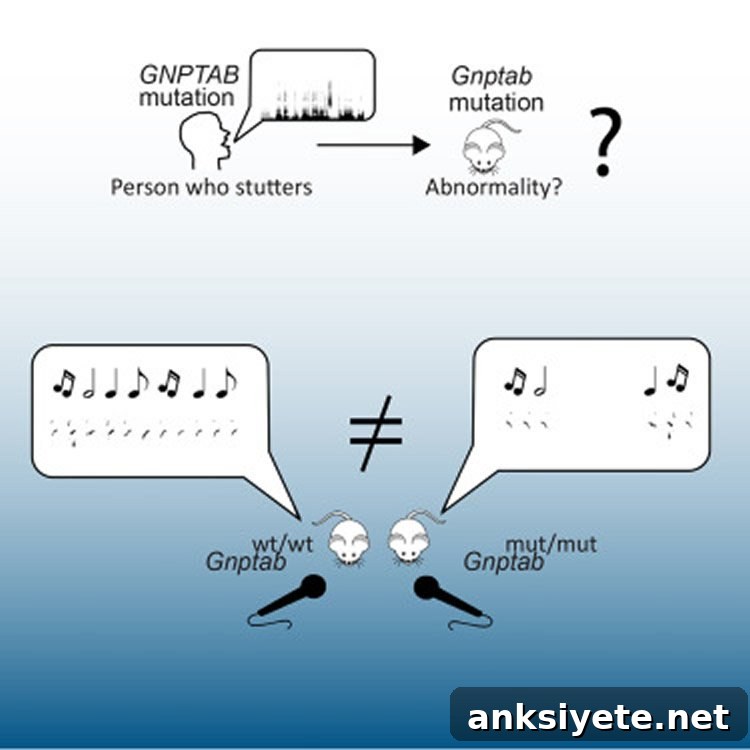
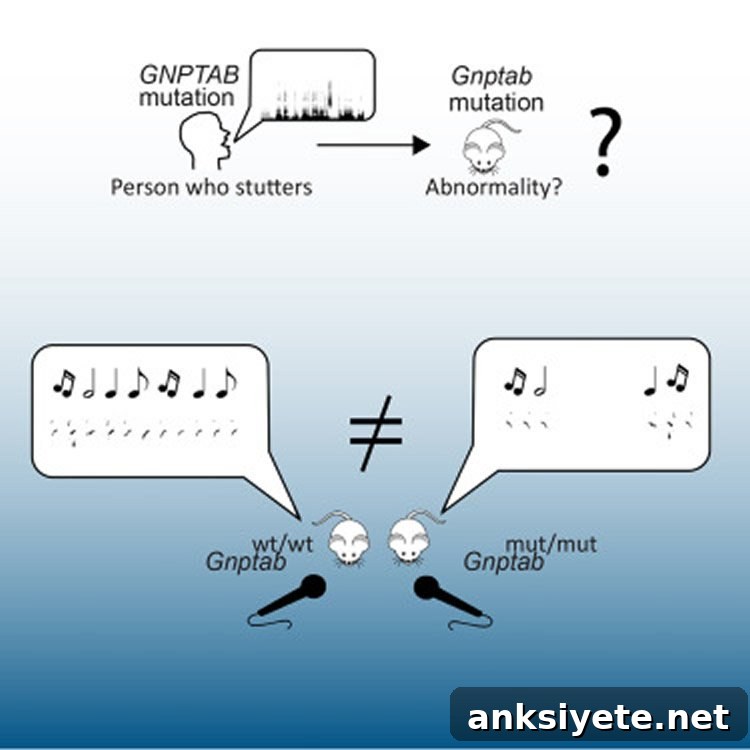
Researchers at Washington University School of Medicine in St. Louis, in collaboration with scientists at the National Institutes of Health, report that mice engineered with a mutation linked to human stuttering produce vocalizations with repetitive, halting patterns that resemble aspects of stuttered speech. This genetically informed mouse model gives researchers a new tool to probe the neurological and molecular roots of stuttering and could help guide development of targeted therapies.
The study, published online April 14, 2016 in Current Biology, focused on a mutation in the Gnptab gene (N-acetylglucosamine-1-phosphate transferase alpha/beta), a gene previously associated with stuttering in some people. The investigators replaced the normal mouse allele with the corresponding human mutation and analyzed the pups’ ultrasonic vocalizations to search for measurable differences that mirror human fluency disruptions.
“Although spoken language is uniquely human, many of the lower-level motor and timing building blocks required for speech — breath control, initiation of movement, coordination of orofacial muscles — are shared across mammals,” said Tim Holy, PhD, associate professor of neurosciences and the study’s senior author. “By studying these building blocks in mice, we can trace how a single genetic change alters the timing and structure of vocal output.”
Mice emit complex ultrasonic vocalizations that are usually too high in pitch for human ears. Young mouse pups produce spontaneous calls when separated from the mother; adults also vocalize in social or stressful contexts. The team recorded these ultrasonic calls from 3- to 8-day-old pups and applied a custom algorithm to analyze temporal patterns, pause durations, syllable usage and sequence structure.
Using this objective, language-agnostic approach, the researchers found that pups carrying the Gnptab mutation produced fewer calls per unit time, showed longer pauses between calls, and exhibited reduced entropy in the temporal sequence of syllables — meaning the sequence of vocal elements was less varied and more repetitive. These measurable features mirror some characteristics of human stuttering, such as long hesitations and repeated units.
To validate the metrics, the same algorithm was applied to recorded speech samples from people, including individuals who stutter and fluent speakers. The analysis successfully differentiated stuttered speech from nonstuttered speech, supporting the relevance of these acoustic and temporal measures across species and demonstrating that the mouse phenotype parallels key aspects of human stuttering.
Beyond their vocal patterns, the mutant mice performed similarly to wild-type littermates on a comprehensive battery of behavioral tests. Co-author David Wozniak, PhD, professor of psychiatry, and colleagues evaluated balance, coordination, strength, initiation of movement, spatial learning, memory and social behavior and found no substantial impairments. In this respect the mice resemble many people who stutter: otherwise neurologically and cognitively typical individuals with a very specific speech deficit.
“One striking scientific feature of stuttering is how specifically it affects speech and not other behaviors,” said Holy. “This mouse model captures that specificity, providing a clean system to study a complex task.”
The mechanism linking Gnptab to speech timing remains unclear. Gnptab plays a role in the lysosomal enzyme-targeting pathway, part of the cell’s system for degrading and recycling molecules. Severe loss-of-function mutations in this pathway cause metabolic diseases such as mucolipidosis II/III, but the missense mutations associated with stuttering appear to spare much of the gene’s known global function. It is possible that the mutation subtly alters a specific protein function or mildly compromises cellular processes in a narrowly defined set of brain cells that are critical for fluent vocal motor control.
“It’s surprising that a gene involved in cellular ‘housekeeping’ can have such a focused effect on vocal timing,” Holy said. “Either the protein has multiple roles and one is essential for speech circuitry, or a slight deficit hits a particularly sensitive population of neurons involved in initiating and sequencing vocal motor patterns.”
With a validated mouse model in hand, the team is planning follow-up experiments to map the affected neural circuits and investigate how the mutation changes cell biology and neuronal activity. These studies aim to deepen understanding of stuttering’s biological basis and identify potential targets for intervention.
Funding: This research was supported by the National Institutes of Health, including the Intellectual and Developmental Disabilities Research Center and the NIH/National Institute on Deafness and Other Communication Disorders.
Source: Diane Duke Williams — WUSTL
Image credit: Holy et al./Current Biology
Original research: “A Mutation Associated with Stuttering Alters Mouse Pup Ultrasonic Vocalizations” by Terra D. Barnes, David F. Wozniak, Joanne Gutierrez, Tae-Un Han, Dennis Drayna, and Timothy E. Holy in Current Biology. Published online April 14, 2016. doi:10.1016/j.cub.2016.02.068
Abstract
A Mutation Associated with Stuttering Alters Mouse Pup Ultrasonic Vocalizations
Highlights
- Mutations in the lysosomal enzyme-targeting pathway have been linked to stuttering in humans.
- Mice engineered with a corresponding mutation show measurable abnormalities in ultrasonic vocalizations.
- Non-vocal behaviors in the knockin mice appear largely intact, indicating a specific vocal deficit.
- People who stutter with this genetic profile display comparable features in their speech recordings.
Summary
Studying disorders that selectively affect speech offers a promising route to uncover mechanisms that shape vocal production. Stuttering has been associated with mutations in genes involved in the lysosomal enzyme-targeting pathway, but how alterations in broadly acting cellular machinery lead to a very specific speech deficit has been unclear. To investigate, the researchers introduced a missense mutation linked to human stuttering into the mouse Gnptab gene and compared the pups’ ultrasonic vocalizations with those of wild-type littermates. The mutated mice emitted fewer vocalizations per unit time, showed longer pauses between vocal elements, and produced vocal sequences with reduced entropy, indicating more repetitive patterns. The mutant mice otherwise performed like control mice across a wide range of behavioral assays. Applying the same analytical metrics to human speech recordings, the team observed parallel abnormalities in people who stutter with this type of mutation. Together, these results demonstrate that mutations in the lysosomal enzyme-targeting pathway can produce highly specific deficits in vocal timing and sequencing and establish the mouse as a useful model for studying stuttering.
“A Mutation Associated with Stuttering Alters Mouse Pup Ultrasonic Vocalizations” by Terra D. Barnes, David F. Wozniak, Joanne Gutierrez, Tae-Un Han, Dennis Drayna, and Timothy E. Holy in Current Biology. Published online April 14, 2016. doi:10.1016/j.cub.2016.02.068