
Gene mutations that disrupt cell signaling during embryonic development and cause major birth defects may also produce more subtle brain alterations that contribute to psychiatric disorders such as schizophrenia, autism, and bipolar disorder, according to new research from scientists at the University of California, San Francisco.
Researchers in the laboratory of psychiatrist Benjamin Cheyette, MD, PhD, have previously shown that mice lacking the Dact1 gene exhibit a spectrum of severe developmental malformations, including defects that resemble spina bifida in humans. Building on that work, the team asked whether Dact1 mutations could also cause less obvious changes in the brain that might increase risk for mental illness.
To investigate this, Cheyette, John Rubenstein, MD, PhD, and colleagues in UCSF’s Nina Ireland Laboratory of Developmental Neurobiology used a genetic approach to remove the Dact1 protein specifically from interneurons — the inhibitory cells that regulate electrical activity across the cerebral cortex and shape key cognitive and sensory processes. Dysfunction of interneurons has been implicated in a variety of psychiatric conditions, so examining Dact1’s role in these cells could reveal links between developmental gene networks and later psychiatric symptoms.
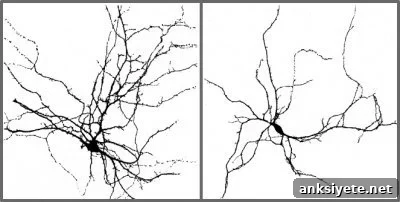
When the researchers examined these genetically altered interneurons in adult mice, the cells appeared to reach their correct positions in cortical circuits and their numbers were preserved. However, the altered interneurons had significantly fewer synapses — the specialized contacts where neurons communicate. In further observations not included in the new paper, the team also noted that dendrites, the fine, tree-like extensions that normally form dense arbors studded with synaptic contacts, were less developed and sparsely branched in mice lacking Dact1 in interneurons.
“When you delete this gene function after the earliest developmental stages — eliminating it only in neurons after they have formed — the cells migrate to the right place and their numbers are correct, but their morphology is somewhat abnormal,” Cheyette said. “That pattern aligns with the subtle kinds of pathology that researchers often see in psychiatric illness. Neurological diseases often show clear, focal lesions you can detect with imaging; psychiatric illnesses tend to be subtler, with differences that are much harder to visualize.”
The Dact1 protein functions within the Wnt signaling pathway, a fundamental biological system that coordinates a wide range of developmental processes across species, from fruit flies to humans. Wnt pathway interactions guide many aspects of embryonic development, including the formation and organization of the nervous system. One essential role of Wnt signaling is maintaining cellular polarity — the asymmetric distribution of proteins and structures within a cell that allows neurons to develop distinct input (dendritic) and output (axonal) regions. Proper polarity is crucial because neurons are among the most polarized cells in the body, and their specialized zones must be correctly positioned for normal connectivity and function.
Cheyette and his colleagues are continuing this line of research by running behavioral tests on the mice used in the current study and on related genetically engineered lines. Those experiments are designed to determine whether loss of Dact1 in interneurons produces behavioral changes relevant to psychiatric conditions, including measures of social interaction, sensory processing, anxiety-like behavior, and motivation. The research team also plans follow-up studies with collaborators at UCSF to assess whether the functional activity of neurons lacking Dact1 is impaired in addition to the structural abnormalities already observed.
Complementing the mouse work, unpublished human genetics data from Cheyette’s group indicate that people with autism may be more likely than typical comparison subjects to carry mutations in WNT1, a key gene in the Wnt signaling pathway. These preliminary findings suggest that genes crucial for embryonic development can also have important roles later in brain maturation and function — and when mutated they may predispose individuals to psychiatric disorders that emerge in childhood or adulthood.
“Just because a gene plays a critical role during embryogenesis doesn’t mean it isn’t important in the mature brain as well,” Cheyette said. “Someone with a mutation in a developmental gene might appear to develop normally at birth yet later show symptoms of autism in childhood or experience a psychotic episode in adulthood that leads to a diagnosis of schizophrenia.”
John Rubenstein serves as the Nina Ireland Distinguished Professor in Child Psychiatry.
Study authors and acknowledgements
Additional authors on the study include postdoctoral scholars Xiaoyong Yang, PhD, Daniel Vogt, PhD, and Amelia Stanco, PhD, and graduate student and first author Annie Arguello. Yang and Stanco received support from a postdoctoral training grant (T32) to the UCSF Department of Psychiatry from the National Institute of Mental Health. Arguello carried out this work while pursuing her PhD in the UCSF doctoral program in Biomedical Sciences and received support from the Initiative to Maximize Student Development Program of the National Institute of General Medical Sciences, as well as support from the UCSF Department of Psychiatry and the Center for Neurobiology and Psychiatry.
Contact: Jeffrey Norris – UCSF
Source: UCSF press release
Image source: The interneuron image is credited to UCSF and was adapted from the laboratory’s materials.
Original research: Full open-access article “Dapper Antagonist of Catenin-1 Cooperates with Dishevelled-1 during Postsynaptic Development in Mouse Forebrain GABAergic Interneurons” by Annie Arguello, Xiaoyong Yang, Daniel Vogt, Amelia Stanco, John L. R. Rubenstein and Benjamin N. R. Cheyette in PLOS ONE. Published online June 24, 2013.