
Summary: New research highlights the structural protein tubulin as a potential biomarker and therapeutic target for depression. Modified tubulin appears to tether the signaling protein Gαs inside lipid rafts in cell membranes, reducing production of cAMP and weakening neuronal signaling. Prior imaging studies have linked reduced cAMP levels in the brain with depression, a deficit that can be reversed by effective treatment.
Source: SfN
Scientists identify a structural protein as a promising focus for diagnosing and treating depression
Tubulin, a key structural protein that forms microtubules inside cells and supports numerous cellular functions, also influences signaling pathways relevant to mood regulation. Research published in the Journal of Neuroscience shows that a less-acetylated form of membrane-associated α-tubulin preferentially associates with lipid raft domains in the cell membrane and helps anchor the G protein subunit Gαs within those lipid rafts. When Gαs is trapped in lipid rafts, it is less effective at activating adenylyl cyclase, the enzyme that produces cyclic AMP (cAMP). cAMP is essential for fast intracellular signaling in neurons, and lower cAMP levels have been observed in people with depression; successful antidepressant treatments restore cAMP signaling.
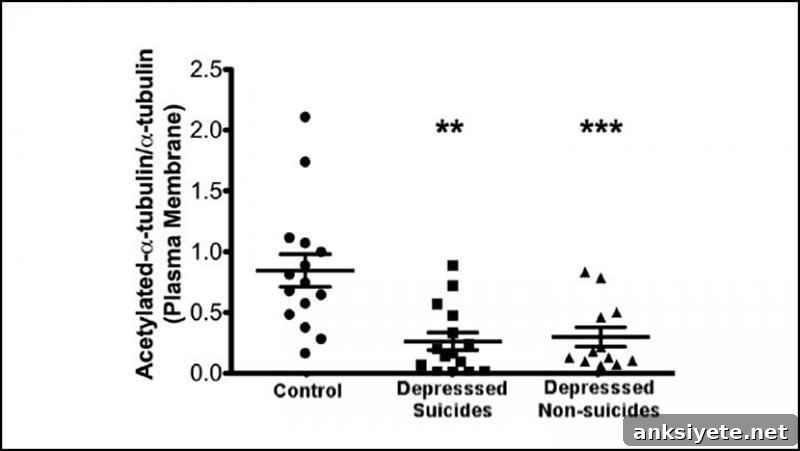
In the study by Singh and colleagues, researchers examined postmortem prefrontal cortex samples from control subjects and from individuals with depression who died by suicide or by other causes. While the total levels of acetylated tubulin in whole tissue homogenates were not different between groups, the fraction of membrane-associated tubulin that was acetylated was significantly lower in depressed subjects compared with controls. This decrease in tubulin acetylation at the plasma membrane correlated with a greater retention of Gαs in lipid-raft domains, which provides a molecular explanation for the reduced cAMP signaling seen in depression.
The findings suggest that the acetylation state and membrane localization of tubulin influence Gαs distribution and thus the efficiency of cAMP production. Because antidepressant drugs and HDAC6 inhibitors can increase tubulin acetylation and reduce the proportion of Gαs complexed with tubulin in vitro, membrane tubulin dynamics could be both a diagnostic marker and a therapeutic target for mood disorders.
About this neuroscience research article
Source: SfN
Media Contacts:
Calli McMurray – SfN
Image Source:
Image credited to Singh et al., Journal of Neuroscience, 2020.
Original Research: Closed access
Title: “Membrane-Associated α-Tubulin Is Less Acetylated in Postmortem Prefrontal Cortex From Depressed Subjects Relative to Controls: Cytoskeletal Dynamics, HDAC6 and Depression”.
Authors: Harinder Singh, Justyna Chmura, Runa Bhaumik, Ghanshyam N. Pandey, Mark M. Rasenick and Jesse Brown.
Journal of Neuroscience. DOI: 10.1523/JNEUROSCI.3033-19.2020
Abstract (condensed)
Post-translational modifications of cytoskeletal proteins play an important role in brain function and have been implicated in mood disorders. Tubulin modifications alter microtubule dynamics and influence interactions with signaling proteins such as Gαs. Prior postmortem studies revealed increased localization of Gαs to lipid-raft domains in depressed brain tissue, and this localization reduces Gαs coupling to adenylyl cyclase and subsequent cAMP production—an effect reversible with antidepressant treatment. Building on in vitro evidence that tubulin anchors Gαs to lipid rafts and that increased tubulin acetylation reduces this interaction, the present study compared tubulin acetylation across whole tissue homogenate, plasma membrane, and lipid-raft membrane fractions from control subjects, depressed suicides, and depressed non-suicides. While whole-tissue acetylation did not differ, membrane-associated tubulin acetylation was significantly decreased in depressed subjects. Enzymes that regulate tubulin acetylation and deacetylation did not show altered expression, suggesting the change is localized to membrane compartments. The authors propose that membrane-localized deacetylated tubulin promotes sequestration of Gαs into lipid rafts, attenuating cAMP signaling in depression. These membrane changes may offer diagnostic and therapeutic opportunities.
Significance
This study strengthens the link between cytoskeletal regulation and depressive disorders by demonstrating a specific change in membrane-associated tubulin acetylation in depressed human brain tissue. The decreased acetylation is associated with enhanced Gαs localization to lipid rafts and reduced cAMP signaling, a pathway previously tied to depressive symptoms and recovery with treatment. By pinpointing membrane tubulin modification as a contributor to impaired G protein signaling, the research highlights a novel locus for potential diagnostic markers and interventions in depression.
Feel free to share this depression research news.