
Summary: Researchers have created a multimodal ion-electronic skin capable of simultaneously detecting temperature and mechanical stimuli with high fidelity.
Source: POSTECH
Human skin is far more than a passive barrier: it is a finely tuned sensory organ that detects temperature, pressure, stretching and pain, and converts those inputs into electrical signals that the nervous system can interpret. That rich sensory capability—provided by a dense network of tactile receptors and electrolytes in the skin—enables rapid, nuanced responses to the environment. Reproducing that same multimodal sensing in artificial systems is a major goal for wearable devices, prosthetics and humanoid robots, but until now most electronic skins could sense either temperature or mechanical deformation well, not both at the same time.
A collaborative team led by Professor Unyong Jeong and Dr. Insang You at POSTECH, together with Professor Zhenan Bao at Stanford University, has developed an ion-electronic skin that overcomes this limitation. Published in the November 20 edition of Science, their work demonstrates a simple, highly stretchable sensor that simultaneously measures temperature and a variety of mechanical stimuli—such as pushing, pinching, twisting and stretching—using the distinct electrical responses of an ion-conducting electrolyte.
The design takes inspiration from natural skin. Human skin’s resilience and sensor functionality arise in part because its tissues contain electrolytes that support ionic motion and polarization under external stimuli. The research team exploited similar properties in an ion conductor: depending on the frequency at which the material is probed electrically, different physical processes dominate the response. By measuring at two carefully chosen frequencies, the device can separate signals that report temperature from those that reflect mechanical deformation.
From the ion conductor’s electrical behavior the researchers identified two key, independent variables. The first, charge relaxation time, describes how quickly ion polarization decays and is sensitive to temperature changes while remaining essentially unaffected by mechanical movement. The second, normalized capacitance, tracks changes in capacitance that result from strain or contact forces and does not respond to temperature. Because these two metrics are orthogonal, the sensor can report temperature and mechanical information independently and simultaneously by running two simple frequency-domain measurements.
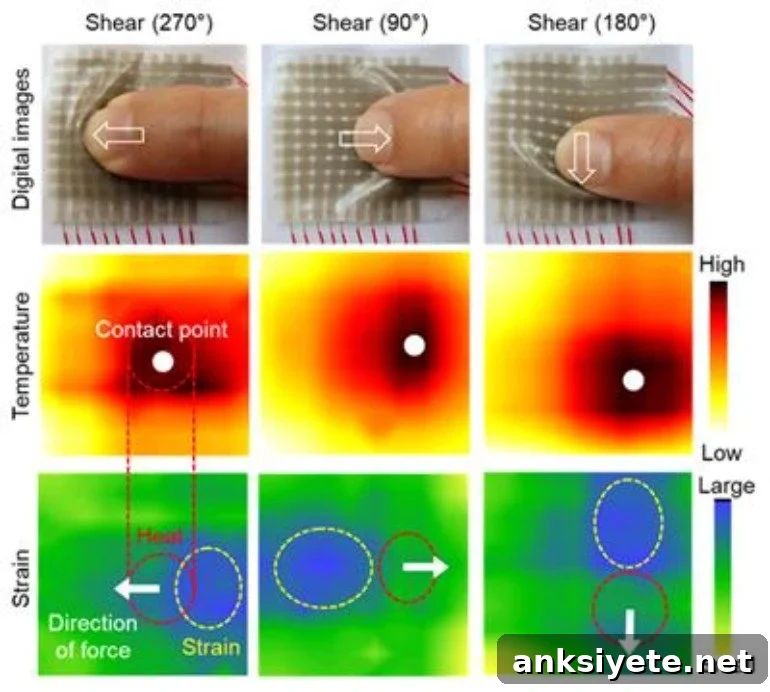
Remarkably, the sensor uses a straightforward electrode–electrolyte–electrode architecture that is mechanically compliant and highly stretchable, mirroring the flexibility of biological skin. That simplicity supports manufacturability and strengthens the device’s commercialization potential. Functionally, the artificial receptor accurately measures the temperature of an object in contact with the skin while also mapping the direction and local strain profile produced by external actions—squeezing, pinching, spreading and twisting are all resolved by the device.
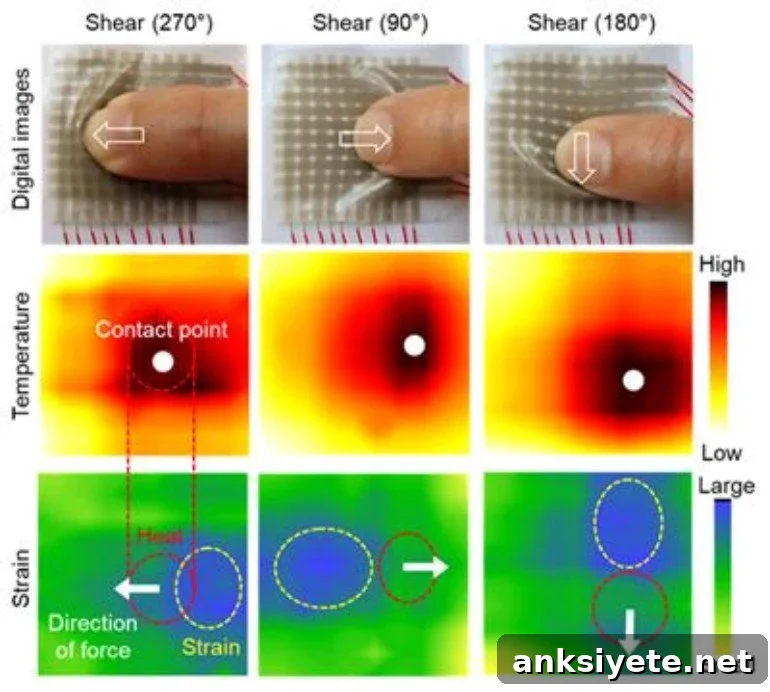
“When an index finger touches an electronic skin, the electronic skin detects contact as a temperature change, and when a finger pushes the skin, the back part of the contact area stretches and recognizes it as movement,” explained Dr. Insang You of POSTECH, first author of the paper. “I suspect that this mechanism is one of the ways that the actual human skin recognizes different stimuli like temperature and movement.”
Professor Unyong Jeong, corresponding author, emphasized the broader implications: “This study opens a new path for multimodal electronic skin research based on electrolytes. Our long-term aim is to develop artificial ion-electronic skin that more fully emulates human tactile receptors and neurotransmitter signaling. Such technology has the potential to restore tactile sensation for patients who have lost it due to injury or illness and to provide more natural touch interfaces for robots and prosthetic devices.”
Because the sensor decouples thermal and mechanical signals using frequency-selective measurements rather than complex material stacks or large sensor arrays, it offers a compact, energy-efficient route to rich tactile feedback. Potential applications include wearable temperature monitors that remain accurate under motion, robotic skins for humanoid machines that require lifelike touch perception, and next-generation prosthetic covers that can return multiple types of sensory information to users.
The research received support from the Global Frontier Project and the Mid-career Researcher Program of the Ministry of Science and ICT, and from the Industrial Strategic Technology Development Program of the Ministry of Trade, Industry and Energy of Korea.
About this neurotech research news
Source: POSTECH
Contact: Jinyoung Huh – POSTECH
Image: The image is credited to POSTECH
Original Research: The study will appear in Science