
Scientists at the University of Tübingen investigate how prior knowledge shapes our visual experience of color
Color perception has long intrigued neuroscientists because the brain shapes what we see to such an extent that color can sometimes be considered an interpretation rather than a simple sensory fact. One persistent question is how the brain responds when we view black-and-white photographs of objects we normally associate with specific colors. Does the brain “fill in” those expected colors even when none are present?
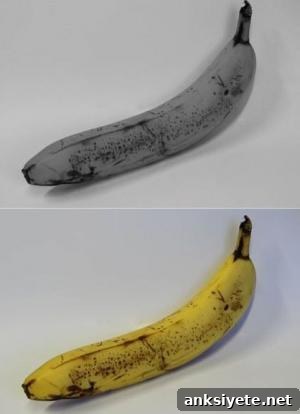
Researchers Michael Bannert and Andreas Bartels from the Bernstein Center and the Werner Reichardt Centre for Integrative Neuroscience at the University of Tübingen explored this question in a study published in the journal Current Biology. Participants saw grayscale photographs of objects with strong color associations—bananas, broccoli, strawberries and others whose typical colors are yellow, green or red. While the participants viewed these monochrome images, the investigators measured brain activity with functional neuroimaging.
To compare responses to imagined color with responses to actual color, the team later presented colored rings—yellow, green, red and blue—to the same participants and recorded the neural responses elicited by real color stimuli. This two-part design allowed the researchers to determine whether the brain signals triggered by grayscale images mirrored the signals evoked by genuine color input.
The results were striking. Simply viewing black-and-white images triggered neural activity patterns that encoded color information consistent with each object’s typical color, despite the absence of color in the photographs. In other words, the brain responses to a grayscale banana resembled those seen when participants looked at the color yellow. The researchers could decode the objects’ typical colors from the measured brain activity even though the images themselves contained no chromatic information.
Equally notable was the location of this color encoding. The effect was observed in the primary visual cortex, the first cortical site to receive visual information from the eyes. Historically, scientists regarded primary visual cortex as primarily responsible for representing the basic physical attributes of a visual scene—edges, orientation, spatial frequency and basic color signals derived from the retina—rather than higher-level object knowledge. These findings indicate that higher-level prior knowledge about object colors is projected back onto the earliest stages of cortical visual processing.
According to the investigators, this top-down influence means that stored knowledge and expectations about the world shape perception very early in the visual pipeline. Such feedback can be highly useful: projecting prior knowledge onto early visual processing likely helps the brain recognize objects under poor viewing conditions, such as in fog, dim light, or when colors are ambiguous because of changing illumination throughout the day or when indoors. In these situations, using prior expectations can speed and stabilize recognition.
However, the same mechanism could also have downsides. When prior knowledge or expectations exert too much influence over early visual responses, they may bias perception excessively, contributing to strong illusions or, in extreme cases, to hallucinatory experiences. Understanding how and when expectations are integrated with sensory signals is therefore important for distinguishing adaptive perceptual inference from maladaptive misperception.
Notes on this neuroimaging and visual neuroscience study
Contact: Dr. Andreas Bartels – University of Tübingen
Source: University of Tübingen press release
Image credit: Mareike Kardinal / Bernstein Coordination Site (BCOS). Adapted from the University of Tübingen press materials.
Original research: “Decoding the Yellow of a Gray Banana” by Michael M. Bannert and Andreas Bartels, Current Biology. Published online October 31, 2013 (doi:10.1016/j.cub.2013.09.016).
Keywords: color perception, visual neuroscience, neuroimaging, primary visual cortex, object knowledge, University of Tübingen