Newly discovered gut-to-brain circuit signals fullness and could offer a route for viruses into the nervous system
When you finish a large meal, your stomach and intestinal cells release hormones into the bloodstream to tell your brain that you’re full. Now, researchers at Duke University describe a more direct pathway: a cellular, contact-based communication line between the gut and the nervous system that transmits real-time information about nutrients and satiety.
The findings, published January 2, 2015 in the Journal of Clinical Investigation, refine our understanding of gut-brain signaling and suggest how procedures such as gastric bypass might alter satiety. The study also raises the possibility that certain foodborne viruses could use this pathway to reach the nervous system.
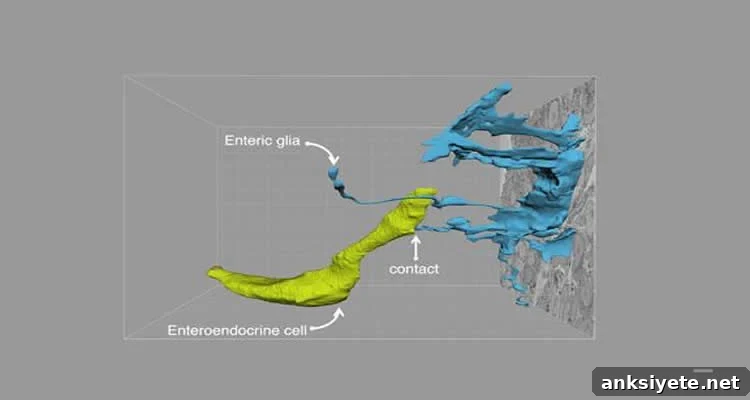
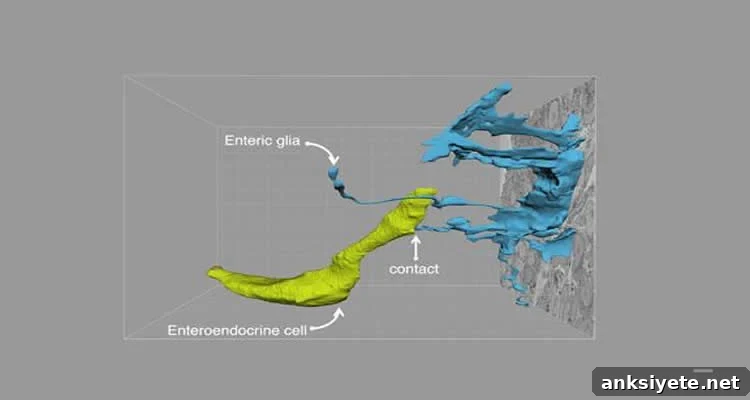
Scientists led by Diego Bohórquez and Rodger Liddle mapped specialized enteroendocrine cells in the intestinal lining that resemble neurons. These cells have conventional apical surfaces that sense luminal contents, but on their basal side they extend a long process—an arm-like projection—that the team has named a “neuropod.” Supported by glial cells (the support cells that normally associate with neurons), neuropods appeared positioned to form part of a neuronal circuit rather than acting solely as hormone secretors.
Using anatomical tracing and high-resolution microscopy, the researchers tracked neuropod contacts throughout the small and large intestine. They found neuropods in close proximity to individual nerve fibers, and roughly 60% of neuropods contacted sensory neurons. This pattern supports the idea that neuropods directly engage sensory neurons to convey information about gut contents.
To test whether neuropods form functional, physical connections with neurons, the team cultured single sensory neurons from the brain in isolation and observed their behavior in relation to neuropods. Remarkably, individual neurons extended processes and made contact with a neuropod located, at a cellular scale, about “half a football field” away—evidence that these enteroendocrine cells actively connect to neurons in a targeted way.
The neuropods contain many of the same molecular components neurons use to send and receive signals. To probe whether neuropods could provide a route for neuronal pathogens, the investigators exposed mouse colons to a genetically disabled form of rabies virus, a virus commonly used in neuroscience because it spreads across synaptic connections. A week after introduction, infection was restricted to cells bearing neuropods, demonstrating that the virus could move from the gut lumen into cells that connect to the nervous system.
“This provides a potential pathway for rabies to move from the gut into the nervous system,” said Rodger Liddle. While the experimental study used a disabled laboratory strain of rabies as a tracer, the results suggest that other viruses may, in certain circumstances, exploit neuropod-to-neuron connections to reach sensory neurons and ultimately the central nervous system.
Diego Bohórquez emphasized the immediacy of the signaling: as soon as food contacts the intestinal lining, neuropods can inform the brain in real time about what’s present in the gut, potentially shaping appetite and digestion independently of slower, blood-borne hormonal signals. That rapid, cell-to-cell gut-brain communication broadens the classical view of enteroendocrine function and highlights an anatomical substrate for “gut feelings.”
The study focused on the local connections between neuropods and nearby neurons in the intestinal wall. Future work from the team aims to trace the entire pathway from neuropod contacts in the gut to the specific circuits in the brain that receive and interpret these signals. Understanding that long-range wiring will be important for clarifying how nutrient sensing influences feeding behavior and how surgical or pathological changes in the gut might modify those signals.
Other contributors to the study include Rafiq Shahid, Alan Erdmann, Alex Kreger, Yu Wang, Nicole Calakos and Fan Wang. The research received funding support from the National Institutes of Health (grants R01DK091946 and F32DK094704) and the Department of Veterans Affairs (grant I01BX002230).
Contact: Karl Bates, Duke University
Source: Duke University press release
Image source: Diego Bohorquez, Duke University (adapted from the original press materials)
Original research: “Neuroepithelial circuit formed by innervation of sensory enteroendocrine cells” by Diego V. Bohórquez et al., Journal of Clinical Investigation, published online January 2, 2015. This open-access study reports the anatomical and functional evidence for direct neuropod-to-neuron communication between the gut epithelium and the nervous system.