
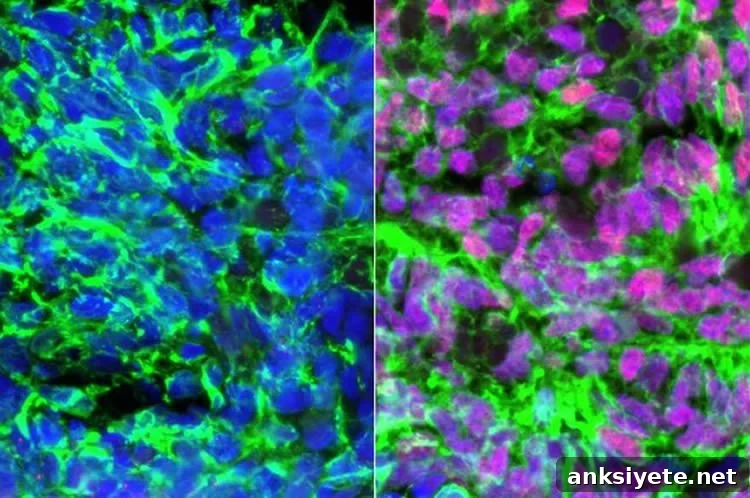
Summary: UCLA scientists have developed a method to convert human pluripotent stem cells into sensory interneurons, the spinal cord neurons that underlie touch and body sensation.
Source: UCLA.
Researchers at the Eli and Edythe Broad Center of Regenerative Medicine and Stem Cell Research at UCLA have, for the first time, directed human stem cells to become dorsal spinal sensory interneurons — the neurons that convey touch and proprioceptive information to the central nervous system. This laboratory protocol represents an important advance toward potential stem cell–based therapies to restore sensation in people with paralysis who have lost tactile and positional awareness in parts of their body.
The study, led by Samantha J. Butler, associate professor of neurobiology and member of the Broad Stem Cell Research Center, was published in the journal Stem Cell Reports.
Sensory interneurons are a class of spinal cord neurons that relay information from sensory receptors to the brain and spinal circuits, enabling touch, pressure detection and proprioception — the sense of body position. Loss of these sensory signals severely affects quality of life for people with spinal cord injuries: they may not feel simple contact or the pain that warns of heat or pressure, increasing the risk of accidental injury.
“Research has often emphasized restoring movement,” said Butler, the study’s senior author. “But the ability to feel is equally essential. Sensation and movement are tightly linked: to walk or perform coordinated actions, the nervous system must continuously sense the body in space.”
The current work builds on prior developmental studies by Butler’s group. In a separate paper published in eLife, the team described how a family of signaling proteins called bone morphogenetic proteins (BMPs) regulate sensory interneuron formation in chick embryos. In the new Stem Cell Reports study, those developmental signals were applied to human pluripotent stem cells in vitro to guide them toward sensory interneuron fates.
When researchers exposed human embryonic stem cells to retinoic acid together with BMP4, the cells differentiated into a reproducible mixture of dorsal sensory interneurons. The resulting population included dI1 interneurons, which drive proprioception (the internal sense of limb and body position), and dI3 interneurons, which contribute to mechanosensory responses such as pressure detection.
The same combination of retinoic acid and BMP4 produced the identical mixture of sensory interneurons from induced pluripotent stem cells (iPSCs) derived from adult cells. Because iPSCs retain the donor’s genetic background, this approach could enable autologous cell therapies that replace lost sensory neurons without triggering immune rejection — a critical advantage for future clinical applications.
Although the protocol reliably generates dI1 and dI3 interneurons together, Butler and colleagues aim to refine the method to produce individual sensory interneuron classes in isolation. Producing a single class at a time would help researchers define the unique roles that each interneuron subtype plays in sensory circuits and would simplify development of targeted cell therapies. The team suspects that additional signaling pathways beyond RA and BMP4 likely shape the decision between dI1 and dI3 fates, and those factors remain to be identified.
Beyond dI1 and dI3 cells, other dorsal interneuron types exist, and the precise combination of growth factors needed to create those classes from human pluripotent cells has not yet been established. Determining those recipes is an active area of investigation.
To assess whether the lab-derived dI1 and dI3 neurons can integrate and function in a living nervous system, the group is transplanting these cells into the spinal cords of mice. These in vivo studies will test whether the neurons survive, make appropriate connections, and contribute to sensory signaling — essential steps in evaluating clinical potential.
“We’re still at an early stage,” Butler emphasized. “We haven’t restored touch in patients, but we have defined a robust protocol to generate key classes of spinal sensory interneurons from human pluripotent cells. That foundational work is a major step toward future therapies that could reestablish sensation after spinal cord injury.”
Funding: This research was supported by grants from the California Institute for Regenerative Medicine, the Cal State Northridge–UCLA Bridges to Stem Cell Research program, the National Institutes of Health, and the UCLA Broad Stem Cell Research Center.
Source: Sarah C.P. Williams – UCLA
Publisher: Organized by NeuroscienceNews.com.
Image Source: Image credited to UCLA Broad Stem Cell Research Center/Stem Cell Reports.
Original Research: Full open-access research article “Deriving Dorsal Spinal Sensory Interneurons from Human Pluripotent Stem Cells” by Sandeep Gupta, Daniel Sivalingam, Samantha Hain, Christian Makkar, Enrique Sosa, Amander Clark, and Samantha J. Butler in Stem Cell Reports. Published online January 11, 2018. doi:10.1016/j.stemcr.2017.12.012
UCLA. “Researchers Make Cells That Enable the Sense of Touch.” NeuroscienceNews. January 14, 2018.
Abstract
Deriving Dorsal Spinal Sensory Interneurons from Human Pluripotent Stem Cells
Highlights
• A robust protocol to generate spinal sensory interneurons from human pluripotent stem cells.
• Retinoic acid with or without BMP4 directs human pluripotent stem cells toward dorsal interneuron classes dI1, dI2 and dI3.
• Only neural progenitors in an appropriate competence state respond to RA/BMP4 signals.
Summary
Cellular replacement therapies aim to restore function by replacing damaged neurons with those derived from human embryonic stem cells (hESCs) or induced pluripotent stem cells (iPSCs). Considerable progress has been made in generating spinal motor neurons for movement recovery, but until now no reliable protocol existed to generate spinal sensory interneurons that mediate perception of touch and body position. This study presents a directed differentiation strategy for both hESCs and iPSCs using retinoic acid and bone morphogenetic protein 4 to yield the proprioceptive dI1s, the dI2s, and mechanosensory dI3s. A key principle is the changing competence of neural progenitors over time, which determines their responsiveness to developmental cues. This protocol provides a foundation for developing cell-based approaches to reestablish sensory connections after injury.
“Deriving Dorsal Spinal Sensory Interneurons from Human Pluripotent Stem Cells” by Sandeep Gupta et al., Stem Cell Reports. Published online January 11, 2018. doi:10.1016/j.stemcr.2017.12.012