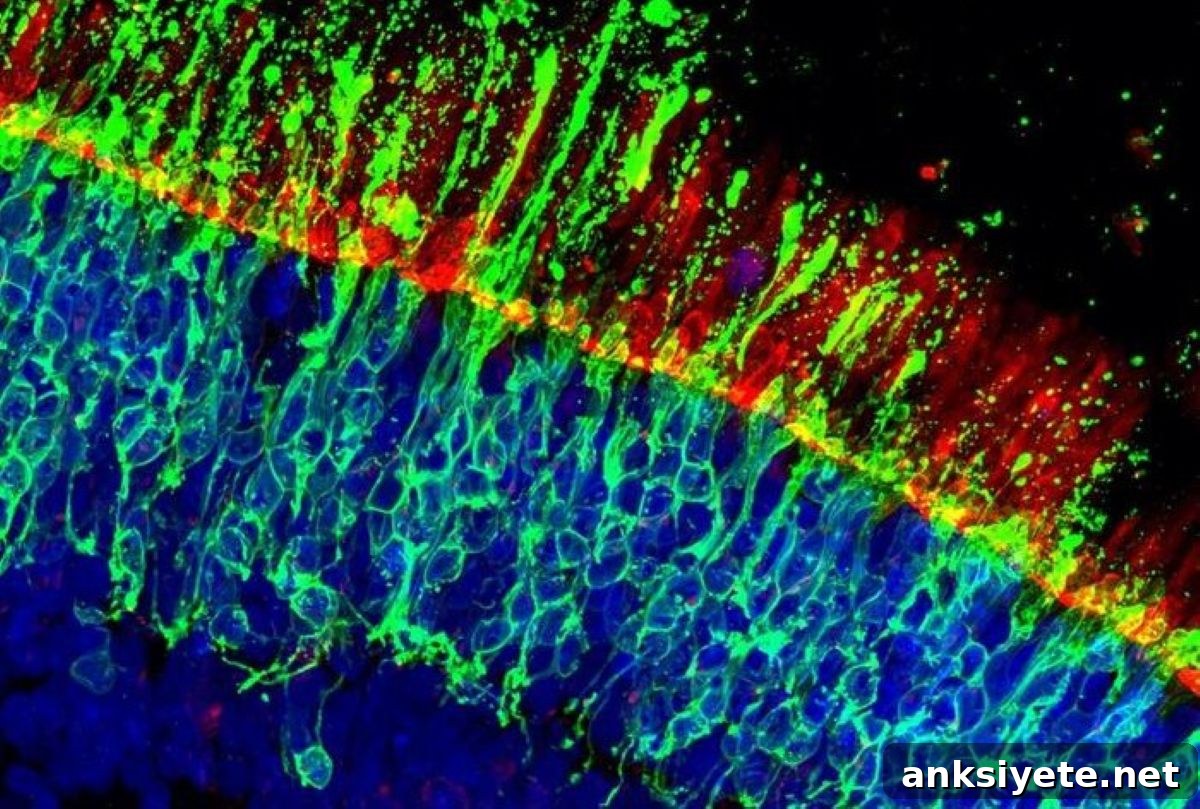
Summary: Losing the ability to read, recognize faces, or perceive color is a devastating consequence of age-related macular degeneration (AMD) and many inherited retinal diseases. Until now, no approved therapy has been shown to prevent the progressive loss of cone photoreceptors—the retinal cells that provide high-resolution central vision. A new study identifies genetic pathways and small molecules that can protect cones from degeneration, offering a promising foundation for therapies that aim to preserve central vision.
Using a large-scale human-based screening platform, researchers tested thousands of compounds in lab-grown retinal tissue and uncovered key molecular targets that either protect cone cells or, conversely, pose safety risks to them.
Key Facts
- Casein Kinase 1 (CK1) as a protective target: Inhibitors of CK1 emerged as robust protectors of cone photoreceptors under stress conditions that mimic disease.
- Extensive compound screen: The team tested 2,707 compounds across 20,000 human retinal organoids to evaluate effects on cone survival and retinal toxicity.
- Cross-species validation: Protective effects of selected compounds were reproduced in a mouse model of retinal degeneration, supporting translational relevance.
- Open dataset: The full screening dataset, including compound targets and their effects, has been released to the public as a resource for researchers developing vision-preserving therapies.
Source: IOB Basel
Study overview
A research team led by Botond Roska at the Institute of Molecular and Clinical Ophthalmology Basel (IOB) and collaborators used human retinal organoids to address a major unmet need in ophthalmology: preventing cone photoreceptor death. Cones, densely packed in the macula, are essential for tasks that require detailed, color vision—such as reading and face recognition. Their selective loss underlies the central visual decline seen in AMD and many inherited retinal disorders.
The investigators generated 20,000 human retinal organoids with cone photoreceptors labeled by green fluorescent protein (GFP), allowing tracking of cone survival over time. They induced cone degeneration to mimic disease-associated stress and screened 2,707 compounds with known molecular targets. The aim was to identify compounds that either sustain cone survival or accelerate cone loss, thereby mapping both protective strategies and potential retinal toxicities.
Major findings
- CK1 inhibitors consistently protected cones across multiple stress paradigms and time points.
- HSP90 inhibitors produced short-term cone preservation but led to longer-term damage, highlighting the importance of time-course evaluation in safety assessment.
- Broad histone deacetylase (HDAC) inhibition by several compounds correlated with significant cone damage, flagging a potential class-wide risk.
- The most promising protective compounds were validated in an in vivo mouse model of photoreceptor degeneration, adding evidence of their potential for further development.
By selectively labeling cones and applying controlled stress conditions, the study enabled a focused, cell type-specific screen rather than a whole-retina readout. This approach revealed clear, reproducible patterns in how molecular pathways influence cone fate and allowed ranking of compounds by their protective or harmful effects.
Key Questions Answered:
A: Cones are metabolically demanding, highly specialized cells concentrated in the macula to support fine central vision and color perception. Their specialized function and high energy needs make them particularly sensitive to metabolic and environmental stress. This study’s use of human retinal organoids—three-dimensional retinal tissue derived from stem cells—permits testing in a human cellular context, improving the relevance of findings compared with animal-only studies.
A: The findings represent a substantial advance toward prevention of cone loss rather than restoration of cones that are already lost. CK1 inhibitors and other protective compounds identified here may help preserve existing cones and slow or prevent central vision loss when applied in early stages of disease. Translational steps, including safety and efficacy testing in humans, remain necessary before clinical application.
A: A retinal organoid is a three-dimensional, lab-grown piece of human retinal tissue created from stem cells. These organoids recapitulate many features and cell types of the human retina and are valuable for screening drugs, studying disease mechanisms, and assessing cell-type-specific responses before advancing to animal models or clinical trials.
Editorial Notes:
- This article was edited by a Neuroscience News editor.
- The journal paper was reviewed in full.
- Additional context was provided by the editorial staff.
About this visual neuroscience and AMD research news
Author: Elsa Sigle
Source: IOB
Contact: Elsa Sigle – IOB
Image: The image is credited to IOB
Original Research: Open access.
Title: “Cell type-focused compound screen in human organoids reveals CK1 inhibition protects cone photoreceptors from death” by Stefan E. Spirig, Álvaro Herrero-Navarro, Larissa Utz, Valeria J. Arteaga-Moreta, Zoltan Raics, Susana Posada-Céspedes, Stephanie Chreng, Olaf Galuba, Inga Galuba, Isabelle Claerr, Steffen Renner, Miklos Boldogkoi, Verónica Moreno-Juan, P. Timo Kleindienst, Adrienn Volak, Jannick Imbach, Svitlana Malysheva, Rebecca A. Siwicki, Vincent Hahaut, Yanyan Hou, Tiago M. Rodrigues, Simone Picelli, Marco Cattaneo, Josephine Jüttner, Cameron S. Cowan, Myriam Duckely, Daniel K. Baeschlin, Magdalena Renner, Vincent Unterreiner, and Botond Roska. Neuron
DOI: 10.1016/j.neuron.2026.02.024
Abstract
Cell type-focused compound screen in human organoids reveals CK1 inhibition protects cone photoreceptors from death
Human organoids that recapitulate the diversity of cell types in their corresponding organs enable large-scale screening for compounds that either protect vulnerable cell types or reveal potential toxicity. In this study, researchers produced 20,000 human retinal organoids with GFP-labeled cone photoreceptors and induced cone degeneration to model disease-relevant stress. They screened 2,707 compounds with known targets to identify agents that preserve cones or accelerate their loss.
The screen identified inhibitors of casein kinase 1 (CK1) as effective protectors of cone photoreceptors. Heat shock protein 90 (HSP90) inhibitors provided transient protection but caused damage over longer exposure, underscoring the need for temporal safety profiling. Broad histone deacetylase (HDAC) inhibition was associated with marked cone toxicity in many instances. Protective compounds were further validated in a mouse model of photoreceptor degeneration.
This work delivers a comprehensive database of cone-damaging and cone-protective compounds and highlights molecular targets that can serve as starting points for the development of neuroprotective strategies aimed at preserving central vision in disorders such as macular degeneration.