
Summary: Chronic activation of microglia drives a subset of these immune cells into a senescent state, which accelerates the buildup of amyloid-beta in the brain and influences the earliest phases of Alzheimer’s disease progression.
Source: University of Southampton
Researchers have identified a small but pivotal population of brain immune cells—microglia—that appear to play a central role in the initiation and early progression of Alzheimer’s disease. Targeting these cells may open new paths for therapies that slow disease onset and progression.
Alzheimer’s disease is the leading form of dementia, accounting for roughly 50–75% of diagnosed dementia cases. In the UK, approximately 850,000 people currently live with dementia, a number projected to increase substantially in the coming decades.
“Alzheimer’s disease unfolds over many years, but we still lack a clear picture of the events that happen in its earliest stages,” said Dr Diego Gomez-Nicola of the University of Southampton, who led the study.
Previous work by the Southampton team established that microglia—the brain’s resident immune cells—are the first responders to accumulating amyloid-beta, a protein strongly linked to Alzheimer’s pathology. Microglia react by proliferating, an attempt to control and remove the abnormal protein deposits.
In the current study, published in Cell Reports, the researchers investigated whether prolonged interaction between microglia and amyloid-beta produces long-lasting changes in microglial biology that could affect the pace of disease development.
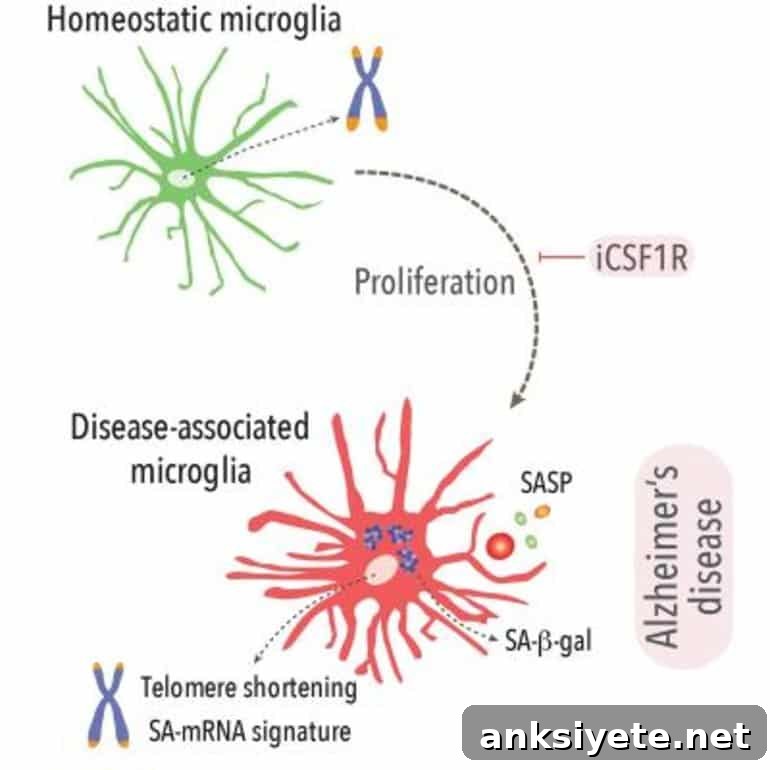
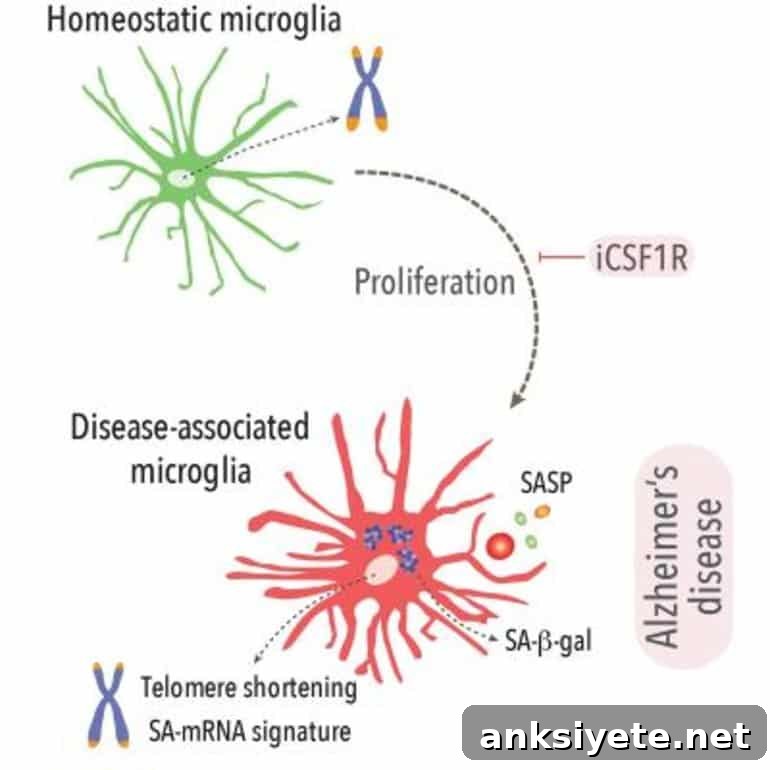
Using an established mouse model that develops Alzheimer’s-like amyloid pathology, the team found that sustained microglial activation and repeated proliferation drive a fraction of microglia into replicative senescence. Senescent microglia show altered metabolism, persistent inflammatory signaling, increased senescence-associated β-galactosidase activity, and shortened telomeres. Importantly, these senescent cells were associated with an accelerated accumulation of amyloid-beta, thereby influencing the disease’s early trajectory. The researchers validated these findings by detecting similar senescent microglial features in post-mortem brain tissue from patients with Alzheimer’s disease.
“We previously showed that microglia proliferate in response to toxic amyloid deposits as part of their immune role,” said Dr Gomez-Nicola. “This study reveals the longer-term consequences of that proliferation and how it can alter the cells’ function in a way that drives early Alzheimer’s pathology.”
Crucially, the team demonstrated that blocking microglial proliferation in the mouse model reduced the emergence of senescent microglia and led to lower levels of harmful amyloid-beta in the brain. Preventing microglial senescence also diminished associated neuritic and synaptic damage, suggesting that intervening at this cellular level could slow disease progression.
Dr Gomez-Nicola added, “Our results identify a distinct subset of microglia whose senescent state has an outsized impact on how quickly Alzheimer’s pathology builds. By focusing future research and drug discovery on these senescent microglia, we may be able to develop more precise therapies that slow or prevent early amyloid accumulation and its harmful effects.”
The experiments employed the APP/PS1 mouse model to reproduce Alzheimer’s-like amyloid pathology. All animal procedures followed UK Home Office regulations. The University of Southampton emphasizes its adherence to legal and ethical standards for animal research and participates in national transparency initiatives related to animal studies.
About this Alzheimer’s disease research news
Source: University of Southampton
Contact: Steve Bates – University of Southampton
Image: The image is credited to the research team and is in the public domain
Original Research: Open access. Title: “Replicative senescence dictates the emergence of disease-associated microglia and contributes to Aβ pathology” by Diego Gomez-Nicola et al., published in Cell Reports.
Abstract
Replicative senescence dictates the emergence of disease-associated microglia and contributes to Aβ pathology
Highlights
- •In models of Alzheimer’s-like pathology, a subset of microglia undergo replicative senescence.
- •Disease-associated microglia (DAM) exhibit multiple characteristics consistent with senescence.
- •Preventing microglial proliferation limits the emergence of senescence and DAM profiles.
- •Blocking microglial senescence reduces amyloid-beta accumulation and lessens synaptic and neuritic damage.
Summary
Sustained microglial proliferation is a defining feature of Alzheimer’s disease and appears to accelerate disease progression. This study explored the long-term effects of prolonged microglial cycling, hypothesizing that repeated proliferation would push cells into a distinct transcriptional and phenotypic state.
The researchers show that early and continuous microglial proliferation in an Alzheimer’s-like model drives replicative senescence, marked by increased senescence-associated β-galactosidase activity, a clear senescence-linked gene expression signature, and telomere shortening. These changes correlate with the presence of disease-associated microglia and similar senescent microglial signatures observed in human Alzheimer’s post-mortem samples.
Intervention to prevent early microglial proliferation impeded the development of senescence and DAM, reducing amyloid-beta accumulation and associated neuritic and synaptic injury. Together, the findings indicate that excessive microglial proliferation produces senescent disease-associated microglia that contribute to early amyloid pathology, highlighting a promising cellular target for therapeutic strategies aimed at slowing Alzheimer’s disease onset and progression.